<– Part 65 – October 17, 1915  | Part 66 – October 24, 1915 |  Part 67 – October 31, 1915 –>

Svetozar Boroević, the brilliant Austro-Hungarian general whose defense in depth tactics elevated him to the nobility and rank of Generalfeldmarschall by the end of the war.

The Entente actions at Artois and Champagne continue, although the seemingly-desperate attacks on the Hohenzollern Redoubt have resulted in little but the bloodletting of a generation, as the redoubt remains in German hands. While the German line seemed to have faltered, the Germans’ new “defense in depth” technique, with features multiple parallel lines of trenches to fall back into, has led to a foundering offensive by the British and French (although the British have claimed major gains at Champagne).

The Bulgarian offensives at Morava and Ovche Pole continue forcing back the Serbian army, although the Bulgarians have been held up at the fortresses of Pirot and Zajecar. Gains are still being made against the French at Krivolak. October 19 saw Italy and Russia declare war upon Bulgaria.

October 18 saw the Italian army surge against the Isonzo for the third time, although they appear to be making some gains this time. It is worth noting, however, that the Austro-Hungarian field marshall, Svetozar Boroević, is able to hold off enemy forces that outnumber him at a greater than 2:1 margin across all metrics – arms, troops, and artillery and heavy equipment.


<– Part 64 – October 10, 1915  | Part 65 – October 17, 1915 |  Part 66 – October 24, 1915 –>

7,000 more men have died in this small area, with nothing to show for it.

The fighting continues at Artois and Champange. The fighting at the Hohenzollern Redoubt has flaired up; the British have suffered enormous casualties in the first few minutes, and do not seem able to retake it.

October 14 saw Bulgaria’s declaration of war again Serbia (followed by the United Kingdom
and France declaring war on Bulgaria on the 15th and 16th, respectively). The result of intense negotiations by all sides, it would appear the Central Powers have won. Because of Bulgaria’s strategic placement, the Entente powers would have benefited with another ally in the region (and one to engage the Ottomans and relieve Greece), while the Central Powers now have an uninterrupted land connection to all main fronts – Western, Eastern, Baltic, Mediterranean, and Turkish.

A German postcard commemorating Bulgaria’s entrance into the war on Germany’s side. The text reads “Bulgaria with us!”

Bulgarian troops have surged across the Morava river valley, and fierce fighting near Pirot continues, with the harsh weather dealing its own toll on the belligerents. Farther south, Bulgaria has advanced in the Ovche Pole plain, and, after defeating the Serbian troops at Kumanovo with decisive cavalry maneuvering, have engaged French forces at Krivolak.


<– Part 63 – October 3, 1915  | Part 64 – October 10, 1915 |  Part 65 – October 17, 1915 –>

Map of the Serbian campaign, renewed in 1915.

October 7 saw Serbia invaded by Germany and Austria-Hungary. Fierce fighting took place around Belgrade, which fell to the invaders October 9.

With Bulgaria having entered the way, German is now able to send heavy artillery (with well-trained and experienced crews) to Gallipoli, along with modern aircraft. The Allied lines find themselves viciously attacked by this new enemy.


In Mesopotamia, surprised at the ferocity and early successes of the British force, the Ottomans have formed a new army to defend Baghdad.

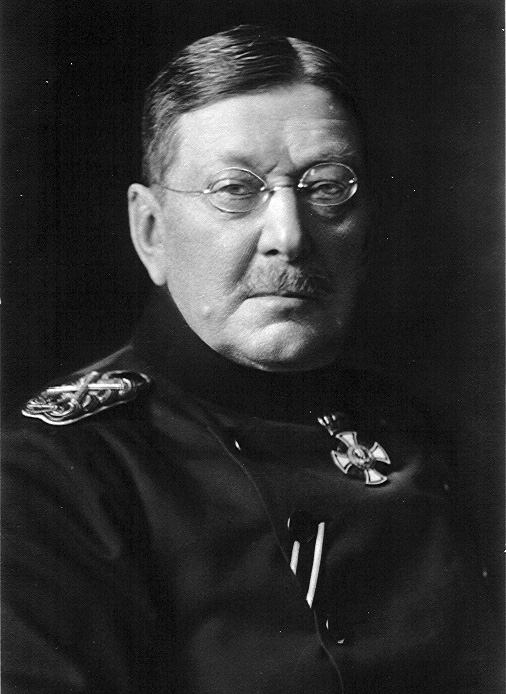
General Goltz.

The German general Colmar Freiherr von der Goltz, currently commanding the Ottoman First Army, has been reassigned to this one. The 72-year-old is a renowned military historian and tactician, having written several books on the subject.

<– Part 62 – September 26, 1915  | Part 63 – October 3, 1915 |  Part 64 – October 10, 1915 –>

Benedetto Brin steaming at high speed.

https://en.wikipedia.org/wiki/Italian_battleship_Benedetto_Brin

https://en.wikipedia.org/wiki/Italian_battleship_Benedetto_Brin

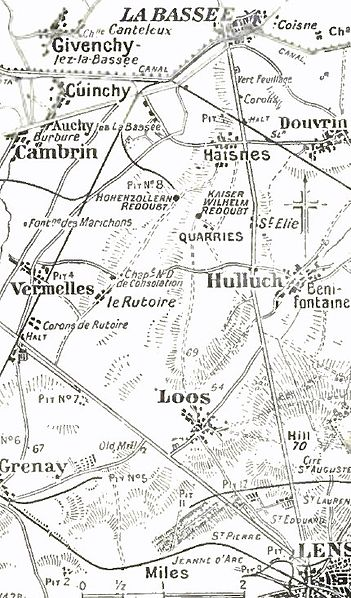
Battle Plan near Loos. Loos is in the lower-right quadrant. The Hohenzollern Redoubt is due north. Note the British line of advance from September 23 to October 10.

Close-up on the Hohenzollern Redoubt. Starting British lines in blue, German in red. All of the German lines in the photo were initially captured except the northernmost around Mad Point.

Another view of the battle

The attack at Loos continued for several days, with some noticeable advances around the Hohenzollern Redoubt, but the British attack came to an end September 28. Several counter-attacks were launched by the Germans, and by October 3 they had regained the Redoubt, erasing most of the British advances in the area.


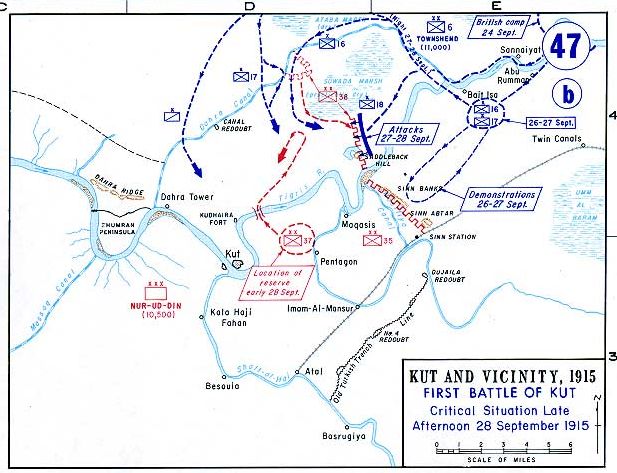
Action near Kut – Es Sinn, securing a British victory over the lower Tigris and Euphrates rivers.

September 28 also saw the British expeditionary force advancing on Baghdad score a victory at Es

British Indian cavalry advancing near the Tigris.

Sinn, capturing the strategic point at the lower base of the Euphrates and Tigris rivers. A risky attack was nearly unravelled when the British Indian troops had several deserters carry the plans to the Ottomans; however, the Ottoman general refused to believe in such a risky operation and was caught unprepared. After fierce fighting, the Ottomans withdraw from the field with 5,300 casualties to the British 1,200.

British and French forces have landed in Greece to assist in attacks there against the Austro-Hungarians and Germans. Meanwhile, skirmishing continues in South Arabia between British and Ottoman forces.

<– Part 61 – September 19, 1915  | Part 62 – September 26, 1915 |  Part 63 – October 3, 1915 –>

The Allies have launched an enormous campaign on the Western Front beginning with an artillery bombardment on September 21 lasting four days. Afterwards they attacked for the third time at Artois. This is significant as the bombardment was mapped out using aerial photography. September 25 also saw and attack at Loos and Champagne.

On September 23, following the British defeat at Gallipoli and the Russian retreat at Gorlice-Tarnow, the king of Bulgaria, Ferdinand, signed a treaty with Germany, entering the war. In response, British troops have begun to march on Baghdad.

Grand Duke Nicholas Nikolaevich of Russia. A bit of a disappointment…

With the Czar having taken control of all Russian troops, Grand Duke Nicholas, recently removed from command, has

General Yudenich.

been promoted to Supreme Commander of all Russian forces in the Caucasus. Of course, General Nikolai Yudenich maintains operative command.

Also on September 24, while attacking SS Urbino, German sub U-41 was attacked by SS Baralong while the latter was flying an American flag. There are reports that German lifeboats were run down and sunk. If true, this would be the second criminal act of war against that vessel.


<– Part 60 – September 12, 1915  | Part 61 – September 19, 1915 |  Part 62 – September 26, 1915 –>

Reports from the eastern Dardanelles indicate that German subs are being kept from progressing through.

Following Germany’s decision to cease unrestricted submarine warfare, the High Seas flotillas have been withdrawn from the merchant east, effective September 18.

September 19 saw the German army occupy Vilnius, and it would appear that their attack at Gorlice-Tarnów has ended. Additionally, their offensive at Sventiany has been halted due to a lack of support and reinforcements, and the Russians are moving to cause the gap.

<– Part 59 – September 5, 1915  | Part 60 – September 12, 1915 |  Part 61 – September 19, 1915 –>

<– Part 59 – September 5, 1915  | Part 60 – September 12, 1915 |  Part 61 – September 19, 1915 –>The last week has been relatively quiet, especially on the western front. The Russian retreat continues, with some fighting near Sventiany. In Gallipoli, the Entente hope for victory is fading, especially as clamor back home grows. Otherwise, the horrors of war continue – disease, starvation, civilian suffering.

<– Part 58 – August 29, 1915  | Part 59 – September 5, 1915 |  Part 60 – September 12, 1915 –>

August 31 saw the Russians forced out of Poland and German forces drawing their wildly-successful offensive to a close. With the Russian

Tsar Nicholas II of the Russian Empire in a naval officer’s uniform. From Wikipedia.

armies still withdrawing, Tsar Nicholas II has removed the general in charge and assumed full and personal control of the Russian armies.

The new month opened with Germany announcing that they will no longer wage unrestricted warfare with their submarines on merchant ships, ending the policy they began this past February. Undoubtedly, the notes from the American government factored into their decision.

Gallipoli continues to be an embarrassment for the Allies as the HMS E7, mentioned in the July 18 dispatch, became trapped in an anti-submarine net. She was scuttled September 4.


<– Part 57 – August 22, 1915  | Part 58 – August 29, 1915 |  Part 59 – September 5, 1915 –>

Kaiajik Dere and Hill 60. From Wikipedia.

Rumors are growing within the United States that the government there is preparing to send as many as one million soldiers overseas. Although the government has consistently denied this, the general fervor towards war in that country is growing.

At Gallipoli, the fighting over “Hill 60” has ended in another loss for the Entente British.

In Eastern Europe, the German 10th Army has attacked the retreating Russian 10th Army and has begun driving them back farther.

<– Part 56 – August 15, 1915  | Part 57 – August 22, 1915 |  Part 58 – August 29, 1915 –>

August 17 saw an attempted invasion of the Island of Palagruza in the Adriatic. An Austro-Hungarian landing force was repulsed by the Italian defenders, who were then fired upon by several Austro-Hungarian cruisers and destroyers. One Italian submarine torpedoed a cruiser.

Details of “The Baralong Incident” against U-27, on August 19, 1915.

Just south of Ireland, the SS Arabic, an English-flagged ocean liner, was sunk by a German U-Boat on August 19. Several Americans went down with it; an American response is expected.

Later that day, the HMS Baralong, frustrated at their inability to rescue SS Arabic’s crew (they picked up the distress call from 70 miles away) came across the U-boat U-27 opening fire on a freighter to scuttle it (the crew had been ordered off in lifeboats). The Baralong, flying the US flag, signaled that she would rescue the freigher’s crew. As the U-boat set a course to intercept, the two ships were blocked from each other’s view by the freighter. Baralong replaced her flag with the Union Jack, opened her gun ports, and opened fire on the U-boat as it appeared, with 34 shells fired at 600 yards sufficient to destroy the U-boat. Fearing the German crew would attempt to reach the freighter and scuttle her, the captain of the Baralong ordered the Royal Marines onboard to shoot the Germans in the water as they swam to the freighter. The legality of this incident remains to be seen. Although no mention has been made in the British press, Americans who had been aboard the freighter have given interviews to media, and German sentiment is opposed to the Baralong’s action of shooting sailors loose in the water.

A Turkish commander at Scimitar Hill, Mustafa Kemal.

The Entente forces have had another disappointing week at Gallipoli, with the actions at Sari Bair and Chunuk Bair both having ended with Ottoman victory.  Another attack was launched at Scimitar Hill yesterday, August 21, together with an attack on Hill 60. Some gains have been made at ANZAC cove and Cape Helles, but not to the degree the Allies wished.