<– Part 14 – November 1, 1914  | Part 15 – November 8, 1914 |  Part 16 – November 15, 1914 –>

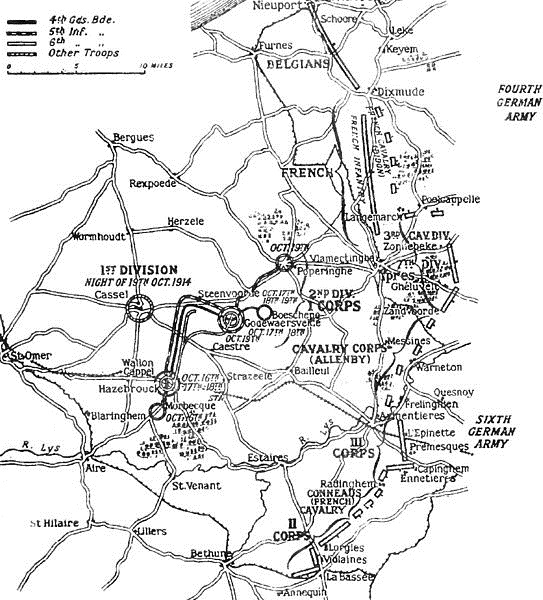
Frontlines near Ypres

French counterattack towards Messines on November 2, before fighting died down in the immediate area.

The Battles of La Bassee, Armentiers, and Messines all fizzled out November 2 inconclusively as each side directed its focus towards Ypres. German attacks were blunted, and French counter-attacks merely regained land recently loss. The United Kingdom, in an attempt to starve the Germans of goods, has declared the entire North Sea a military area, creating a de facto blockade.

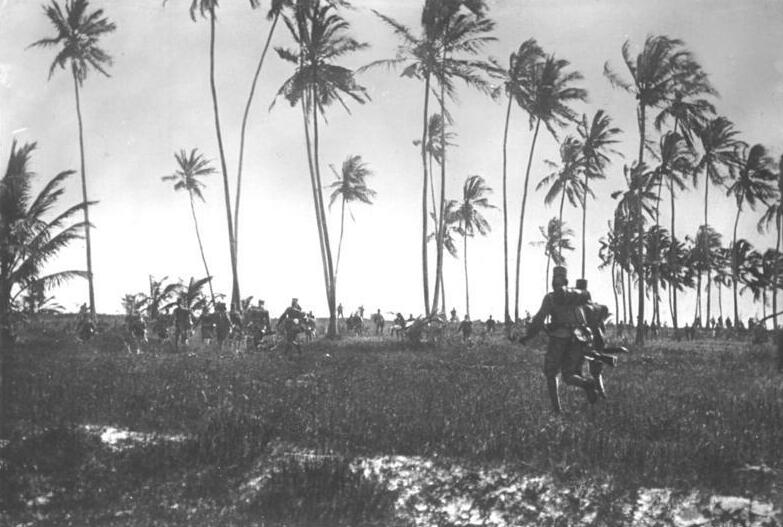
The following day, Montenegro declared war on the Ottoman Empire (following Russia, who did the same the day after its invasion). In East Africa, the German colonial troops ambushed a British and Indian force near Mt Kilimanjaro. Nearby Tanga, defended by the Germans, was assaulted by a British force eight times its size. Despite a series of miscommunication by the Germans, and aided by a swarm of angry bees, the British were forces to withdraw two days later.

November 5 saw France and England officially declare war on the Ottomans, while the Turks suffered another setback as Bergmann, Russian commander of the Caucasus Army, reached his objectives but continued his assault. In Serbia, the Austrians have launched an attack towards the Kolubara River and Cer Mountain.

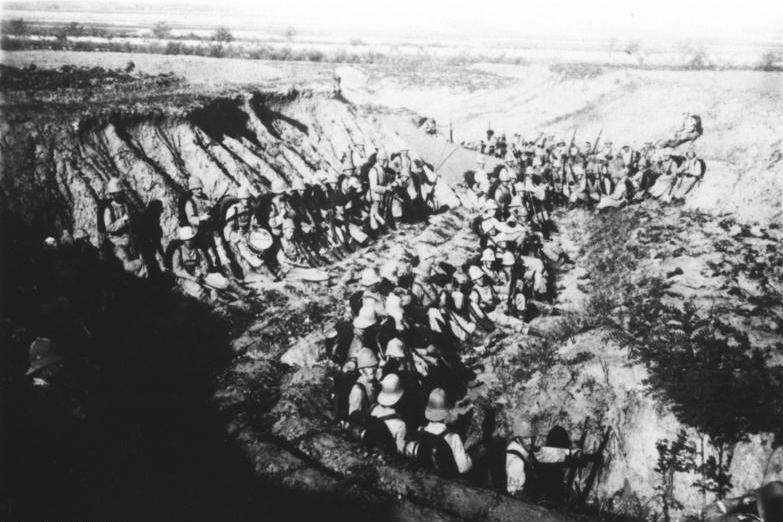
German marines in the frontline trenches at Tsingtao

Askaris (German colonials) skirmishing, possibly near Tanga

Britain, fearful of attacks upon its Persian Gulf oil facilities, landed forces near the fortress of Fao to capture the Ottoman coast, on November 6. The infantry was forces to dig in and await artillery. Two days later, the artillery breached the fortress walls and the infantry charged in and overwhelmed the defenders in hand to hand fighting. 300 Ottomans were taken captive, and the British are landing the remained of the troops at the captured port.

In the Pacific, the German city of Tsingtao in China was captured by Allied and Japanese troops on November 7. Under blockade since the end of August, it had been under siege for the last week.


I think it’ll be fun to write newspaper-like articles, looking back 100 years to the day and remembering the events of World War 1.  It does occur that this will be an ongoing, 5-year project -> approximately 260 posts, if I do it weekly. But I do think it will be fun. SO next Saturday I’ll start blogging World War I.

We’ve just finished another national election, and again I’m wondering what percentage of the votes cast boil down to what I call “Betting on the Horse Race Voting” – the idea that, like in a horse race, the idea is to choose the winner before it’s over. In elections, I wonder how many people vote, not on policies or personalities or ideologies or even parties, but simply on who they think will win the election.

An example that is close to my heart is from my own political history – 9th Grade elections for Student Council. Each homeroom elected one candidate. At the end of the election, I found out that I had lost 17-16. My best friend came up after class and confessed that he had voted against me, because he didn’t think I had a chance. Of course, I’m over it now…

Back to the present, how many people are elected like this? I think it’s part of the de facto 2-party system we have – no one votes for a third party candidate because that candidate isn’t seen as having a shot at winning. Why is that? Because no one will vote for that candidate. It’s a circular-reasoning that, as a habitual third-party supporter, drives me crazy.

Of course, the rebuttal is, “Voting for a sure-loser is throwing your vote away.” But again, that betrays the mindset – a vote is only seen as valuable if it “wins.” And that means that a vote is not seen as something cast in support of an ideology, but rather a crude tool that is only useful if victorious. How many soldiers marched proudly to a battle they knew they would lose?

(I’m not comparing myself to Leonidas)

So my exhortation: come 2016, vote with your conscience, not just your idea of how you’ll “win” if your votes are for the winner. There is no excuse to vote for “the lesser of two evils.” We have enough alternate candidates that one of them should be to your liking. Support them – there’s no shame in supporting the right thing even when it fails, but there is in supporting the wrong, no matter what.

<– Part 13 – October 25, 1914  | Part 14 – November 1, 1914 |  Part 15 – November 8, 1914 –>

On October 26, British forces entered the town of Edea, the Germans continuing their retreat further into the colony.

British and German troop dispositions near Lille

The Ottoman Empire formally entered the war October 29 on the side of the Central Powers. The Russian Empire declared war on the Turks November 1 and launched an offensive led by Georgy Bergmann to secure a defensive position against a possible Ottoman attack.

Flooding on the Yser, indicated by the shaded area

Fighting ended on the Vistula river several days ago, having secured and crossed bridgeheads. The Germans have declared their retreat from the area a strategic repositioning. The Germans suffered another setback October 31 at another river, the Yser in Belgium. Allied forces, unable to defend themselves militarily, flooded the area on the nights of the 26-29th during high tide, forcing the German attack to withdraw due prevent themselves being cut-off to the rear.

The Battle of Coronel, a stunning German victory

The German Empire did have a moment of victory in the Pacific Ocean near Coronel, off the coast of Chile, where the German Kaiserliche Marine under Graf von Spee engaged a British Royal Navy squadron, each having a pair of armored cruisers and several light cruisers. The Germans suffered 3 losses, compared to the British losing nearly 1,600 men and both armored cruisers. However, Graf von Spee expended half of his ammunition, with no way to resupply. Additionally, the Royal Navy again knows where the German force is.

Graf Maximilian von Spee

Rear Admiral Christopher Cradock

<– Part 12 – October 18, 1914  | Part 13 – October 25, 1914 |  Part 14 – November 1, 1914 –>

Locations of the Allied and German armies, 19 October 1914, near Ypres.

Fighting erupted across the Yser in Belgium as Allied and German forces battle for Ypres on October 18. With the front closed, the forces “racing to the sea” seem to have settled into more minor attempts at flanking operations, far removed from those attempted by entire armies earlier this month.

In Kamerun, the Germans retreating from Jaunde took up defensive lines near Edea. The French and British advance on October 20, simulataneous by land, river, and rail, led to the Germans retreating towards the colonial capital rather than risk encirclement.

<– Part 11 – October 11, 1914  | Part 12 – October 18, 1914 |  Part 13 – October 25, 1914 –>

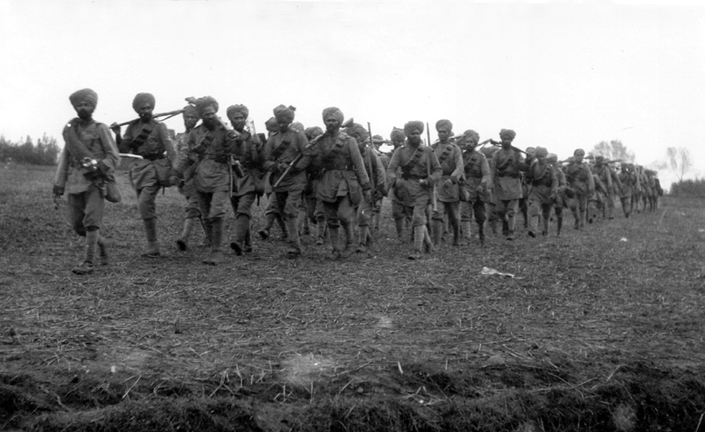
British colonial forces (the 129th Baluchis) near Holobeke, at Messines.

The Belgian Plain, site of much of this week’s fighting. Lille is in the middle of this map.

Fighting erupted October 12 around the Belgian town of Messines as the opposing forces attempt to outflank one another towards the North Sea. Some ground was retaken by the French and British forces, with only minor losses.

Later that day, the Germans captured Lille, and the following day, the Battle of Armentieres

German Uhlans in 1912

around Lille began. The Germans

Dismounted Uhlans during the war

ordered all French citizens to leave; some died of exhaustion on the long walk to safety while others were captured by German Uhlans. British aerial reconnaissance spotted German forces withdrawing to strongpoints, while the Germans dropped bombs from their own aeroplanes. On October 14, the Allied forces met and closed the line from the North Sea to the Swiss border.


After the failed assaults on Jabassi in the German Kamerun colony last week, a second assault on the 14th was successful with the addition of artillery support, and the station has been occupied by the British troops. 4 Germans were killed, and 10 captured.

Belgian soldiers

HMS Hawke

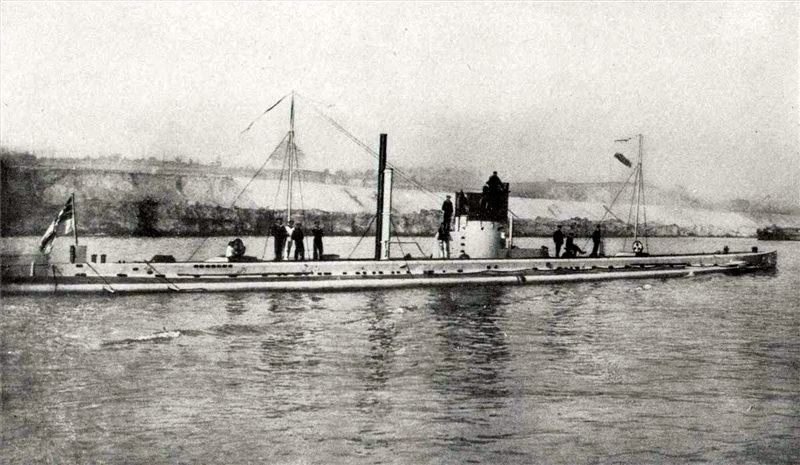
On October 14, the German sub U-9 sunk the British protected cruiser HMS Hawke.

U-9 before the war

On October 16, fighting on the Yser opened up between German and French & Belgian troops on the Belgian coast. The Belgian army is attempting to hold the last sliver of their territory; despite fierce fighting with heavy casualties on both sides, the Belgian army successfully held the city of Diskuide.

<– Part 10 – October 4, 1914  | Part 11 – October 11, 1914 |  Part 12 – October 18, 1914 –>

Postcard commemorating the capture of Antwerp.

On October 7, British troops landed near Jabassi in the German Kamerun colony. Two assaults were attempted, but both were driven back by German machine gun fire.

Map of the defenses around Antwerp. Click to enlarge

Antwerp has fallen to the besieging Germans on October 10 following artillery bombardments and the capture of the inner forts. Approximately 60,000 prisoners were taken, and they way for further advance has been opened. At La Bassée, the Allied armies have launched an attack following cavalry and infantry skirmishing. The British and French forces have made some advances, but not as many as had been hoped.

Location of the battle of Flirey. Verdun is the fortified area shown in blue.

The following day, the three week long battle of Flirey ended with the German offensive cutting of many supplies to the fortified Verdun area, but failing to completely surround it. A salient now exists in the Western front to the south of that city.

Belgium and northern France. La Bassée is near the center, south of Lille.

<– Part 9 – September 27, 1914  | Part 10 – October 4, 1914 |  Part 11 – October 11, 1914 –>

The National Redoubt around Antwerp. Green are forts, and blue are smaller redoubts.

In Belgium, Antwerp has been under siege by German troops since September 28. The outer forts of the “National Redoubt” have been taken by the Kaiser’s troops, but the other forts hold still. The Germans have brought forward heavy artillery to pound the defenders into submission.

German “Big Bertha” cannon in action at Antwerp.

September 29 saw German and Austro-Hungarian forces engage Russian troops on the eastern bank of the Vistula River outside Warsaw. Some Russian troops have withdrawn, though others are fighting and resisting orders to withdraw themselves.

The Allies have established a new front line at the river Marne. The last 4 days have seen fighting in Arras, as the French and German armies again attempt flanking and counter-flanking operations towards the North Sea. Fighting also ended earlier today at the Drina – the Serbian army succeeded in holding back the Austro-Hungarian army, though they did establish beachheads in the Serbian territory.

In Tsintao, China, the German base remains under siege by the British and Japanese.

<– Part 7 – September 13, 1914  | Part 8 – September 20, 1914 |  Part 9 – September 27, 1914 –>

The Austro-Hungarian assault across the Drina in Serbia has settled down into the trenches. Further north, the Austro-Hungarian town of Przemyśl has been under siege by the Russian Army since September 16. However, the Russians are in retreat from the battle of the Masurian Lakes, where the Germans have crushed them and destroyed one full army and elements of another. 70,000 German casualties show, compared to 100,000 Russian casualties, plus an additional 45,000 prisoners.

To the West, with fighting ongoing at the Aisne in France and Belgium, the Allied and German forces are attempting to flank one another to the north, with the result that both flanks are being extended towards the North Sea. The Germans, prepared as they were for a fast, mobile war, have been forced to adapt to trenches. These trenches, started as shallow depressions to shield them from bullets, have grown in some places to be nearly seven feet deep.

In South Africa, former Boer rebels from the Second Boer War have launched a rebellion on September 15 under the command of Manie Martiz. They are attacking the British Union of South Africa and have declared a new Boer South African Republic. They are undoubtedly supported by the Germans.

On September 20, the naval battle of Zanzibar was fought between the Kaiserliche Marine and British Royal Navy. The German light cruiser Konigsberg sailed into harbor past a British tugboat and fired upon the British protected cruiser Pegasus, whose guns were not able to reach the German vessel. After sinking the cruiser, the Konigsberg left the harbor, damaging the tug on the way out. 100 British marines died, with no casualties aboard the Konigsberg.

<– Part 8 – September 20, 1914  | Part 9 – September 27, 1914 |  Part 10 – October 4, 1914 –>


The Allied retreat to the Marne seems to be coming to a close as forward units begin their entrenchment.

The German freighter Walkure, captured at the beginning of the war by the French, sunk at Papeete.

Damage at Papeete after the bombardment.

September 22 was a big day for the German Navy, the Kaiserliche Marine, as they saw three victories in three oceans that day. In French Polynesia, the SMS Scharnhorst and SMS Gneisenau entered the port of Tahiti and sunk the French gunboat Zélée and freighter Walkure (herself a German ship captured by the Zélée at the start of the war) and then bombarded the town of Papeete. The coastal defenses returned fire ineffectively. While the German raid was an attempt to secure the coal reserves stored there, and in this they failed, yet the prestige of the German East Asia Squadron under Admiral Spee has been increased – though at the cost of alerting the Allies to her location.
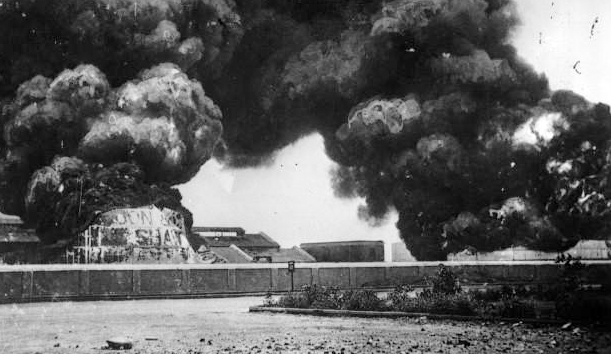
Madras burning after Emden’s bombardment.

Main battery of the Scharnhorst.


To the West, in the Indian Ocean, the light cruiser Emden closed to within 3,000 meters of Madras later that night and opened fire, destroying the oil tanks and a merchant ship. Again, return fire was ineffective. While the loss of the oil is a minor concern, the prestige of the British has also been decreased, as they though the Emden would be with Spee at Tahiti.

In the North Atlantic, the German sub U-9, under command of Lt. Otto Weddingen, who turned 32 last week, spotted a ship on the horizon and immediately submerged for intercept. She discovered that it was in fact three outdated British armored cruisers – the Aboukir, the Cressy, and the Hogue. All three were staffed by reservists, and in fact an order to withdraw them was in discussions at the Admiralty, though too late to save the ships from their fate. After torpedoing the Aboukir, the other two ships came to her aid, thinking she had struck a mine. U-9 sent two torpedoes into Hogue, and then two more into Cressy as she fled. All sunk, with 1,460 British sailors lost. Amazingly, a newspaper report has shared the story of one 15-year-old British midshipman, Wenman Wykeham-Musgrave, who was aboard all three ships when they were torpedoed. As his daughter shared in the interview,

He went overboard when the Aboukir was going down and he swam like mad to get away from the suction. He was then just getting on board the Hogue and she was torpedoed. He then went and swam to the Cressy and she was also torpedoed. He eventually found a bit of driftwood, became unconscious and was eventually picked up by a Dutch trawler.


Postcard commemorating the U-9’s sinking of the three British armored cruisers. Lt. Weddigen in the top corner.

On land, fighting has erupted in Picardy as the French Second Army, attempting to flank the German lines but were stopped by the German Sixth Army. The race to the sea continues as each army attempts to turn the other’s flank. Three days later, on September 25, fighting erupted at Albert as those same two armies encountered encountered one another farther north, each advancing into territory thought to be clear.

September 26 saw a further British defeat at Sandfontein, South Africa, were forces of the Union of South Africa entered German territory but were surrounded and attacked from multiple directions by an overwhelmingly superior force. The 120 British troops (with 2 cavalry squadrons) lost 67 men, compared to 60 German casualties from their force of 1,700. The remaining British forces surrendered after their artillery and machine guns were destroyed, the Germans tightening the noose and beginning to rain explosive shells upon them.

In German Kamerun, however, the tide of war is much different. September 21 saw an allied landing at Ukoko, At the German fort of Kusseri, the 37 Germans in the fort have surrendered to a force of 250 French troops on September 25, having been under siege since late August (though, after destroying the sole French artillery piece, the French withdrew and returned only on the 20th of September). The French lost 23 troops, to the German 12. Two days later, with the harbor of Douala, the largest city in the German Kamerun colony, cleared of mines by French troops, surrendered, the entire coastline now belonging to the Allies.

Finally, earlier today, the Italian battleship Benedetto Brin, exploded violently at her mooring in the port of Brindisi. Rumors and research point to an Austro-Hungarian saboteur.