<– Part 149 – May 27, 1917  | Part 150 – June 3, 1917 |  Part 151 – June 10, 1917 –>

Major General John J. Pershing

Following a two-day battle, Allied forces have captured Skra, Greece, on May 31, taking it from the heavily-outnumbered Bulgarian defenders.

Along the Isonzo, the impressive Italian gains have been completely erased by a concentrated Austrian counterattack earlier today, returning all units essentially to their starting positions, although the Italian forces are still advanced from their initial trenches.

In Belgium, odd troop positions among British troops indicate possible future activities along the coast.

Scattered reports indicate that U.S. General John J. Pershing has arrived in France, in preparation for the American Expeditionary Force’s own arrival.

<– Part 148 – May 20, 1917  | Part 149 – May 27, 1917 |  Part 150 – June 3, 1917 –>

The Resident-Governer of Morocco, Hubert Lyautey

The Romanian army seems to have rebuilt from in the last few months, and rested, supplied, and trained soldiers have been seen preparing for some type of offensive.

The Resident-General of Morocco, Louis-Hubert Lyautey, has returned to his headquarters, preparing to launch a new offensive against the Zaian Confederation and other rebels.

The use of convoys for naval transportation has paid off for the Allies, as losses to U-boats seem to have begun dropping.

Fighting at Monastir ground to a halt May 26, with the Central Powers firmly in control of their lines. It would appear the Allied attack has failed, losing 14,000 soldiers.

<– Part 147 – May 13, 1917  | Part 148 – May 20, 1917 |  Part 149 – May 27, 1917 –>

On May 15, Philippe Petain replaced Robert Nivelle as the French Chief of the General Staff. He has promised an end to suicidal attacks, rest for beleaguered troops, and no executions for the mutinies, which have affected nearly 1/2 the French army and seen 20,000 deserters. Petain is popular with the soldiers already, having risen up through the ranks for the last 40 years.

In the Mediterranean, a naval sortie by the Austro-Hungarian Navy against the Otranto Barrage, the Allied blockade of the Otranto Strait, was somewhat successful, although the attackers were forced to withdraw as reinforcements sailed towards them.

Fighting at Arras ended May 16. Although minimal territorial gains were had by the Allies, it was nevertheless successful in tying down German troops, preventing them from reinforcing other parts of the front. 158,000 British troops fell, with approximately 125,000 Germans with them.

At Monastir, Bulgarian forces have taken the Crvena Stena Ridge May 18, following weeks of stagnation in the trenches.

<– Part 146 – May 6, 1917  | Part 147 – May 13, 1917 |  Part 148 – May 20, 1917 –>

Another series of British assault against Bulgarian lines at Doiran on May 8 failed after five waves and massive casualties. Although the opposing sides’ artillery dueled until the next day, the British attack was called off. 12,000 British casualties – nearly 1/3 of the forces – effected only 2,000 on the Bulgarian side.

At Aisne, the fighting ended in failure May 9, along with the entire Nivelle plan. Serious mutinies in the French army have erupted following the failure, which included 350,000 Allied casualties and 165,000 German. The French General Staff is working to halt the mutinies.

In Italy, the 10th Battle of the Isonzo was launched May 10. Whereas the previous nine had focused on small, focused thrusts, this one has seen fighting along a wide front towards Trieste. Indeed, it seems to have been a minor Italian success, with some territory gained, although at the expense of 150,000 Italian casualties to the Austro-Hungarian’s 75,000.

At Arras, fighting continues, although stiff German resistance has halted any possible Allied advance.\

<– Part 145 – April 29, 1917  | Part 146 – May 6, 1917 |  Part 147 – May 13, 1917 –>

At Arras, British forces attempted to take the Oppy Wood on their way to a strongly-held German position but failed. However, the failure has been analyzed as a lack of coordination between infantry, artillery, and tanks, and it is expected that the lessons learned will be of great value in future engagements.

On May 5, an enormous artillery barrage was launched by the Allies against Bulgarian forces in occupied-Serbia, supplementing the attack at Doiran, where the Allies assault has bogged down. The barrage was halted at nightfall but renewed earlier this morning. Patrols sent to assess damage to the defensive lines were driven back by the defenders.

<– Part 144 – April 22, 1917  | Part 145 – April 29, 1917 |  Part 146 – May 6, 1917 –>

Samarrah and its vitally important railroad fell to the British April 23, ending operations in that sector.

At Arras, a second round of fighting at the Scarpe has yielded territorial gains to the British. On April 28, British forces launched a shallow offensive intended to draw German reinforcements away from the Aisne. In addition to gaining territory at Arleux, German counter-attacks were halted. Despite the British efforts, French gains at the Aisne are minimal.

The British bombardment of Bulgarian lines at Doiran ended April 24, and the infantry offensive was launched, gaining several positions before losing them to Bulgarian counterattacks. All British attacks since have been stopped, and the British have withdrawn to their initial positions.

Due to heavy losses of Allied shipping, the British have agreed April 27 to use convoys. Initially hesitant to impose the delay on shipping that convoys require, the nearly 900,000 gross tons of lost shipping in April, over half of it British, has led to British supplies of wheat being less than six weeks worth. This has encouraged the Admiralty to revise its opinion. In the Meditteranean, no U-boat was sunk in the past month, although the Allies lost nearly 100.

<– Part 143 – April 15, 1917  | Part 144 – April 22, 1917 |  Part 145 – April 29, 1917 –>

A British assault on Gaza beginning April 17 failed after 2 days, the Ottoman lines holding steady. The British lost 6,500 men to the Ottomans’ 450, half of whom are MIA.

The following day, an intense British artillery barrage began on the Bulgarian lines at Doiran, and is still ongoing some days later. Tens of thousands of shells have reduced the forward defense to rubble, while the Bulgarian anti-battery fire has been equally intense.

At Arras, the tide has shifted against the Allies. German air superiority, due in large part to a “Red Baron” fighter ace, has led to shortages of capable pilots for the British – indeed, the average life expectancy of a British pilot is only 18 hours. Many of them have had their training abruptly ended and have been shipped to the front with little flight experience. On the ground, the British have been ordered to keep the Germans occupied to prevent excessive French casualties at nearby Aisne, where the French commander, Nivelle, expects the exhausted German lines to collapse in 1-2 days. However, the Germans, aware of the Allied plans, have formally adopted a revised defensive plan that emphasizes defense-in-depth and protection of artillery vantage points. The French have suffered heavy losses to German machine guns, while German artillery has devasted French tanks. Although 7,000 Germans have been taken prisoner, little land has been gained despite frequent attacks and counter-attacks.

In Persia, due to the Tsar’s abdication, the Russian Grand Duke has been arrested, and the royally-appointed General Yudenich has been reassigned to an inconsequential position. The troops have begun deserting en masse.

<– Part 142 – April 8, 1917  | Part 143 – April 15, 1917 |  Part 144 – April 22, 1917 –>

Map of the “creeping barrage” of artillery at Vimy Ridge

The Allied assault at Arras began April 9, with Canadian forces distinguishing themselves at the Vimy Ridge. The offensive had been originally scheduled for Easter Sunday, but was delayed one day to prevent Christian nations from slaughtering one another on that holiday. The Canadians achieved their objectives quickly, due to a focus on divisional-level attacks and artillery commanded by divisions in a “rolling attack,” where the artillery is just ahead of advancing infantry. Meanwhile the German commander was confused about his defensive orders and kept his reserves too far from the battle to be of use. Both sides are now consolidating their positions, with thousands of engineers building roads, digging gun pits, and dragging heavy artillery into position.

Canadian soldiers and their tank at Vimy Ridge


At Monastir, the French assault is still bogged down, but neither side possesses the peak of the mountain. In Persia, the Russian forces face desertions as soldiers receive news of the revolution. In Africa, the Senussi have signed a peace with Italy and England on April 14.


<– Part 141 – April 1, 1917  | Part 142 – April 8, 1917 |  Part 143 – April 15, 1917 –>

On April 2, Australian Lieutenant Colonel John Gellibrand ordered an attack by 2nd Division on Noreuil, expecting it to be vacated due to the German withdrawal to the Hindenburg Line. In fact, said withdrawal was completed some time last week, so he suffered intense casualties in a disastrous assault. Gellibrand’s career is already checkered, as his landing at ANZAC Cove on Gallipoli was mishandled, his pride continually clashes with his superiors, and he is often criticized for having his headquarters over 3 miles from the front. Nevertheless, the German withdrawal has given the Allies more territory in the last few weeks than they had taken the entirety of the war since September 1914.


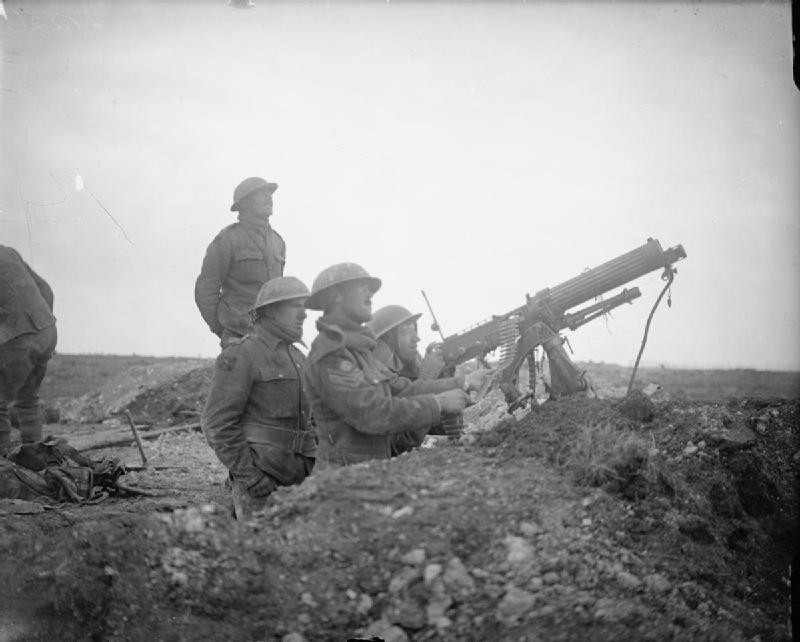
British machine gunners firing on German planes at Arras

The same day, US President Woodrow Wilson delivered a message to Congress at 8:32pm, asking the House of Representatives to declare war on the German Empire. The United States ended is neutrality April 6, declaring war, and entering the war.


At Arras, a bombardment of a front only 24 miles wide has been ongoing the last week, with German trenches having been reduced to mere “nests of men.” Allied troops have been seen massing, while aerial reconnaissance and underground tunneling (some tunnels large enough to accommodate light rail, and tens of thousands of troops), indicate a large, upcoming offensive.

French forces at Monastir have been unable to dislodge Bulgarian and German troops from the positions. In Russia, rumors have arrived that exiled communist Vladimir Lenin has arrived to oppose the Provisional Government. At Samarrah, British attacks on the Ottoman garrison continue.

<– Part 140 – March 25, 1917  | Part 141 – April 1, 1917 |  Part 142 – April 8, 1917 –>

The British Army’s Egyptian Expeditionary Force marched and engaged the Ottoman defenses at Gaza March 26. Despite encircling the 16,000 Ottomans with 22,000 of their own soldiers and taking trenches on three sides of the city, the British were ordered to withdraw that night as Ottoman reinforcements approached. 4,000 British soldiers were killed, while the Turks lost 1,400, with an additional 1,000 missing. Both sides have claimed victory, although the Ottomans are still in possession of the city.

The United States War College Division issued a report March 29, calling for preparations to raise an army nearly one million strong, and estimating ten months to send a force of 500,000 to Europe after training. This would put any potential US involvement in the war mid to late 1918, as the War College Division is adamant that untrained, drafted soldiers not be sent overseas. President Woodrow Wilson has called for a national army to be drafted and trained.