Now that I’m starting the New Year, I’ve settled into an organization system that works pretty well for me. I thought I’d at least record it here if anyone’s interested, including my future self who may look back on this system as an unmitigated disaster and wonder what I was thinking.

WEEKLY PLANNER

The first part is a weekly planner I carry around – yes, a hard-copy. It’s a little booklet folded down to 3.5 x 6, which I’ve found is a good size to fit in my pockets. It has 2 pages for notes, then a list of long-term goals I have (with weekly milestones), and upcoming events. The main point is a daily planner section in the middle (I make a new one each week). On the left page is all of my daily tasks, and the right side is a daily schedule. I update it diligently, and record my hourly usage (if i have time, I’ll upload a sample page).

The last page is a review section, where I total up how many hours I spent each day on tasks, and then write a review of the week, noting room for improvement, and so on. It also faces my 6 month goals, “this month” goals, and weekly goals (which also appear at the top of each daily task list, so I make sure my daily tasks align).

KANBANFLOW

I use the Pomodoro technique to stay productive. Last year, I was only using my planner, but was not NEARLY as productive as I would have liked. The pomodoro technique keeps me accountable, and assuages my guilt over doing things for fun (I’m a little obsessive about productivity). I work for 25 minutes, then take a 5 minute break. Every fourth break is 15 minutes.
I also use the kanban system, with each column being a day of the week (though the first is “today”, followed by “done”, and the last 2 columns are “next week” and “later”). I sort the cards by the order I need to do them and get started. The cards match tasks on the daily agenda in my weekly planner.
Kanban flow combines a pomodoro timer with a Kanban board, so it’s great. I’m still working on totaling numbers, but my average productivity has probably increased 8-10x so far this year!

OpenProject

Finally, to track work for software projects, I use OpenProject. It’s open source,  enjoy it, have contributed to it (okay, I fixed a grammar mistake…), and it’s been very useful. I put a lot of detail in the user stories and tasks, and then reference the work package # in my planner and Kanban board.

That’s my org technique. Time will tell (or has already told, future self) how it works. I imagine I’ll continue refining it, though – every week so far since mid-May 2014 I’ve made some minor tweak or another.

<– Part 23 – January 3, 1915  | Part 24 – January 10, 1915 |  Part 25 – January 17, 1915 –>

Soissons, on the Western front, site of fighting in the Champagne area.

The fighting on the Western front continues at Artois and Champagne, but it is merely a flurry of attacks, counter-attacks, captures and recaptures, as thousands of men die in the same place day after day.

In the Caucasus, the Russian Caucasus Army has scored a victory at Sarikamish, with large numbers of Turkish soldiers captured and many lost in the mountains. Hafiz Hakki Pasha, the Turkish second-in-command, toured the front lines, realized the situation, and a retreat has been ordered towards Erzurum. In Persia, the skirmishing at Ardahan continues, with the Russians repulsing charge after charge.

On January 4, the Turkish “Mosul Group” marched to and captured Urmia in Persia.

January 5 saw a German attempt to recapture Edea, in the German Kamerun colony, held by the Allies. Of the 1,000 German attackers, over 100 were killed and another 100 wounded. French losses were 4 dead, 11 wounded.


<– Part 22 – December 27, 1914  | Part 23 – January 3, 1915 |  Part 24 – January 10, 1915 –>

HMS Formidable in 1898

The last day of the year saw the HMS Formidable, lead ship of her pre-dreadnought class, was sunk by U-24 in the English channel, with a loss of 547 British sailors.

New Year’s Day, 1915, saw the Allies launch an offensive in Artois and Champagne. Fighting has been back and forth, which each side capturing, then recapturing, the trenches. Elsewhere on the Western Front, the clay soil has left the trenches knee-deep in water, causing severe illness and other medical complications.

The next day saw a renewed Russian offensive in the Carpathians launched.

Russian infantry in the forests around Sarikamish

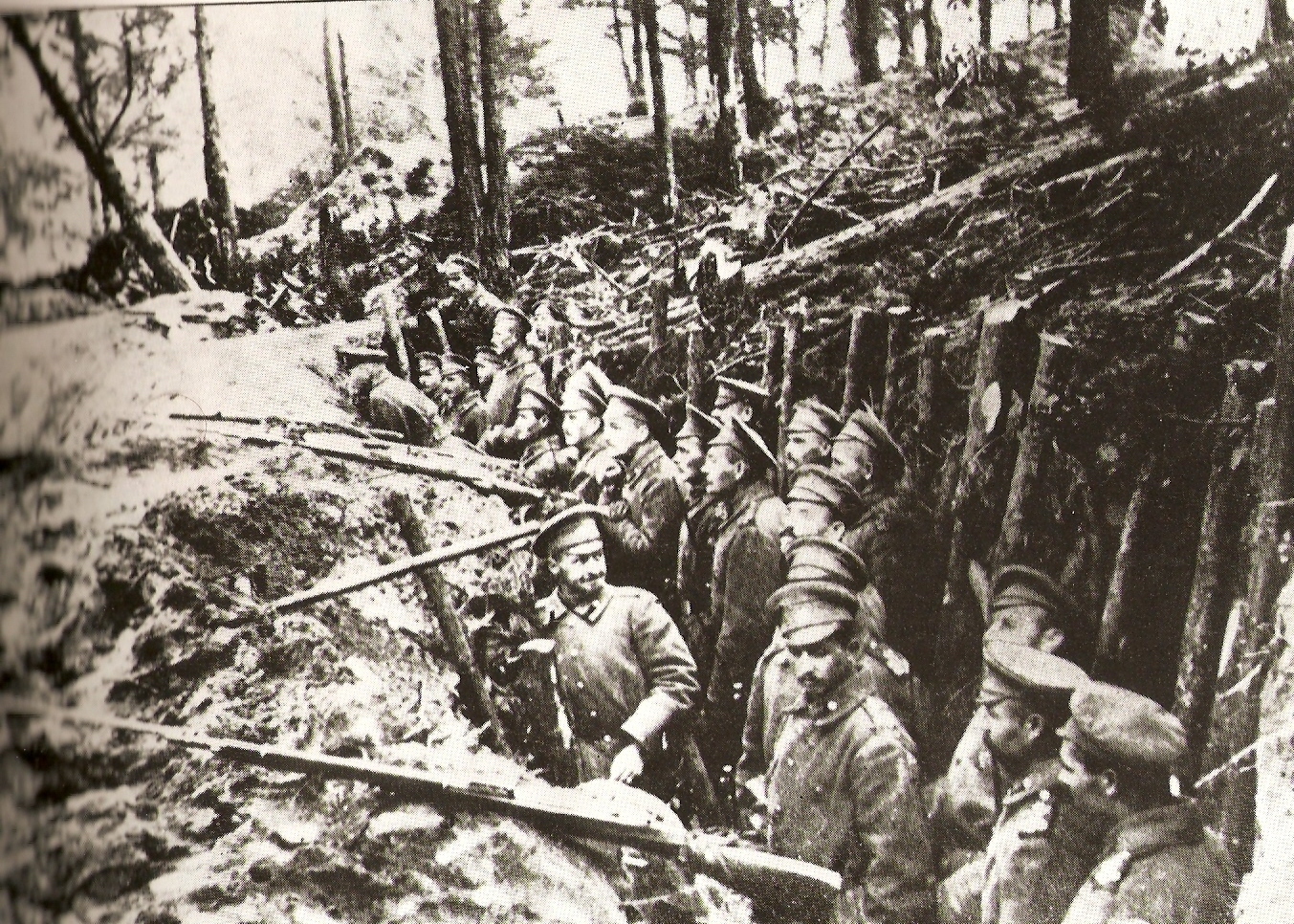
On the Caucasus front, at Sarikamish, two Ottoman infantry corps have attacked the Russian defenses, losing half of their 12,000 strength. The Russian movements, perceived by the Turks to be a retreat, were in fact an encirclement, so the Ottoman defense has begun. To make it worse for the Turks, one corps has lost 90% of the force in the mountain, both to weather and to repeated frontal assaults against the Russian force. The corps commanders have reported to the Ottoman general Enver Pasha that their corps are too weak to attack; he has ordered assaults to continue anyway.

To east, on the Persian front, Ardahan has come under assault by an Ottoman force, threatening supply (and potential retreat) lines to Sarikamish for the Russians.

<– Part 21 – December 20, 1914  | Part 22 – December 27, 1914 |  Part 23 – January 3, 1914 –>

(Lucky) Turks in their winter gear

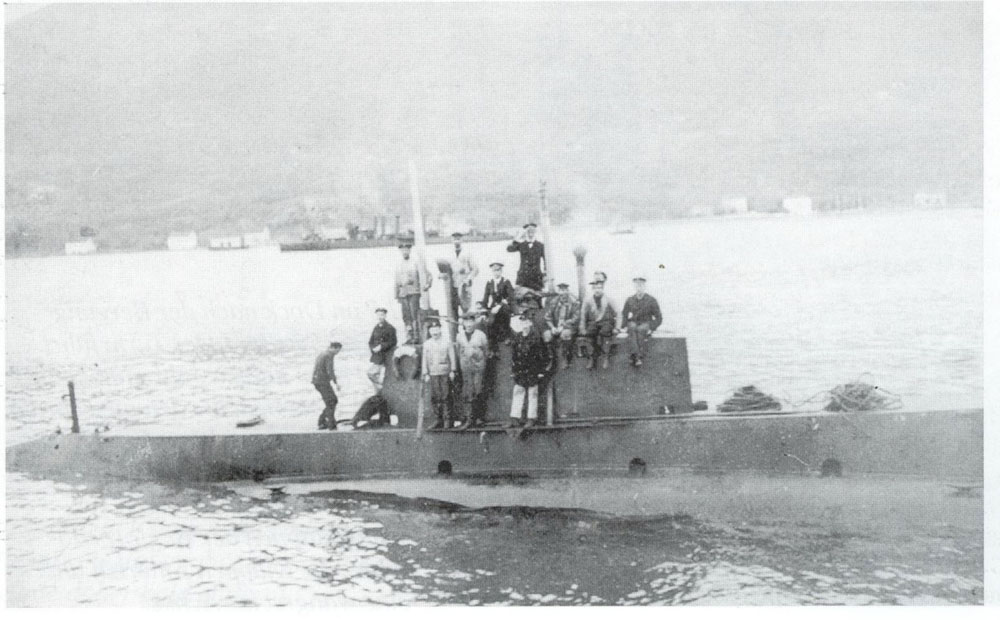
Fighting between the Allies and the Germans continues at Artois. To the north, across the channel, bombs were dropped on Britain December 21 by German aerial vehicles, perhaps signaling the launch of a new era of warfare. In the Mediterranean, the Austro-Hungarian submarine U-12 torpedoed the French battleship Jean Bart, which has withdrawn to Malta for extensive repairs.


Ottoman soldiers hauling artillery through a mountain pass

On December 22, fighting ended at Givenchy on the Western Front as reinforcements arrived to shore up British defenses. The British received another stroke of fortune in the person of a German deserter, who brought word of an surprise attack an hour and a half before it began. No real changes have occurred in the area other than a few minor German advances.


In the Caucasus, a battle has been launched at Sarikamish, as Ottomans troops have begun an offensive through the Allahuekbar Mountains. The advantage seems clearly to the Russians, who are well-supplied, well-equipped, and in strong defensive lines. By way of contrast, many of the Turkish units have no winter clothing in the snowy mountains, and many have only dried bread and olives for rations. At the same time, the Turks are finding German tactics, which include Napoleonic-style precision marches and extreme focus on units arriving on time, poorly working in the moutnains. Many of the Ottoman soldiers have already been lost to hypothermia and friendly-fire incidents in the fog and snow. The 60,000-strong Russians (half the army was sent to Prussia earlier to assist in the German offensive) are finding it easy to hold the 135,000 Turks at bay. Meanwhile, a minimal Russian cavalry presence is deterring attacks from Persia.

U-12 entering Pola Harbor

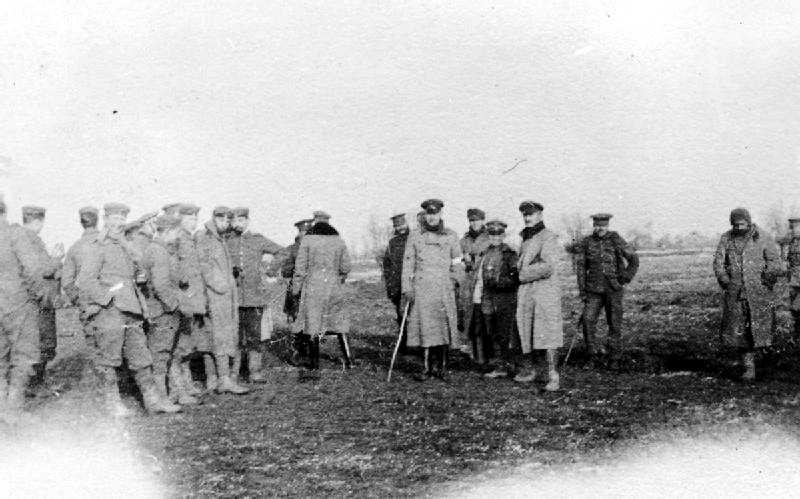
Soldiers meeting in no-mans-land

The Polish legions were used again at Łowczówek from December 22-25, reinforced with Hungarian infantry

& Austrian artillery, in another delaying action allowing the Austro-Hungarian army to withdraw and avoid encirclement, before withdrawing themselves The Russian offensive seems to have been halted.

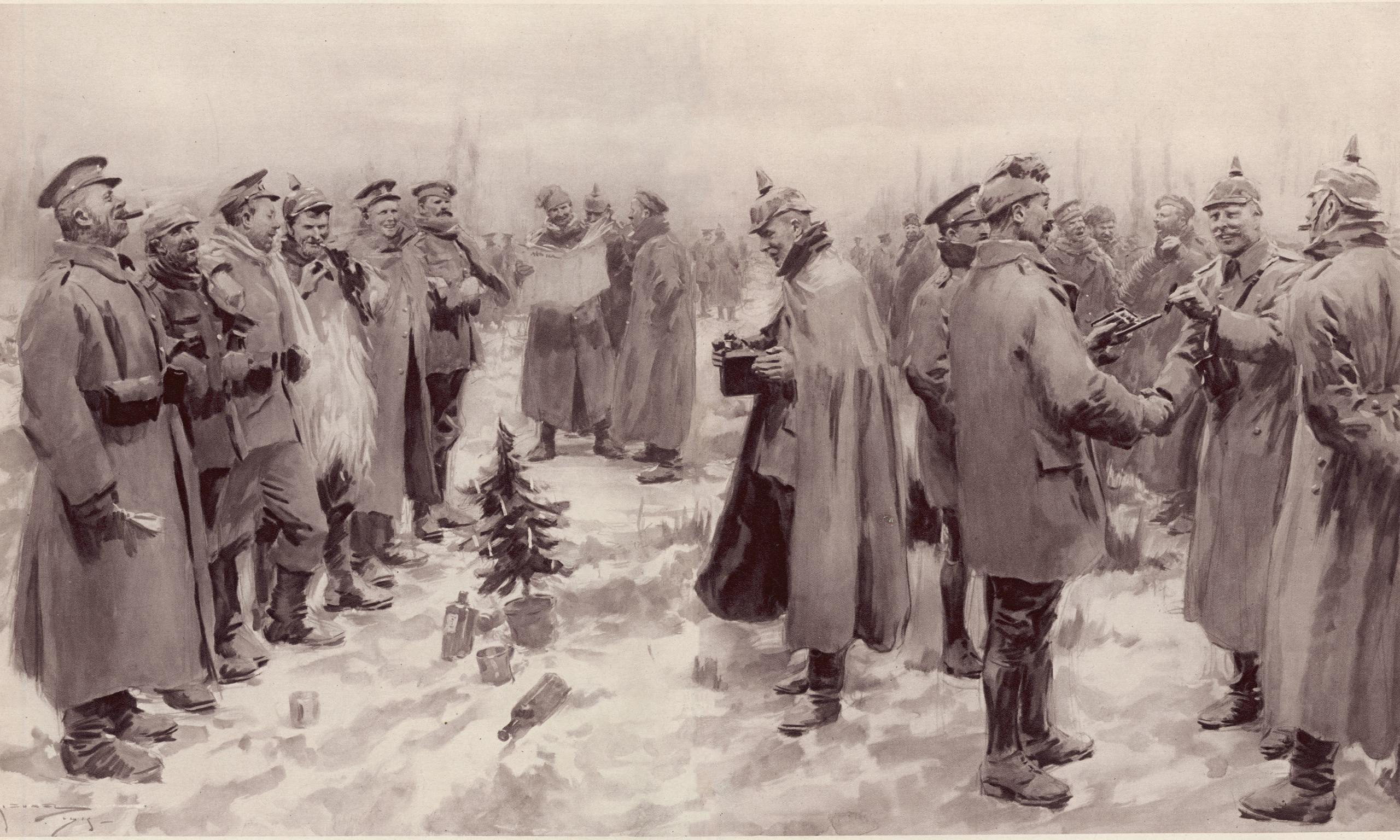
A surprising sight was seen Christmas Day, 1914, as an informal truce was called by the soldiers of the Western front. Although obviously not sanctioned by their commanders, the soldiers left their trenches at met in no-mans-land, where they exchanged gifts, played football, and decorated the few remaining trees together. The tragedy of the war has been highlighted, as well as the adage that politicians start wars, and soldiers have to fight them.

An artist’s impression in a January newspaper of Allied and German soldiers exchanging gifts – here, headgear worn by the armies.

<– Part 20 – December 13, 1914  | Part 21 – December 20, 1914 |  Part 22 – December 27, 1914 –>

A war poster in England, calling upon the memory and seeming-savagery of the raid on Scarborough, in North Yorkshire

Austria-Hungary abandoned Belgrade December 14-15, and the Serbian army entered that day. It is an astonishing victory for Serbia, and a crushing defeat for the Austrians, as all objectives of their Serbian offensive – removing Serbia from the war, convincing Bulgaria to join the Central Powers, and convincing Romania to remain neutral – have failed. The commanders of the two Austro-Hungarian armies have been removed from command. The 400,000-strong Serbians have defeated the 450,000 Austrians, losing 22,000 killed, 91,000 wounded, and 19,000 missing/prisoners to the Austrians’ 30,000 KIA, 173,000 WIA, and 70,000 POW. The Serbian Army is expected to entrench and rebuild for many months, as the invaders have been expelled.

On the morning of December 16, elements of the Imperial German Navy shelled Scarborough, Hartlepool, West Hartlepool, and Whitby, killing 137 and wounding nearly 600 others, many of them civilians – the first deaths on British soil of the war. The German forces – 4 battlecruisers, 1 armored cruiser, 4 light cruisers, and 18 destroyers – split between the towns and shelled them for 50 minutes, exchanging fire with coastal batteries and small, ineffective coastal support vessels. Minimal damage was done to the German vessels. Outrage in Britain has intensified against the Germans for killing civilians, and against the Royal Navy, for failing to intervene. When leaving, the Germans encountered a portion of the Royal Navy, and fearing it to be the advance guard, fled combat. Had they engaged this much smaller, unsupported squadron, the Germans would undoubtedly have been victorious and, furthermore, would have evened the naval balance of power. A true stroke of good fortune for the British.

A combined French-British assault at Artois was launched December 17, but little progress has been made, and stalemate is expected.

Indian reinforcements at Givenchy

December 20 saw a flurry of activity around Europe, as the French sub Curie, returning from a raid on the Austrian Adriatic port of Pola, was caught in an anti-submarine net and forced to surface. She was fired upon and sunk by the Austrian destroyer SMS Magnet and torpedo boat Tb 63T, losing 3 crewmembers. On the Western front, minor skirmishing broke out at Perthes, in Ardennes; a second French offensive was launched at Champagne, making small gains; and the Germans launched an assault towards Givenchy, capturing the trenches around the town and advancing nearly 1 mile.

It would seem all armies are attempting to make gains before the winter season brings a lull to combat.


<– Part 19 – December 6, 1914  | Part 20 – December 13, 1914 |  Part 21 – December 20, 1914 –>

The Battle of the Falklands

Following a humiliating defeat November 1 at Coronel, the British fleet has hunted down the German East Asia Squadron, and the forces met December 8 at the Battle of the Falkland Islands. As the Germans attempted a raid on the British base at Stanley, a much larger British squadron had arrived just one day earlier. Unable to escape, the German armoured cruisers engaged the British in an attempt to allow the light cruisers to escape – and were sunk. The light cruisers themselves were overtaken. Only one German light cruiser and one auxiliary vessel escaped. The Germans suffered nearly 1,900 killed, 200 captured, and 6 ships sunk, the British 10 killed, and 19 wounded. Admiral Graf Spee went down with his ship, SMS Scharnhorst. Only Seeadler and Cormoran remain as independent convoy raiders.

HMS Inflexible rescuing German sailors from SMS Gneisenau

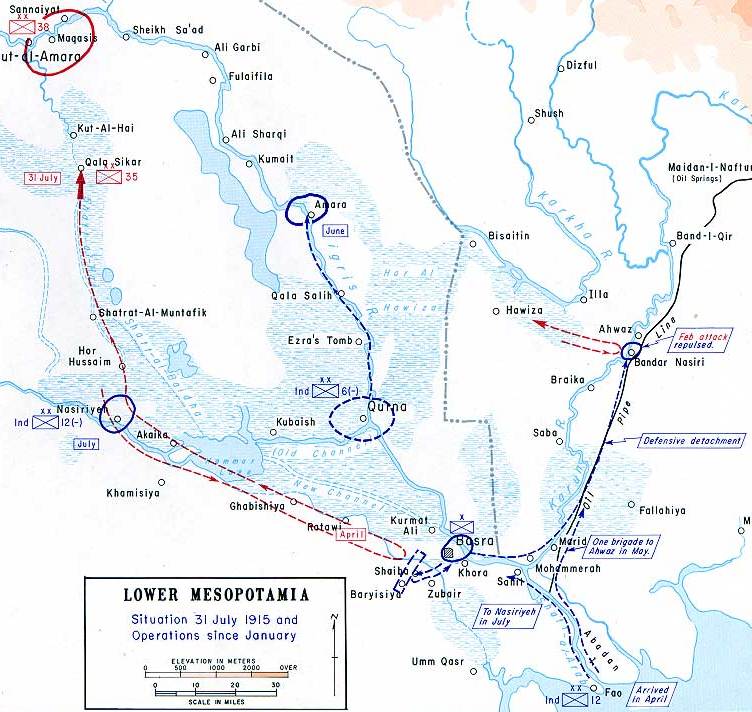
On December 9, the Battle of Qurna ended with unconditional surrender by the Turks, who were surrounded the previous night. The Ottoman commander, Subhi Bey, and the Governor of Basra, has been captured. 1,000 Turks have been taken prisoners, to 281 British casualties (mostly wounded).

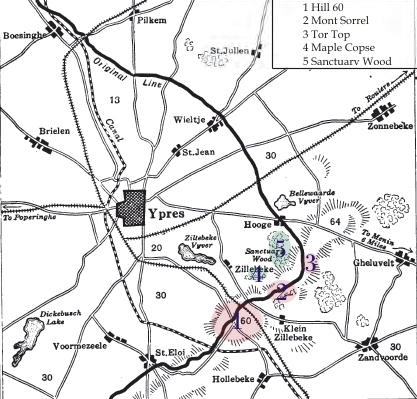
At Ypres, Hill 60 captured by the Germans on December 10, giving them a strategic highpoint, overlooking Ypres itself.

The Austro-Hungarians declared victory at Limanowa on December 13. With 2 Russian armies in retreat, the Russians have halted their advance deeper into Hungary. 30,000 Russians fell against 12,000 Austro-Hungarians.

Hill 60, at Ypres

However, not all is well with the Austro-Hungarians. The Serbian offensive at Kolubara continues, with the unprepared Austrians forced back from one hastily- and poorly-prepared defensive position to another. With forces at Belgrade nearly surrounded, and assaults at all points, the order was issued a short time ago, ordering a retreat from Belgrade, and the Austrians are expected to withdraw soon.

<– Part 18 – November 29, 1914  | Part 19 – December 6, 1914 |  Part 20 – December 13, 1914 –>

The Mesopotamian front. Qurna is in the center

The Russian withdrawal from Lodz began November 30, and the Germans took the city December 6. In the offensive, the Germans lost 35,000 men to the Russian 70,000 casualties, 25,000 prisoners, plus heavy artillery.

To the south, fighting between Austria-Hungary and Serbia continues at Kolubara. The capital of Serbia, Belgrade, was evacuated the night of November 29/30, and the Austrians occupied it the next day, while the Serbian army and citizenry retreated 12 miles to Mount Rudnik, near the railroad bringing much needed supplies from the Allies. Due to perceived overextension, and seeing as December 2 was the 66th anniversary of Austro-Hungarian emperor Franz Josef’s coronation, the Austro-Hungarian empire halted and began organizing a victory parade in Belgrade – only to be caught off-guard by a Serbian counterattack, which has been widely successful the last few days. Although the city is still in enemy hands, the Serbians have successfully pushed back the flanks and front lines of the Austrians by several miles.

December 1 also saw the Austrians engaged at Limanowa, in the Austrian province of Galicia, against the advancing Russians. The Russian advance, however, seems to be stalling, as the 125,000 Russian troops have stalled against 90,000 Austro-Hungarians.

The British advance in Mesopotamia against fleeing Ottomans has come to the city of Qurna, where the Euphrates and Tigris rivers meet. Although gunboats assisted the Allied troop advance, they stalled as they neared the city, even as reinforcements arrived, boosting the British force to over 2,000, twice the number of Turkish defenders.

I enjoy memorizing Scripture, and since I’ve been asked this a few times, I thought it would be useful to share on here.

My memorization system is built around doing certain activities at certain periods of time. The most basic thing is that I memorize two chapters per week. Now, if a chapter is very long (like Mark 14), I’ll spend the full week on it. On the other hand, if it’s short, I may do three in one week (like 1 Peter 3-5).  I determine “long” and “short” chapters by how many verses it’ll be per day.


Six Month Plan

I maintain a six month plan of what I’ll be memorizing, at a granularity of what chapters I’ll memorize each week.

Monthly

Each month, I read through the New Testament. This takes about 30 minutes per day, and is a daily tasks (see below).

Weekly

Each week, I recite everything that I have memorized. I also read through everything I have memorized to keep it “fresh”; this is spaced so that I read a passage about midway between recitations of that passage. Both of these are daily tasks (see below).

I also have a weekly goal of memorizing two chapters. Again, it may rarely be one or three chapters depending on length, but I stick to 2. I decide to increase/decrease based on what the number of verses will be per day; I try to keep it between 6 and 18. It usually falls around 10.

Daily Tasks

First, I memorize a certain number of verses depending on what my chapters are.  I memorize that passage one verse at a time, with and then building on that. So I say verse 1 over and over, then 2, the vv1-2 twice, then 3, then vv1-3 twice, etc. Once I have the entire passage, I recite it every 30 minutes for two hours. After that, I recite it every hour on the hour. So, with memorizing it by 6am (my goal), I’ll recite at 6, 6:30, 7, 7:30, 8, 9, 10, 11, noon, etc.; until I go to bed.

I also use www.memverse.com to help with memorization. Their website can tell you more, but basically it quizzes me periodically on what I have memorized, and I grade how well I remembered. Based on the grade, it increases or decreases the frequency of quizzing. It’s great at catching little mistake that creep in without you realizing it. I do a review each evening.

Additionally, each day, I recite whatever book or section I’m memorizing out of. I recite up to that day’s memorization, and then read the rest.

I also read a New Testament passage as part of my Reading the Bible in a Year plan. When I’m in the Old Testament, I supplement with a Read the New Testament in One Month (RNTOM) reading.

I also recite one section of what I have memorized. When I first started, that was one book at a time. As I’ve memorized more, I’ve shifted to doing one section based on the RNTOM sections, so about 1/30th per day. I then grade myself based on how I did, and note any sections I need to pay attention to in the memorized book reading.

I also read either one section that I have memorized, or the “Next book” I’ll do. This is when I review sections I had trouble with.

I also do the RNTOM unless I’m already doing so with my Reading in a Year plan.

Example

Here’s the breakdown of my daily tasks for this week. My weekly goal is to memorize 1 John 4-5.

[table id=1 /]


How Long Does it Take?

I keep track of this and have 30 weeks worth to look back on.

The Daily Memorization & Memverse practice takes around an hour (but spread out in about 30-40 second chunks, plus a larger one at first when I memorize, and another large one when I review on Memverse.

The Memorization Book Reading takes between 30 minutes (mainly reading) to an hour (mainly reciting).

The Daily Bible Reading takes about 15 minutes (plus another 15 for notes I take).

The Recitation Practice takes right at 30 minutes.

The Reading/Review takes about 30 minutes.

This adds up to about 3-3.5 hours per day, and averages to about 24 hours per week.

It’s time well spent.

<– Part 17 – November 22, 1914  | Part 18 – November 29, 1914 |  Part 19 – December 6, 1914 –>

On November 23, the German sub U-18 followed a supply trailer into Scapa Flow, the home base for the British fleet. Fortunately for the British, the fleet was elsewhere, so the sub was not able to sink the British vessels in port. On her way out, the sub’s periscope was spotted by a British guard vessel, who rammed it, disabling the periscope and destroying her depth-maintaining equipment. After undulating up and down in the water, and striking the sea floor at one point, the sub was scuttled. One sailor died, and the remaining 22 were captured by the British.

German U-boats at Kiel in 1914. U-18 is the second from the right in the second row

The German XXV Reserve Corps, stuck in a pocket at Lodz, has reportedly broken out of the pocket on November 26, bringing 12,000 Russian prisoners with them – the prisoners themselves hauling nearly 70 captured artillery pieces. Rumors from the Russian high command November 29 report a general withdrawal from Lodz. It would appear the fighting over the city is ended.

Reports of a surprise attack by Germans upon the Russian Black Sea Fleet have arrived. Apparently sailing through a thick fog, the German warships Goeben and Breslau, perpetrators of the shelling of Sevastopol, site of a Russian Imperial Naval Base, appeared out of the fog and opened fire on the entire Russian fleet, scoring several hits on the flagship before sailing on.


<– Part 16 – November 15, 1914  | Part 17 – November 22, 1914 |  Part 18 – November 29, 1914 –>

The Eastern Front, highlighting the battle of Lodz

The Austro-Hungarian army reached the Kolubara river in Serbia on November 16 and began its assault of the Serbian forces. After several days of fighting, and establishing several beachheads, the Serbian army was pushed back and, due to a failure by the Austrian commander to pursue, they did so in an orderly retreat.

In the Caucasus, the Russian forces under Bergmann halted their offensive. As they were recoiling by Turkish counter-attacks, reinforcements on the night of 16-17 November strengthened the Russian line and pushed the Ottomans back in several places. Fighting continued for 2 more days. The Russian Caucasus Army has suffered severe casualties – 40,000 of their 100,000-man force, compared to just 14,000 of the Turks 118,000.

At Khenifra, French reinforcements arrived November 17 and relieved the besieged garrison, forcing the Zaian tribal forces to flee.

A rainstorm slowed the British assault of Basra on November 19, but after maneuvering artillery into place, the British opened fire on the mud fort, causing its collapse. The Turkish forces retreated, and the Brits entered Basra November 21.

Fighting also came to an end at Ypres, on the Western Front, on November 22, after a reshuffling of Allied troops and reinforcements. The German attacks had essentially ceased on the 17th, and several divisions were sent east to halt the Russians.

At Lodz, chaotic fighting between the German and Russian forces has been further complicated by severe winter conditions. A series of pockets, breakouts, salients, and frontal assaults have been affected by slowed supply lines and attempts merely to survive the freezing temperatures. It appears the Germans may have the upper hand at this point, although conflicting reports about German prisoners captured make it difficult to ascertain with any certainty.