<– Part 199 – May 12, 1918 | Part 200 – May 19, 1918 | Part 201 – May 26, 1918

The Czechoslovak Legion, a unit of the Russian Army formed in large part from Austro-Hungarian deserters, has revolted against the Bolsheviks, following a broken promise of safe passage through Soviet territory. On May 14, a Soviet train was stopped in Chelyabinsk, in the Urals, and a Soviet soldier aboard was shot and killed following his throwing a rock at a Czech soldier and injuring him. The local Soviet government arrested and ordered the execution of several Czech soldiers, but other members of the Legion freed their men and have occupied the city. The Czechoslovak Legion has begun occupying other cities along the railway.

On May 16, the Espionage Act in the United States was extended. Earlier in the month, Joseph Franklin Rutherford & other directors of the Watch Tower Bible and Tract Society were arrested, following the publication of a book expounding on the prophecies of Revelation and Ezekiel, and calling on Christians to seek higher authorities than civil government, especially in light of the ongoing war.

<– Part 198 – May 5, 1918 | Part 199 – May 12, 1918 | Part 200 – May 19, 1918

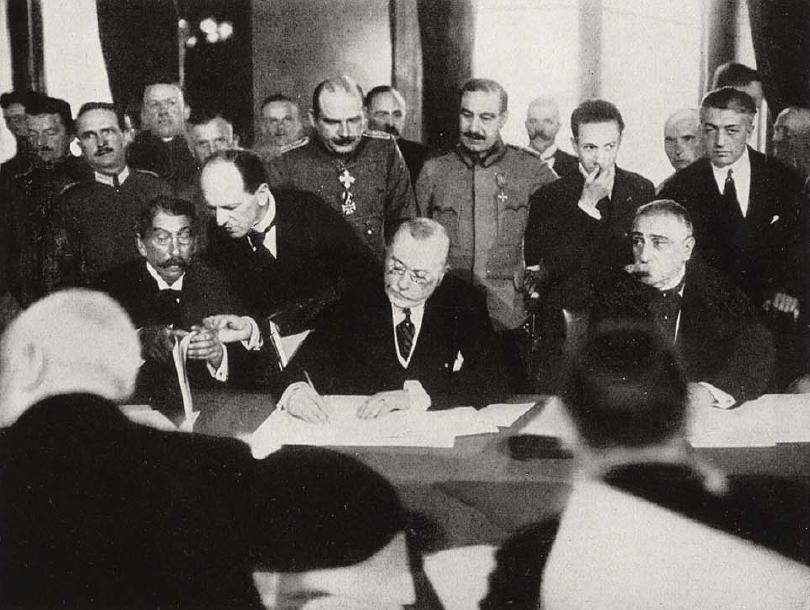
The Romanian Prime Minister signing the treaty

Romanian territorial concessions. Dobruja, in blue, to Bulgaria. Green jointly governed by the Central Powers. Orange/Yellow Bessarabia, and Purple to Austria-Hungary, giving them passes through the Carpathian Mountains.

Following Romania’s isolation from the other Entente Powers due to Russia’s withdrawal from the war, coupled with the stalemate of the last few years, the Treaty of Bucharest was signed May 7 between Romania and the Central Powers. Romania gave up portions of land (see map), her oil wells must be leased to Germany for 90 years, and German civil servants are able to veto all Romanian cabinet decisions and fire any Romanian civil servant. In return, Romania’s Union with Bessarabia is recognized. The Bessarabian region of Russia had declared independence at the start of the February Revolution as the Moldavian Democratic Republic. Last month, her government voted for a Union with Romania, fearing a total annexation, but recognizing the need for alliance.

On May 8, another Central American power declared war on Germany and Austria-Hungaria: Nicaragua.

The Polish II Corps in Russia was ordered to camp near Kaniów, Ukraine, by the Regency Council – a German and Austro-Hungarian-appointed semi-independent government of Partitioned Poland. The II Corps is comprised of elements of the Austria-Hungarian army who deserted after the Treaty of Brest-

Austria-Hungary signing the treaty

Litovsk with Russia removed the possibility of an independent Poland. These Poles joined up with Polish elements of the Imperial Russian Army and refused to engage in hostilities. After camping, they were quickly surrounded by German forces, who ordered them to surrender. They refused and prepared for battle, surprising the Germans, who quickly told them the ultimatum was a mistake (and then prepared for reinforcements). Once the German reinforcements arrived, the 12,000 Germans attacked the 8,000 Poles on the night of May 10. Brutal fighting continued until the evening of May 11, when the Germans proposed a ceasefire, accepted by the Poles. Approximately half the surviving Poles were captured, though the rest escaped. Polish casualties were 1,000, with another 3,250 captured, while the Germans suffered 1,500 casualties. The Polish commander was able to fake his death and flee to France.

Battle of Kaniow


<– Part 197 – April 28, 1918 | Part 198 – May 5, 1918 | Part 199 – May 12, 1918
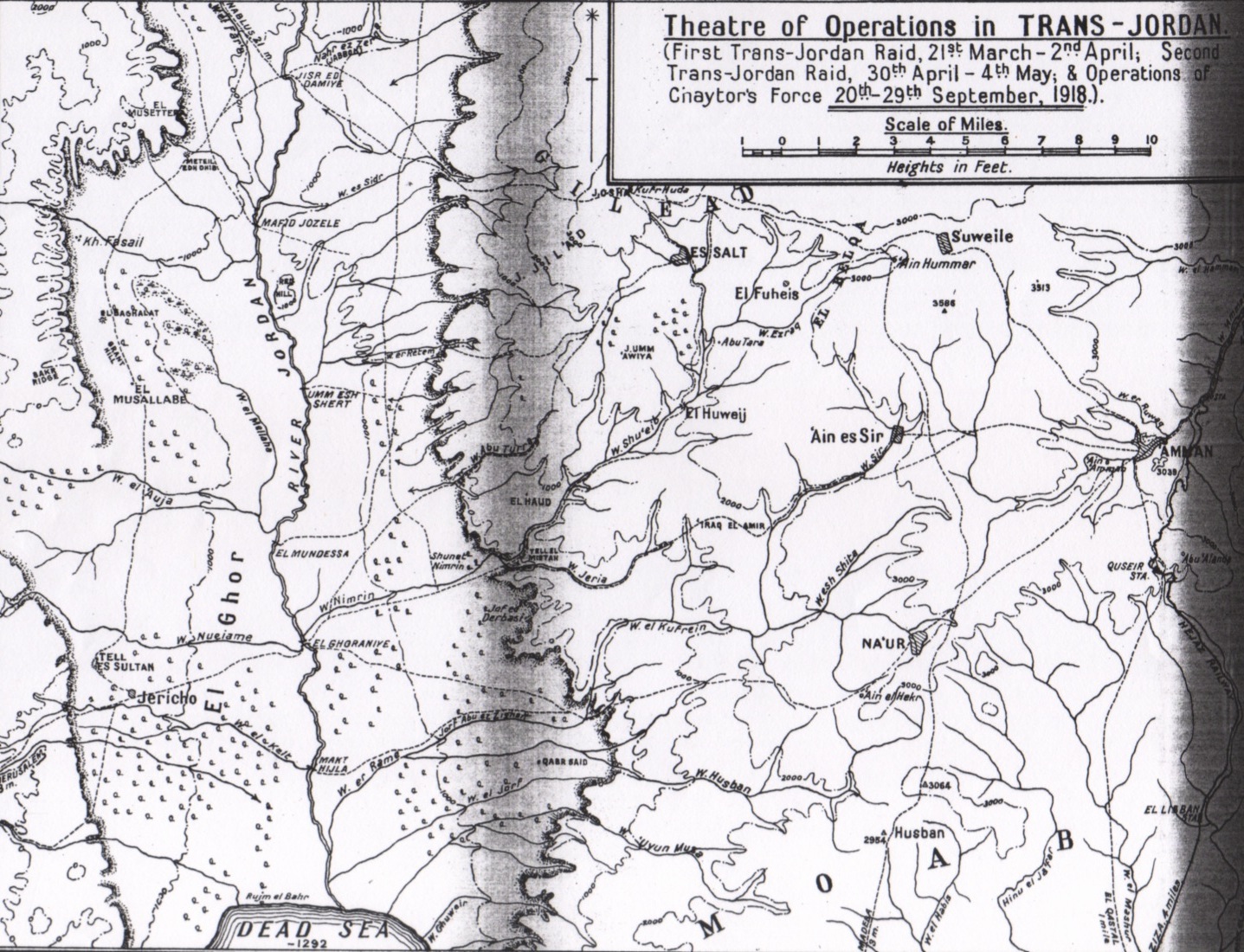
 

Sketch of the theater of operations in the Second Transjordan attack. Es Salt is in the center top; the thin, steep trail to it, held by desperate fighting by the British, runs to the south-west of the town.

Photo, taken by plane, of the Jordan river and foothills

The German Spring Offensive ended April 29, at the Lys, with the final German attack capturing

Scherpenberg, a hill north-west of Kemmelberg.

The main action of the week happened near Shunet and Es Salt, in the Transjordan; formerly a primary theater of British operations, the recent offensive in Europe has made this nearly a distraction, and 60,000 men have been shifted to Europe and replaced by colonial forces of the British Indian Army. The weakened east flank at the Transjordan is still a problem for the British; failure to hold it could force a British retreat all the way back to Egypt; so the attempts to take Amman continue.

The central thrust was towards Es Salt,  but large numbers of German & Ottoman forces moving to the west side of the Jordan River at Mafid Jozele & Jisr ed Damiye are threatening the British left flank. The left & right flanks have both been pinned down by enemy fire, while bad terrain limits the British artillery’s effectiveness at spotting and neutralizing targets.

Position on May 2, 1918 – Es Salt nearly surrounded, with only a thin, steep, single-file path to the south-west

May 1 – desperate defense on the British left flank

A German & Ottoman counter-attack on the left flank came May 1, and pushed the British into the foothills, forcing them to abandon much artillery. The Ottomans had places piles of stones at measured distances to help with artillery ranging. Around 1,500 British troops were able to regroup north of the Umm esh Shert track, allowing the light horse to retreat along the only viable path to safety. The British commander at Es Salt, the “point of the triangle” for the British assault, found out at 1640 of the retreat, and rushed troops to the new western flank (he was already facing threats to the north, east, and southeast. Supplies had to be brought to the troops at Es Salt in the evening on 200 donkeys, a 40-mile round trip, as this is the only way now to resupply the troops. A road expected to be held by the Beni Sakhr (a native Arab tribe), is still open, as the tribe fled when seeing the intense fighting.


On May 2, the fierce fighting continues. Unable to push the left flank to relieve pressure on Es Salt – now under attack on 3 sides – the British forces south were ordered to continue their attack on the German troops at El Haud & Shunet Nimrim. After an advance under blistering fire of 1 mile – which took 6-7 hours – the German/Ottoman heavy machinegun and artillery fire forced a retreat back to safety, in defiance of superior orders. To the west, 1 battalion advancing at night was caught on a hill when the sun rose and was forced to lie flat until nightfall. The British ambulances are running out of supplies, so airplanes have dropped supplies – packed into sandbags, padded with cotton dressings, only the glass vials were damaged in the 1,000-foot drop.

British light horse watering the horses in the Jordan, during the retreat

May 3, the Central Power attacks in the morning were barely repulsed by the beleaguered British defenders. Es Salt is virtually surrounded, while more German/Ottoman troops are on the way. The order to withdraw was finally given at 4pm. Es Salt evacuation began, and the town was empty by 0230 the following morning, and the forces had crossed the Jordan river by evening of May 4. The hills were entirely cleared by 10:30 that day; some units left to defend the evacuation trail have been in continuous combat since May 1. The bridgeheads are held, but the rest of the troops crossed the Jordan to safety. The battle was over May 4. A tactical defeat for the British, it nonetheless had only 1,800 casualties. It would have been much worse had the thin British defense failed at any number of places.

Speaking of the dead during the retreat, Bernard Blaser, in his book Kilts Across the Jordan, said:

Each lifeless body was lifted into the wagons; ten, twenty, thirty and more, the very best of fellows; men with whom we had lived, with whom we had laughed, men with who we had discussed the past and planned the future, now all covered with blood and dust, tattered and disfigured – dead. It was a horrible sight. As each corpse was lifted up, we half expected to hear the old familiar laugh or the same cheerful voice. There had been no last look, no parting words. Not a sound broke the grim silence save the dull thud as each limp form found its place at the bottom of the wagon.

 

<– Part 196 – April 21, 1918 | Part 197 – April 28, 1918 | Part 198 – May 5, 1918


Diagram of the Zeebrugge raid

On April 22, a squadron of five Austro-Hungarian destroyers encountered four Allied ones in the Adriatic and traded shots; the HMS Hornet was seriously damaged, but the Central Powers were forced to withdraw.

The next day, Guatemala declared war on Germany. In the North Sea, the British launched a raid on Zeebrugge Harbor in Belgium. They were attempting to prevent Imperial German Navy access to the harbor by sinking large ships to block it, but two of the ships were dropped in the wrong place, and the Germans were able to clear it in a matter of days.

The German Spring Offensive continues, as the Germans rush to bring men from the now-ended Eastern Front to the West before American reinforcements are enough to turn the tide of war. On April 4, a second battle was fought at Villers-Bretonneux as part of Operation Georgette. An artillery barrage the night of the 23/24 was followed by the German infantry taking. Scouting tanks on both sides engaged one another in the first tank battle, as three German tanks encountered three British; however, two of the British tanks were of the “female” type, having only machine guns, as opposed to the “male” tanks with a larger gun. The Germans damaged the two light tanks, but the British “male” tank was able to hit the lead German tank. The British then counterattacked, retaking the town. 10,400 German casualties and 15,500 Allied casualties were the results.

From April 25-26, the offensive saw fighting at Kemmelberg. A French division was able to relieve the British forces but was then pushed back by the German Fourth Army. Despite this, the Allied line held.

Gavrilo Princip, the assassin of the Austro-Hungarian Archduke Franz Ferdinand, died in Terezín prison of tuberculosis on April 28. Terezín, an Austro-Hungarian fortress mainly used for political prisoners, is in the midst of Czech lands.

In Persia, the British took Kifri, but have begun shifting troops west to support the Sinai/Palestine offensive.

<– Part 195 – April 14, 1918 | Part 196 – April 21, 1918 | Part 197 – April 28, 1918

Operation Georgette continues, with the German Fourth Army attacked towards Kemmelberg April 17, but called off the attack April 19 after a strong defense by the British.

The Red Baron

The Sixth Army attacked the British towards Bethune April 18, but likewise were repulsed.

The famed German aviator, Manfred von Richthofen, the “Red Baron,” was shot down April 21 over Vaux-sur-Somme and killed. He is the “ace of aces,” with 80 confirmed combat wins.

At Van, in Turkey, the Armenians were finally forced to withdraw, as control of the city switches yet again

<– Part 194 – April 7, 1918 | Part 195 – April 14, 1918 | Part 196 – April 21, 1918

“Backs to the Wall” order

Fighting at Lys began April 9 as the German Sixth Army began an advance towards Estaires. The advance progressed over 9 miles before finally being halted by floods of British reinforcements. On the 10th, the Sixth Army took Armentières.

At Messiness, the German Fourth Army took Messines, advancing 2 miles on a 4 mile front. The following day, the British situation “desperate,” General Haig issued his famous “backs to the wall” order (pictured to right).

On April 12, the German Sixth Army attacked south towards Hazebrouck, a key depot 6 miles south. They were stopped the next day at Melville, still 3 miles from their destination. Forces at Passchendaele were withdrawn, although the Germans did not discover this for several days.

April 13 saw a German thrust towards the middle, Bailleul, though British reinforcements arriving are slowing the German advance. However, fighting continues all across the front.

Ottokar Czernin

April 14, Austria-Hungary’s Foreign Minister, Ottokar Czernin, resigned following the “Sixtus Affair,” named after the Austrian Emperor’s brother-in-law, Prince Sixtus of Bourbon-Parma. On March 24 of last year, Sixtus was authorized by the Emperor to begin negotiations with the Allies for a separate peace, seeing the war entering its 4th year of massive casualties. The peace fell through, due to German refusal to participate in handing over Alsace-Lorraine, liberate Serbia, and give Constantinople to Russia (difficult, following the civil war). As Clemenceau was introduced as the new French Prime Minister, Czernin blamed him for the war ongoing; Clemenceau, in return, published the secret “Sixtus Letter,” forcing the Austro-Hungarian emperor to reassure his allies that the letter was a fake, and Czernin unauthorized to negotiate. Czernin, betrayed and on the edge of a nervous breakdown, resigned.

<– Part 193 – March 31, 1918 | Part 194 – April 7, 1918 | Part 195 – April 14, 1918

The month began with British combining the Royal Flying Corps and the Royal Naval Air Service into the new Royal Air Force.

At Amman, British forces were ordered to withdraw on April 2, having destroyed miles of railway, but failing to deal a more serious blow.

The first stage of Germany’s massive offensive at the Somme, Operation Michael, ended April 7. Although advancing 40 miles, they failed to reach their objectives, despite a near-victory towards Amiens at the Avre. Altogether, the offensive saw a loss of 240,000 Germans and 260,000 Allied troops. Operation Georgette was launched that same day, with an attack towards the Lys River. An artillery bombardment began earlier this evening.

Isolated cases on influenza continue popping up around the United States.

<– Part 192 – March 24, 1918 | Part 193- March 31, 1918 | Part 194 – April 7, 1918

Germany’s Spring Offensive on the Western front continues. A British officer’s letter on the 25th is telling: “What remains in my memory of this day is the constant taking up of new positions, followed by constant orders to retire, terrible blocks on the roads, inability to find anyone anywhere; by exceeding good luck almost complete freedom from shelling, a complete absence of food of any kind except what could be picked up from abandoned dumps.” March 28, the Germans had advanced nearly 35 miles in the center of the thrust at Arras. However, massive casualties to that point have caused the offensive to lose steam, although fighting with marginal German advances continues elsewhere.

To facilitate cross-national maneuvers, French Field Marshal Ferdinand Foch was given “coordinating authority” over all allied forces, following a conference at Doullens on March 26.

At Khan Baghdadi, on the Euphrates, British forces launched another attack against the Ottomans. Since the normal series of events to date has had the victor advancing up the river while the loser withdraws, the British this time sent a flanking force around the Ottomans with armored cars, cavalry, and artillery. Following the frontal attack, the Turks retreated as usual – and encountered the new British force. The entire 5,000 man division surrendered. The British lost 159.

On March 27, at Amman, the exhausted Allied troops were pushed back to their locations at the beginning of the battle March 9 by a sustained Ottoman and German counter-attack. The attack was called off earlier today.


March 29 saw the most deadly attack by the Germans and their “Paris Gun” when a shell hit the roof of St-Gervais-et-St-Protais church during the Good Friday service, collapsing the roof and killing 91, wounding 68. An average of 20 shells have been landing each day. Although French aviators quickly located the entrenched artillery gun 75 miles away, they are unable to damage it.

<– Part 191 – March 17, 1918 | Part 192 – March 24, 1918 | Part 193 – March 31, 1918 –>

Map of the German Spring Offensive

The “Paris Gun,” which began shelling Paris from 75 miles away on March 21, 1918.

Germany launched an enormous offensive March 21, with an especial focus on the Picardy region of the western front. An enormous artillery bombardment dropped 3.5 million shells on the British over a period of 5 hours and across a 40-mile front. Most German armies were able to advance under cover of fog, helping them to take the front lines. 40,000 Germans were lost the first day, slightly more than the British. By the 22nd, the offensive had advanced nearly 10 miles in some places, and by the 24th, the Allied 5th Army had been shattered into pieces, and units were mixed & retreating piecemeal. Much of the Somme has been handed over to the Germans. The breakthrough has occurred just north of the British-French line, as the Germans attempt to push the British into the sea.


The British had some success March 21, with swimmers crossing the Jordan and erecting pontoon bridges as they continue their conquest of the Transjordan. The rest of the British force is advancing towards Amman, but German and Ottoman reinforcements are arriving from the North on the Hedjaz railway.

The Germans have a new weapon of terror – the “Paris Gun,” able to launch artillery on Paris from 75 miles away.


<– Part 190 – March 10, 1918 | Part 191 – March 17, 1918 | Part 192 – March 24, 1918 –>

The influenza outbreak at Fort Riley, Kansas, has infected nearly 500 soldiers, and similar cases have now been reported in Queens, New York.

Fighting ended at Tell ‘Asur March 12, with the British securing their positions along the heights. A total gain of 5 miles across a 14 mile front has had minimal casualties (approximately 1,300). The front facing the Transjordan has been secured.

The Czechoslovak Legions at Bakhmach also secured a victory against Germany on the 13th, forcing a truce that will allow them to evacuate deeper into Russia. The Legions lost approximately 500, with the Germans closer to 1,000.