<– Part 165 – September 16, 1917  | Part 166 – September 23, 1917 |  Part 167 – September 30, 1917 –>

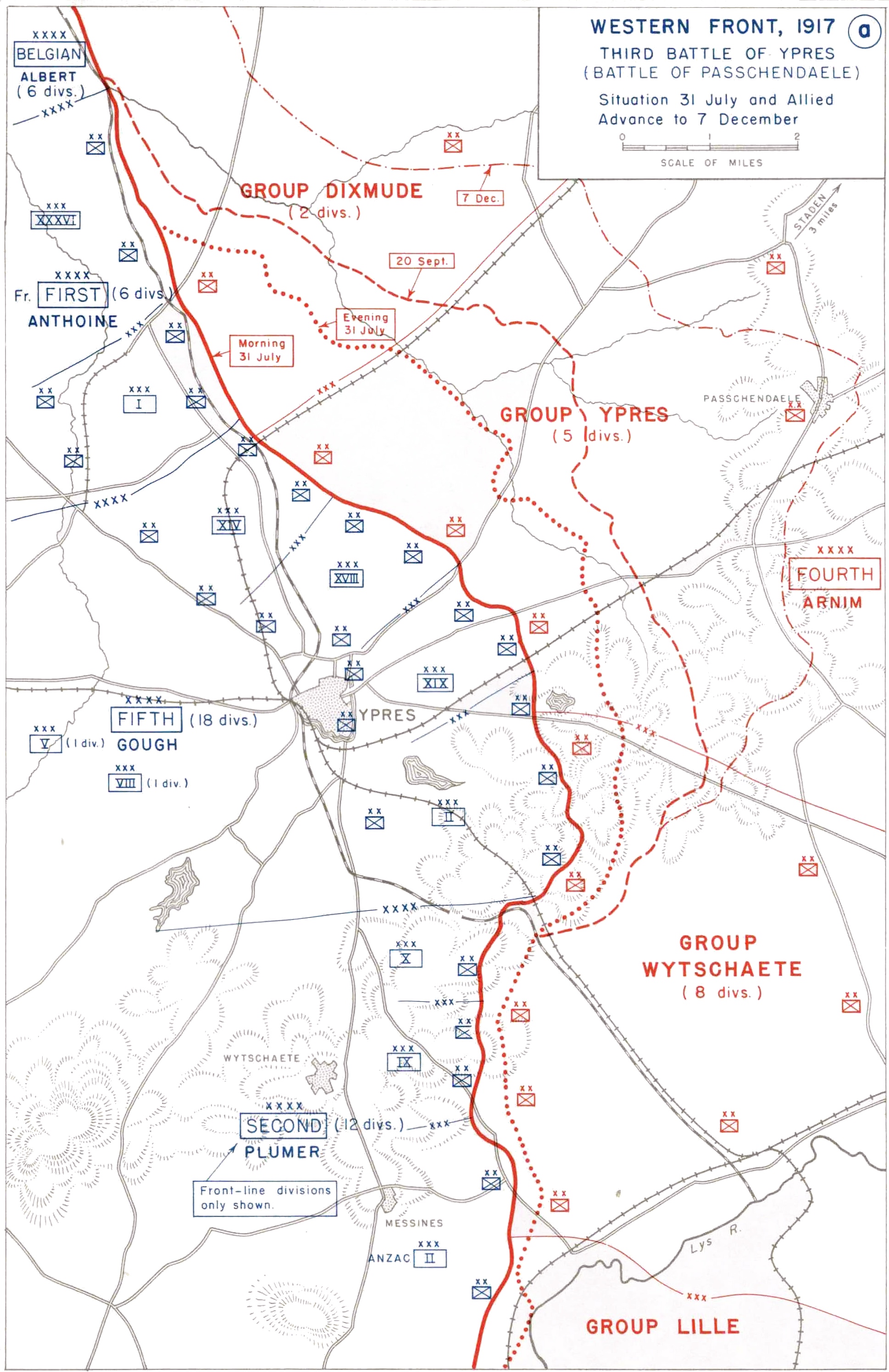
Map of British objective lines

On September 20, British forces launched their third attack at Passchendaele, this time at the Menin Road Ridge in the Ypres salient (Flanders). They are using a new method called “leapfrogging,” wherein waves of infantry stop when reaching their objective, secure it, and then prepare to act as reinforcements for the next wave as it passes them. Heavy artillery was brought into the region and used to devastate German lines – many of the German defenders were so dazed from the artillery that they surrendered en masse as the British arrived. Coupled with air superiority plotting out German reinforcement point and routes, anti-air guns keeping German planes away, and the repositioning of German forces away from the area due to a mistaken belief that British offensive operations had concluded, the Allies succeeded in reaching their objectives in nearly all areas within several hours. Additionally, the leapfrog tactic of securing gains quickly has resulted in German counter-attacks failing quickly.

<– Part 164 – September 9, 1917  | Part 165 – September 16, 1917 |  Part 166 – September 23, 1917 –>

Paul Painlevé, the new French Prime Minister

The former Prime Minister Ribot

The French Prime Minister, Alexandre Ribot, resigned September 12 following a summer of failures (most notably of the Nivelle Offensive), the mutinies of vast portions of the French army, the resignation of his cabinet following the dismissal of the Interior Minister, and other seeming-failures in foreign affairs & achieving peace. He has been replaced by Paul Painlevé.

The Eleventh Isonzo also ended September 12, with both sides too exhausted to continue fighting. Although the Italians did gain some ground, the Second Army is split across the Isonzo river, which is a seriously weak point in their line. Altogether, the Italians lost 158,000 men to the Austro-Hungarians’ 115,000.

On September 13, following a lull in the British attacks, the Germans transferred 2 infantry divisions, 25 artillery brigades, and 7 air units away from Passchendaele, expected a cessation of attacks.


<– Part 163 – September 2, 1917  | Part 164 – September 9, 1917 |  Part 165 – September 16, 1917 –>

At Jugla, the Russian 12th Army has finished its retreat, with cover provided by a now heavily-depleted forces of the Latvian Rifles. Although outnumbering the Germans nearly 4:1, the Russians lost 25,000 soldiers to the Germans’ 5,000.

Sailors from the beached SMS Seeadler, the last vestiges of Germany’s Pacific Fleet, captured the French schooner Lutece. The German captain and a few forces, sailing for Fiji, have been captured, leaving these sailors alone to continue the war. The captured French ship was seen sailing towards Easter Island.

The Romanian defense at Marasesti has ended successfully, as mounting losses for the Central Powers have led the German commanders to call off the offensive. 65,000 Germans and similar numbers of Austro-Hungarians have become casualties, compared to 53,000 losses for the Russo-Romanian armies, shared relatively evenly between both nations.

The world’s socialists are holding yet another large, anti-war conference, this one in Stockholm.

<– Part 162 – August 26, 1917  | Part 163 – September 2, 1917 |  Part 164 – September 9, 1917 –>

The Germans have launched an enormous offensive at Jugla, towards Riga, beginning September 1. An enormous artillery bombardment pushed back the Russians, and the Germans quickly crossed the Daugava river. The Russians hurriedly rushed the Latvian Rifles to halt the assault, and the Latvians have held back the entire German army – together with the Germans’ planes, flamethrowers, and gas – for the last 26 hours as the Russian army retreats. The Rifles should be able to withdraw by tomorrow morning.

On the Isonzo, both the Italians and the Austrians continue to suffer heavy casualties. At Passchendale, both sides have paused to consolidate their gains and treat casualties.

<– Part 161 – August 19, 1917  | Part 162 – August 26, 1917 |  Part 163 – September 2, 1917 –>

French attack at Verdun, August 20-26 1917

The Romanian armies at Oituz and Mărășești have held their ground. The Germans and Austro-Hungarians have shifted the full offensive away from Oituz, but have had no luck breaking the Allied line.

On August 21, near Hill 70, at Lens, a Canadian offensive was interrupted by German one; armies met between objectives for hand-to-hand fighting, eventually forcing the Canadians back to their starting lines. A series of

Russian General Lavr Georgiyevich Kornilov in 1916

counter-attacks had minimal results, although several Canadian units did manage to gain ground, creating a salient in their line. The Allies suffered 10,000 casualties to the German 26,000.


The Italians continue to press their attack on the Isonzo, though the Austrians are inflicting heavy casualties on them.

At Verdun, a French offensive delayed since August 11 by poor weather was launched August 20, in the face of heavy German artillery, mustard gas, and strong defenses. By August 26, the French had gained some ground, taking 11,000 prisoners, while suffering 14,000 casualties of their own.

In Russia, an attempted coup by General Lavr Kornilov has failed. Initially ordered by the Provisional Government to bring troops to Petrograd to pacify the capital, Kornilov saw it as an opportunity to overthrow the left-wing government seen as weakening the Russian military and nation. Kornilov took advantage of “ambiguous communications” to launch his assault on both the government and the Petrograd Soviet. Only an armed resistance, led by the Bolsheviks, was successful in foiling Kornilov’s plot.

Fighting in Flanders continues, near Passchendaele, as both sides fight on the Gheluvelt Plateau.

<– Part 160 – August 12, 1917  | Part 161 – August 19, 1917 |  Part 162 – August 26, 1917 –>

At Mărășești, the Romanians have assumed full control of the joint forces with Russia and have completely halted the German-Austrian advance, while beginning their own. At nearby Oituz, the elite Romanian mountain troops, the “Vânători de munte”, arrived following a 100-mile forced march. After a 20 minute rest, they assaulted the mountain peak and broke through enemy defenses. Elsewhere, however, Romanian reinforcements failed to achieve ground against the defenders. Yet the Allies seem to be halting the Central Powers’ advance, which is losing steam.

On August 15, at Ypres, Canadian forces were sent to capture Hill 70 to draw German soldiers away from the Ypres salient. Attacking at 4:25 A.M., they reached their second line of goals within two hours and began defensive preparations. German counter-attacks were repelled later that morning. Since then, the past few days have seen attacks and counterattacks, with neither side gaining much ground, despite German use of Yellow Cross mustard gas. Both sides have halted the past day, no doubt revising their plans.

At Langemarck, near Ypres, the Allies have launched a large offensive August 16 to drive German forces back and keep the pressure on them at all sectors. The new Allied plans call for sophisticated artillery calculations, allowing infantry to advance much closer to the barrage, be shielded by smoke screens when halting, and to form flanking units when adjacent units are slowed by defenders. The British have made some advance, although the German Fourth Army halted any significant gains. FIghting seems to have ended two days later.

<– Part 159 – August 5, 1917  | Part 160 – August 12, 1917 |  Part 161 – August 19, 1917 –>

Following the Romanian victory at Maresti, the German and Austro-Hungarian forces have launched a counter-offensive August 6 towards Mărășești. So far, the Romanian and Russian defenders have held their line, forcing the Germans to turn their offensive slightly north-western, while suffering moderate casualties.
Two days later, the Central Powers launched another offensive just to the north, near Oituz. Here too the Romanian defenders have held the line, although a series of breakthroughs and counterattacks from both sides of the fighting have caused the defense to be much more lively.

The fighting at Rumbo, German East Africa has ended August 10 with a British-Portuguese victory. The Allies suffered nearly 400 casualties, while the Germans had 1,500 killed and 600 captured.

<– Part 158 – July 29, 1917  | Part 159 – August 5, 1917 |  Part 160 – August 12, 1917 –>

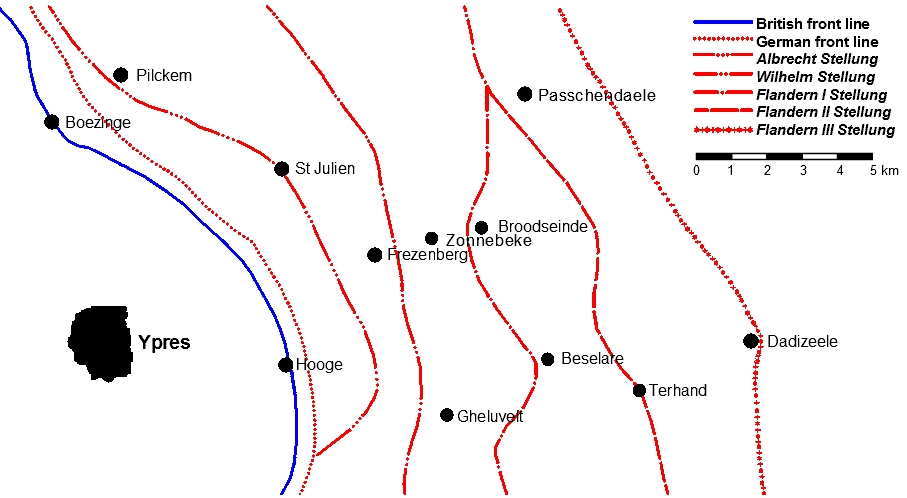
Lines at Ypres

German defensive lines

The Allies launched a major offensive at Passchendaele at 3:50am on July 31, the third major battle near Ypres. An artillery barrage began the fighting, with infantry advancing closely behind the advancing bombardment. The Second Army front lines advanced approximately 600 years along a front of 2,500, less than hoped for due to seasonal rains and German counterattacks. The Allied  Fifth Army, however,advanced nearly 3,500 yards in the center of the front and achieved its objectives. French forces also achieved their goals, although intense rains are still slowing the advance. Altogether, 13 Allied divisions lost 33,000 men, while the defending 7 German divisions lost 30,000, with an additional 5,500 taken prisoner. British General Haig has praised the low number of casualties and the success of a 3,000 yard advance. German counterattacks have been halted, but British forces in the center are exposed to heavy enfilading fire.

Details of German lines


On August 1, the Romanian forces at Marasti achieved a large victory the largest offensive advance of the war.

On August 2, a combined British-Portuguese force of 6,000 defeated German defenders at Rumbo, in German East Africa.

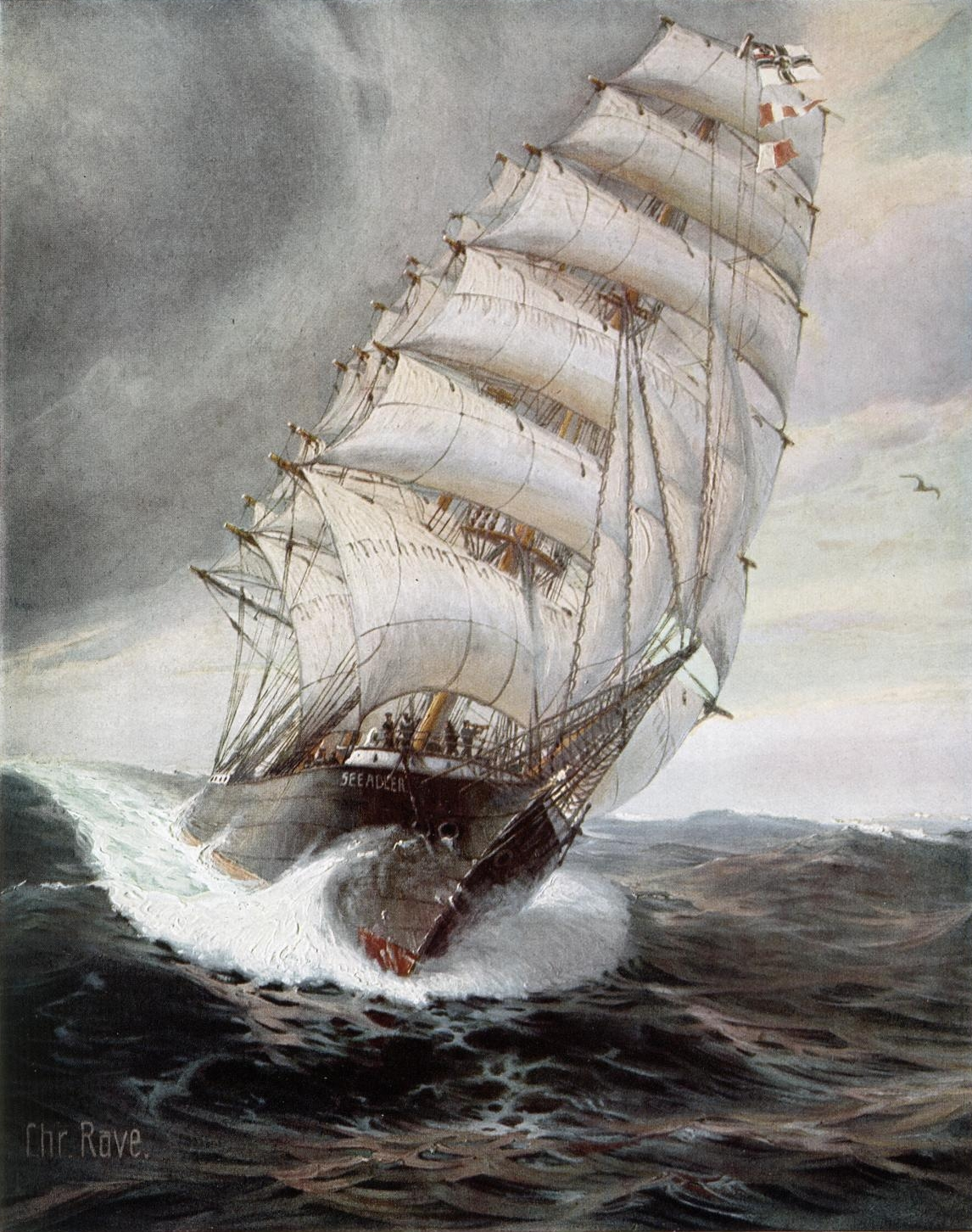
The German warship SMS Seeadler, a merchant raider, has wrecked in French Polynesia. Her captain and 5 crewman have sailed for Fiji, while the rest of the crew has been left to scuttle the vessel.


German pillbox diagram in Flanders

SMS Seeadler

<– Part 157 – July 22, 1917  | Part 158 – July 29, 1917 |  Part 159 – August 5, 1917 –>

Romanian forces at Marasti continue their rapid advance, which is on pace to become the largest offensive rate of advance for the Allied powers in the entire war – nearly 3km per day across a 35km front.

On July 29, 3,000 German defenders at the Kiawe bridge, in German East Africa, were attacked by a 4,000-strong British force. After intense fighting, in which 122 British soldiers and 500 Germans were killed, the remaining German force surrendered, and the British have captured the bridge.

<– Part 156 – July 15, 1917  | Part 157 – July 22, 1917 |  Part 158 – July 29, 1917 –>

The Romanian Armies in Eastern Romania, with assistance from Russian Republic forces, launched their offensive against the Central Powers June 22 towards Mărăști. The German and Austro-Hungarian forces, although outnumbered nearly 2:1, expect to easily repel the assaults before launching their own counter-attacks. However, expert artillery fire coordinated with infantry attacks has broken the German defenses along a nearly 30km front and the Romanian infantry is advancing quickly.

To the north, the Russian forces in the failed Kerensky Offensive are in full retreat, having withdrawn nearly 240km. The German advances in their wake seems limited only by an inability to hold occupied territory.

In Petrograd, Bolshevik forces assisting in unrest against the Provisional Government have been crushed; Lenin has fled to Finland while Trotsky has been arrested. However, Bolshevik membership has swelled nearly ten-fold in the last few months, so their power remains substantial.