<– Part 115 – October 1, 1916  | Part 116 – October 8, 1916 |  Part 116 – October 15, 1916 –>

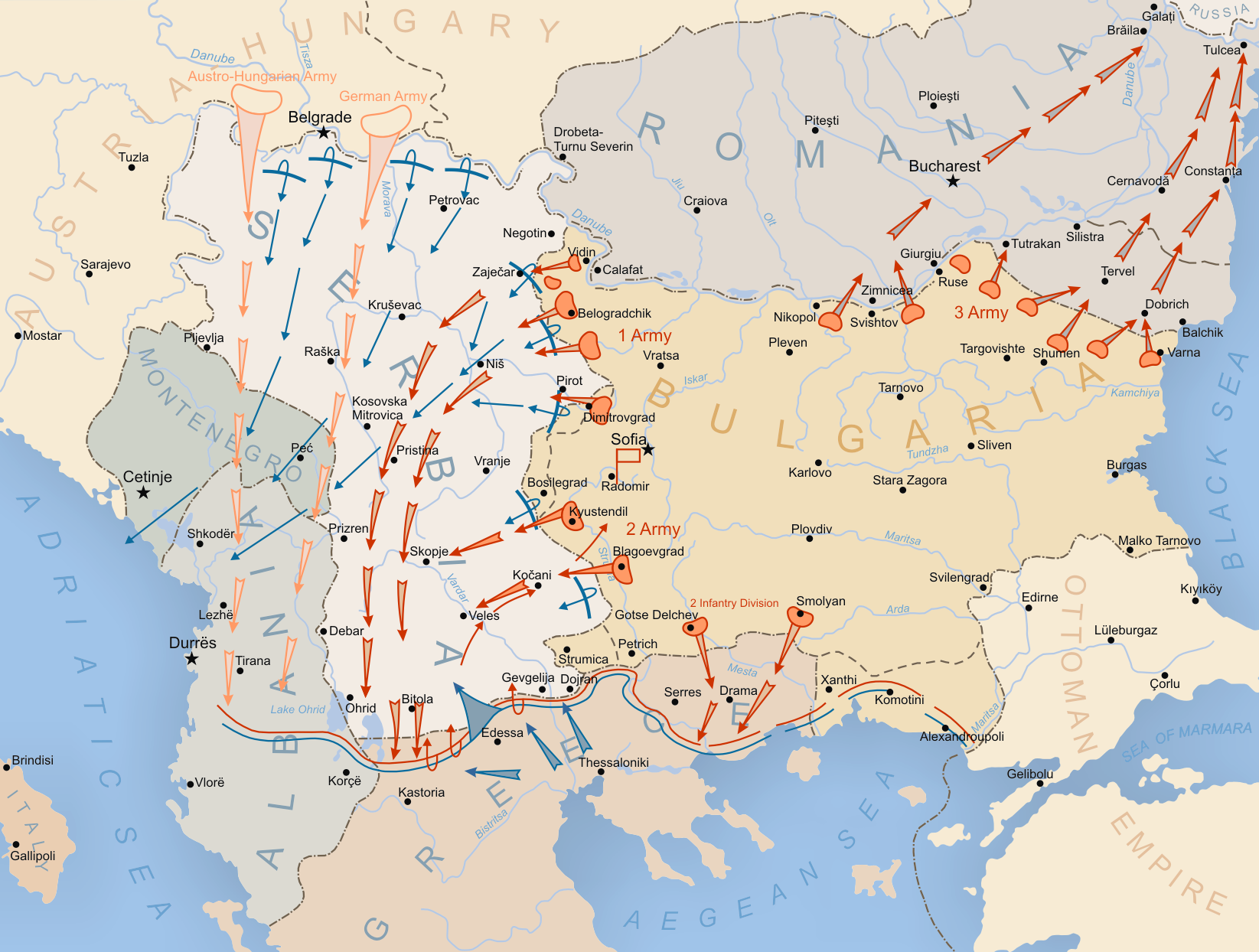
At Flamanda, the Austro-Hungarian Navy’s Danube flotilla dispatched patrol boats to oppose the Romanian bridgehead, which were shelled and forced to retreat. A set of river monitors returned, but they too were damaged and forced to retreat. However, with the Transylvania operations swinging against Romania, the Flamanda offensive was halted October 5 and the forced pulled back into defensive lines.

At Monastir, in Macedonia, Serbian forces attempted to force the bend of the river Crna October 5 but were pushed back across both there and at various nearby villages.

At Le Transloy, the British forces continue their offensive, although forces have withdrawn in a few zones, allowing the Germans to retake their lost trenches. At nearby Ancre Heights, also part of the Somme offensive, some advances have achieved their objectives, although German defenses in other areas have forced a halt until earlier today; however, today’s assault was blunted by well-entrenched German infantry and artillery.

<– Part 114 – September 24, 1916  | Part 115 – October 1, 1916 |  Part 116 – October 8, 1916 –>


Flamanda Offensive plans

Flamanda Offensive plans

The Allies forces at the Somme continue to make advances following their victory at Flers-Courcelette. Fighting from September 25-28  captured Morval, with only 5,000 casualties, while nearby fighting captured the Thiepval Ridge before advancing east to the Ancre Heights earlier today (although fighting has slowed there). Additionally, fighting at Le Transloy earlier today, following 6 hours of artillery, have seen the forward German trenches captured. The Germans seem unable to counter the manpower, supply, tanks, and aeroplane superiority the Allies enjoy, and September has been their costliest month to date in terms of casualties, having lost 135,000 men.

The Romanians launched an offensive across the Danube at Flamanda September 29, and have taken a 2.5 mile deep, 8.5 mile wide bridgehead earlier today.

The peak of Kaymakchalan, in Macedonia, was captured September 30 by the Serbian army after exchanging hands all week. The Serbs lost 4,600 to the Bulgarian 7,000+, and have lost 10,000 men so far, a costly victory for a smaller country.

<– Part 113 – September 17, 1916  | Part 114 – September 24, 1916 |  Part 115 – October 1, 1916 –>

The great Russian Brusilov Offensive came to an end September 20, having nearly conquered Austria-Hungary, drawing large numbers of German troops from the Western front (halting advances at Verdun), and advancing all the way to the Carpathian mountains.

The Romanian offensive has stagnated, with troops ordered to hold defensive positions. The Germans and Austro-Hungarians are launching counter-attacks, halting further advances. At Cobadin, the joint Russian and Romanian defense is slowing the Central Powers’ advance.

In Macedonia, the Monastir offensive has seen the Bulgarians pushed back into defensive positions at Kaymakchalan mountain. At the Somme’s Flers-Courcelette advance, British forces have slowed their assault as of September 22, their tanks seeming to have turned the tide. The skies above are filled with German aeroplanes harassing them, though Allied planes are fighting back.

At Mesopotamia, the British are consolidating their positions, supply lines, and are preparing for another offensive.

<– Part 112 – September 10, 1916  | Part 113 – September 17, 1916 |  Part 114 – September 24, 1916 –>

British Mark I tank in action at the Somme campaign

The South African attack on German forces at Kisaki, in German East Africa, ended September 11 with the Allied forces withdrawing. The German commander, Lettow-Vorbeck, abandoned Kisaki 3 days later.

Somme progression at Flers-Courcelette, showing gains by the Guards division, which used the tanks

In Macedonia, the Allies have launched a new offensive September 12, with the intent of pushing the entrenched Bulgarian forces back. Following a two-day artillery barrage and attacks at Malka Nidzhe and Kaymakchalan, the Bulgarians have been pushed back in several sectors, although fighting continues at Kaymakchalan, with heavy casualties.

On September 14, Italian forces, still outnumbering the opposing Austro-Hungarian 2:1, launched the seventh assault across the Isonzo, attempting to broaden the bridgehead they’ve reached at Gorizia. After 17,000 Italian and 15,000 Austro-Hungarian casualties, the assault ended September 17 with no ground gained.

At the Somme, Allied forces launched an assault at Flers-Courcelette September 15, which included the introduction of a mighty, armored war machine called a “tank,” which was used to attack German trenches and provide cover for infantry. The Germans have suffered heavy casualties, and many trenches and some village have been taken, with the Allies gaining nearly 1,000 yards so far.

Battle of the Somme, 1916

That same day, two Austro-Hungarian seaplanes obtained a world first, as they dropped bombs on the French submarine Foucault, forcing it to surface and then be destroyed. The 27 survivors held onto the landed planes until an Austrian torpedo boat took them prisoner. The French, however, had their revenge, as the French sub Ampere torpedoed an Austrian hospital ship, which had to be beached for repairs.

The Bulgarian offensive into Romania has been opposed at Cobadin by a combined Romanian and Russian army earlier today. Fighting is ongoing. At Verdun, more French attacks have failed. At Transylvania, the Romanian offensive continues, gaining support from some local populations, opposed to the Austro-Hungarian occupation.

<– Part 111 – September 3, 1916  | Part 112 – September 10, 1916 |  Part 113 – September 17, 1916 –>

German lines near Delville wood, at the Somme, July-September 1916. Guillemont & Ginchy are on the left of this map

The Bulgarians continue to push the Romanians north following the Battle of Dobrich of September 5-7, despite being outnumbered 2:1.

At Turtucaia, the fortress was captured by the Bulgarians September 6, following bombardment and an infantry assault. At the Somme, Guillemont was captured by the British, although difficulties of weather and communication made it more difficult than needed.

In German East Africa, South African forces attacked the British as Kisaki September 7, and the fighting continues as German artillery and defensive positions obliterate African attacks.

Troops advance at the battle of Ginchy September 9, 1916

The village of Ginchy was taken by British forces September 9, the Germans having been pushed back, and the Delville Wood salient eliminated and the lines straightened. This victory was assisted by the nearby taking of Guillemont. At Verdun, a French counter-attack at Fort Souville again achieved only minimal gains.

Meanwhile, in Transylvania to the north, the Romanian army continues its advance north.

<– Part 110 – August 27, 1916  | Part 111 – September 3, 1916 |  Part 112 – September 10, 1916 –>

Italy finally declared war on Germany August 28, following months each fighting the other’s allies. Near Florina, the Chegan offensive ended with the Bulgarian advance halted and their positions shelled. The Serbian counter-attacks, likewise, were repulsed. The offensive saw nearly 10,000 total casualties.

In Germany, Erich von Falkenhayn was removed as German chief of staff, and Paul von Hindenburg replaced him August 29. Two days later, Germany suspended her unprovoked U-boat attacks on merchant ships.

The Central Powers launched an invasion of Romania from Bulgaria on September 2, attacking the fortress of Turtucaia. The outer lines of defense have been quickly taken, and the Romanians seem unprepared and their defense poorly-organized and executed. To the North, in Transylvania, the Romanian Second Army continues its advance.

At the Somme, following the failure of full-frontal assaults to reach objectives, as well as weeks of costly casualty reports, the Allies have opted for smaller-scale attacks. An attack has been launched towards Guillemont by the Allied forces on September 3. With a severe breakdown in communications over the last month, caused by fog, smoke, and other issues, an elaborate system has been set up for this offensive, including telegraph, carrier pigeon, Roman candles, and more. Additionally, decision-making has been moved closer to the front, both in positioning and in permission for front-line commanders to make decisions as necessary.

At Verdun, an assault at Fleury by the French retook several hundred meters of land lost earlier in the battle. At Delville Woods, nearby on the front line, attacks and counter-attacks by each side have been costly, but the victory seems to be swinging to the British.

<– Part 109 – August 20, 1916  | Part 110 – August 27, 1916 |  Part 111 – September 3, 1916 –>

Following six days of fighting, the Bulgarian army conquered all Macedonia territory east of the Struma River on August 23. Meanwhile, to the West, the Chegan offensive is stalling, as Serbian reinforcements, coupled with Bulgarian ammunition shortages, is hindering further advances beyond the recently-captured Florina.

The German East Africa defense forces suffered a defeat at the hands of the British August 24 at Mlali.

Earlier this morning, August 27, Romania entered the war on the side of the Allies, and sent three armies through barely-defended passes in the Carpathian mountains into Austro-Hungarian Transylvania. One Austrian army opposes the advance, and several villages have been lost to the Romanians. Casualties have been minimal thus far, but only because resistance has been minimal as well.

<– Part 108 – August 13, 1916  | Part 109 – August 20, 1916 |  Part 110 – August 27, 1916 –>

Fighting at the Isonzo – the sixth battle to date at that location – ended August 17, with minimal gains by the Italians, yet still counted as a victory. 30,000 Italian and 8,000 Austro-Hungarian soldiers are dead, with a further 21,000 and 34,000 wounded.

In Macedonia, the Central Powers launched an offensive intended to disrupt a perceived Allied assault, with the threat of Romania joining the Allies looming. The assault was launched towards Florina and Chegan, and took Lerin early on.

Fighting at Doiran ended August 18, as additional Allied attacks against the Bulgarians on the 15, 16, and 18th all failed. 3,200 Allied soldiers have fallen, with 900 Bulgarian casualties.

At Verdun, Fleury was recaptured by the French.

At the Somme, the armies are entrenching as attention seems to focus towards Verdun. Brusilov’s advance continues.

<– Part 107 – August 6, 1916  | Part 108 – August 13, 1916 |  Part 109 – August 20, 1916 –>

At Pozieres, in the Somme campaign, a German counter-attack took Allied trenches August 7. An Australian platoon, reduced to 8 men, was surrounded & passed in the advance. Its commander, Lt. Albert Jacka, led a charge with his half-dozen men against the Germans lines, which was sufficient to inspire the other Australian units to attack. This rally captured the Germans. No more fighting has happened at Pozieres since then, and the town is still firmly in Allied hands.

The fighting at Kowel ended August 8, with the Brusilov offensive complete stalled – massive assaults against defended trenches seem ineffective. The Russians have now suffered 500,000 casualties in the offensive, a crippling hit to manpower.

Falls’ Sketch Map 10 Stages of Battle of Romani to Bir el Abd

At the Isonzo, and following the Battle of Doberdo yesterday (an exceptionally bloody fight – of the 50,000 Italians and 20,000 Austrians, 14,000 Italians and 9,500 Austrians have fallen – 24,000 out of the 70,000 total!), Gorizia has been taken by the Italians, and a bridgehead across the river established.

Sinai area of operations

August 9 saw the Russian Caucasus Army in possession of Bitlis and the surrounded area. The Ottoman offensive is collapsing, with nearly 30,000 killed. Persian operations also are shifting towards an Allied advantage.

In Macedonia, 4 Allied divisions attacked one entrenched Bulgarian division, and were repulsed on the 9th and 10th.

Following the Battle of Romani, in the Sinai, British forces pursuing the retreating German/Ottoman/Austrian forces harassed them for several days, until the Ottoman rearguard positions were encountered near Bir el Abd, an Ottoman base. British supplies are stretched thin, so they are awaiting infrastructure improvements before continuing.

At Verdun, continual French counter-attacks are failing to regain much ground lost to the German attack 2 weeks ago.

<– Part 106 – July 30, 1916  | Part 107 – August 6, 1916 |  Part 108 – August 13, 1916 –>

The first day of August saw a surprise German attack towards Fort Souville at Verdun advancing nearly 1km. French counter-attacks have been unable to recapture much of the land thus far.

At the Somme, on August 4, week-long preparations for a dusk attack (necessitating troop organizations in daytime, which required custom trench digging), following last week’s failed offensive by the Australian forces, have come to fruition as the Australian forces capture more than expected of the German trenches, including Hill 160 near Pozieres. The Germans have replied with an intense, nearly 360 degree artillery bombardment on the salient, but a German attack this morning was unable to breach the Allied lines.

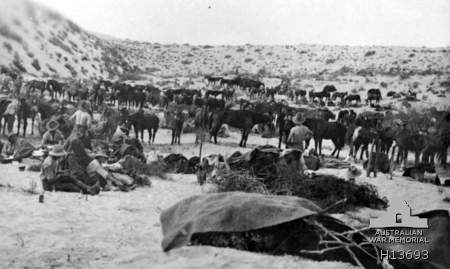
The Australian 8th Light Horse at Romani, defending the Sinai peninsula and Suez canal

The Italian battleship Leonardo da Vinci capsized during the night of August 2/3, following an internal explosion. While it is possible that unstable compounds used in the engines are to cause, attention has turned to possible sabotage by Austria-Hungary.

The Ottoman Empire launched an invasion of the Sinai peninsula on August 3, which lead to fighting through the 5th at Romani. Australian & New Zealand mounted troops skirmished and checked the combined German-Ottoman-Austrian advance long enough for thirst & overextended supply lines to lead to a retreat by the invading forces. 1,200 of the 14,000 British soldiers fell, to the enemy 9,200 out of 16,000 (including 4,000 prisoners).

The Isonzo saw the sixth offensive launched on August 6, with an Italian offensive against Gorizia succeeding in capturing supply roads in the area. 22 Italian divisions have forced a retreat on the 9 Austro-Hungarian divisions in several sectors. On the western edge of the Karst Plateau, 50,000 Italians nearly encircled 20,000 Austrians before the Austrians retreated. 14,000 Italians and 9,500 Austro-Hungarians have been killed, wounded, captured, or are missing.

Ottoman forces are attempting to counter the Russian advance in the Caucasus, while at Darfur, the British commander has broken off discussions with the Sultan, as it has become apparent the Sultan is merely stalling for time as his own forces desert and the Anglo-Egyptian forces become stronger.