<– Part 145 – April 29, 1917  | Part 146 – May 6, 1917 |  Part 147 – May 13, 1917 –>

At Arras, British forces attempted to take the Oppy Wood on their way to a strongly-held German position but failed. However, the failure has been analyzed as a lack of coordination between infantry, artillery, and tanks, and it is expected that the lessons learned will be of great value in future engagements.

On May 5, an enormous artillery barrage was launched by the Allies against Bulgarian forces in occupied-Serbia, supplementing the attack at Doiran, where the Allies assault has bogged down. The barrage was halted at nightfall but renewed earlier this morning. Patrols sent to assess damage to the defensive lines were driven back by the defenders.

<– Part 144 – April 22, 1917  | Part 145 – April 29, 1917 |  Part 146 – May 6, 1917 –>

Samarrah and its vitally important railroad fell to the British April 23, ending operations in that sector.

At Arras, a second round of fighting at the Scarpe has yielded territorial gains to the British. On April 28, British forces launched a shallow offensive intended to draw German reinforcements away from the Aisne. In addition to gaining territory at Arleux, German counter-attacks were halted. Despite the British efforts, French gains at the Aisne are minimal.

The British bombardment of Bulgarian lines at Doiran ended April 24, and the infantry offensive was launched, gaining several positions before losing them to Bulgarian counterattacks. All British attacks since have been stopped, and the British have withdrawn to their initial positions.

Due to heavy losses of Allied shipping, the British have agreed April 27 to use convoys. Initially hesitant to impose the delay on shipping that convoys require, the nearly 900,000 gross tons of lost shipping in April, over half of it British, has led to British supplies of wheat being less than six weeks worth. This has encouraged the Admiralty to revise its opinion. In the Meditteranean, no U-boat was sunk in the past month, although the Allies lost nearly 100.

<– Part 143 – April 15, 1917  | Part 144 – April 22, 1917 |  Part 145 – April 29, 1917 –>

A British assault on Gaza beginning April 17 failed after 2 days, the Ottoman lines holding steady. The British lost 6,500 men to the Ottomans’ 450, half of whom are MIA.

The following day, an intense British artillery barrage began on the Bulgarian lines at Doiran, and is still ongoing some days later. Tens of thousands of shells have reduced the forward defense to rubble, while the Bulgarian anti-battery fire has been equally intense.

At Arras, the tide has shifted against the Allies. German air superiority, due in large part to a “Red Baron” fighter ace, has led to shortages of capable pilots for the British – indeed, the average life expectancy of a British pilot is only 18 hours. Many of them have had their training abruptly ended and have been shipped to the front with little flight experience. On the ground, the British have been ordered to keep the Germans occupied to prevent excessive French casualties at nearby Aisne, where the French commander, Nivelle, expects the exhausted German lines to collapse in 1-2 days. However, the Germans, aware of the Allied plans, have formally adopted a revised defensive plan that emphasizes defense-in-depth and protection of artillery vantage points. The French have suffered heavy losses to German machine guns, while German artillery has devasted French tanks. Although 7,000 Germans have been taken prisoner, little land has been gained despite frequent attacks and counter-attacks.

In Persia, due to the Tsar’s abdication, the Russian Grand Duke has been arrested, and the royally-appointed General Yudenich has been reassigned to an inconsequential position. The troops have begun deserting en masse.

<– Part 142 – April 8, 1917  | Part 143 – April 15, 1917 |  Part 144 – April 22, 1917 –>

Map of the “creeping barrage” of artillery at Vimy Ridge

The Allied assault at Arras began April 9, with Canadian forces distinguishing themselves at the Vimy Ridge. The offensive had been originally scheduled for Easter Sunday, but was delayed one day to prevent Christian nations from slaughtering one another on that holiday. The Canadians achieved their objectives quickly, due to a focus on divisional-level attacks and artillery commanded by divisions in a “rolling attack,” where the artillery is just ahead of advancing infantry. Meanwhile the German commander was confused about his defensive orders and kept his reserves too far from the battle to be of use. Both sides are now consolidating their positions, with thousands of engineers building roads, digging gun pits, and dragging heavy artillery into position.

Canadian soldiers and their tank at Vimy Ridge


At Monastir, the French assault is still bogged down, but neither side possesses the peak of the mountain. In Persia, the Russian forces face desertions as soldiers receive news of the revolution. In Africa, the Senussi have signed a peace with Italy and England on April 14.


<– Part 141 – April 1, 1917  | Part 142 – April 8, 1917 |  Part 143 – April 15, 1917 –>

On April 2, Australian Lieutenant Colonel John Gellibrand ordered an attack by 2nd Division on Noreuil, expecting it to be vacated due to the German withdrawal to the Hindenburg Line. In fact, said withdrawal was completed some time last week, so he suffered intense casualties in a disastrous assault. Gellibrand’s career is already checkered, as his landing at ANZAC Cove on Gallipoli was mishandled, his pride continually clashes with his superiors, and he is often criticized for having his headquarters over 3 miles from the front. Nevertheless, the German withdrawal has given the Allies more territory in the last few weeks than they had taken the entirety of the war since September 1914.


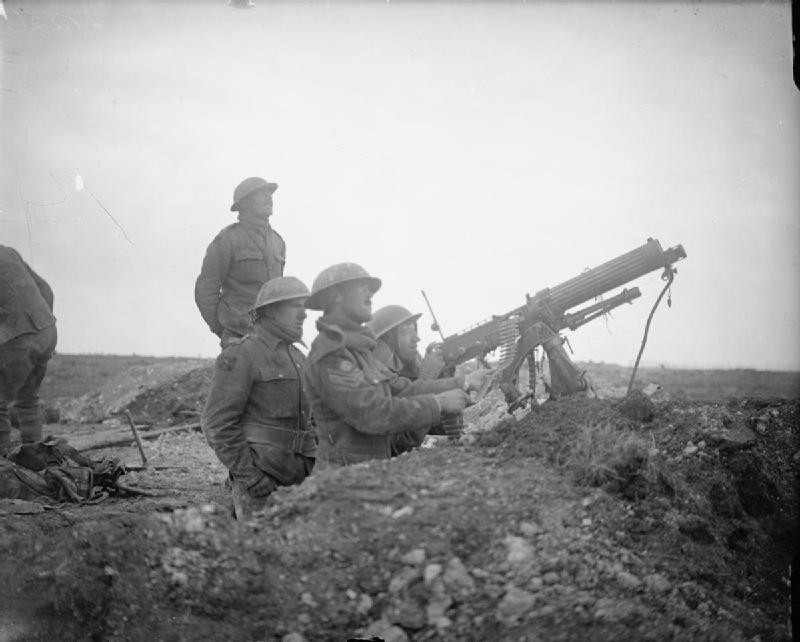
British machine gunners firing on German planes at Arras

The same day, US President Woodrow Wilson delivered a message to Congress at 8:32pm, asking the House of Representatives to declare war on the German Empire. The United States ended is neutrality April 6, declaring war, and entering the war.


At Arras, a bombardment of a front only 24 miles wide has been ongoing the last week, with German trenches having been reduced to mere “nests of men.” Allied troops have been seen massing, while aerial reconnaissance and underground tunneling (some tunnels large enough to accommodate light rail, and tens of thousands of troops), indicate a large, upcoming offensive.

French forces at Monastir have been unable to dislodge Bulgarian and German troops from the positions. In Russia, rumors have arrived that exiled communist Vladimir Lenin has arrived to oppose the Provisional Government. At Samarrah, British attacks on the Ottoman garrison continue.

<– Part 140 – March 25, 1917  | Part 141 – April 1, 1917 |  Part 142 – April 8, 1917 –>

The British Army’s Egyptian Expeditionary Force marched and engaged the Ottoman defenses at Gaza March 26. Despite encircling the 16,000 Ottomans with 22,000 of their own soldiers and taking trenches on three sides of the city, the British were ordered to withdraw that night as Ottoman reinforcements approached. 4,000 British soldiers were killed, while the Turks lost 1,400, with an additional 1,000 missing. Both sides have claimed victory, although the Ottomans are still in possession of the city.

The United States War College Division issued a report March 29, calling for preparations to raise an army nearly one million strong, and estimating ten months to send a force of 500,000 to Europe after training. This would put any potential US involvement in the war mid to late 1918, as the War College Division is adamant that untrained, drafted soldiers not be sent overseas. President Woodrow Wilson has called for a national army to be drafted and trained.

<– Part 139 – March 18, 1917  | Part 140 – March 25, 1917 |  Part 141 – April 1, 1917 –>

Georgy Lvov, head of the Provisional Government duma

Nikolay Chkheidze, Chairman of the Executive Committee of the Petrograd Soviet

British General Maude issued the Proclamation of Baghdad March 19, following his occupation of the city. It contains the famous line, “Our armies do not come into your cities and lands as conquerors or enemies, but as liberators.” The citizens seem to welcome the British forces. Otherwise, both armies have halted; the British due to extended supply lines, and the Ottomans in preparation for another advancing enemy column.

The former Russian Tsar Nicholas II has been reunited with his family in the Alexander Palace, where he was greeted by disrespectful sentries as “Nicholas Romanov.” The Provisional Government Duma, although an equal, in theory, to the Petrograd Soviet, has been subordinated by a new decree that the Duma’s authority cannot conflict with the Soviets, but the reverse is not true.

In Serbia, the Toplica Uprising has been crushed, with thousands of civilians dead. At Monastir, the French assaults, begun last week, continue with no signs of success.

<– Part 138 – March 11, 1917  | Part 139 – March 18, 1917 |  Part 140 – March 25, 1917 –>

US President Woodrow Wilson issued an executive order arming US merchantmen on March 12, following Congress failing to approve his proposed bill. In Serbia, an uprising in Toplica against the occupying Bulgarians has been met with violence, as thousands of Serbs have been killed by Bulgarian and Austro-Hungarian forces.

German withdrawal at Ancre

German forces withdraw from the Ancre salient March 13, having lost 5,300 soldiers (many of them as prisoners) to the British, who lost only 2,200 themselves. British forces have launched an offensive towards Samarrah, in Mesopotamia; although Baghdad has been taken by the British, a 10,000-strong Ottoman force evacuating the city to the north of the city is marching towards a 15,000-strong force evacuating Persia from the Russian offensive there. To prevent the two armies from linking up, the British hope to take the strategic Samarrah railroad.


On March 17, Aristide Briand resigned as French prime minister, following disgreements between Allied war planners over a plan developed by Briand’s appointed Commander-in-Chief of French Forces Robert Nivelle, as well the resignation of his minister of war.

In Arabia, Ottoman forces are sweeping the area, dealing casualties to the rebels, but the Ottoman failure to capture Yanbu means the rebels are still well supplied.

In the Russian capital of Petrograd, a company of soldiers refused to muster March 12, shooting its officers and joining the protesting civilians. Other regiments have followed, distributing 40,000 rifles to the workers, while loyal army officers have withdrawn to the admiralty building, one of the few remaining areas not under rebel control. Several members of the duma have formed the “Provisional Committee of the State Duma” in response to loyalist members abiding by the Tsar’s order not to meet. Socialist elements have declared the “Petrograd Soviet.” The following day, the Grand Dukes signed a manifesto calling on Tsar Nicholas II to issue constitutional reforms, removing much power from himself. The Tsar abdicated on March 15 on behalf of himself and his son, nominating his brother Grand Duke Michael Alexandrovich as his successor. Michael declined the next day, unless the people chose him democratically.

<– Part 137 – March 4, 1917  | Part 138 – March 11, 1917 |  Part 139 – March 18, 1917 –>

50,000 British soldiers advanced towards Baghdad March 5, reaching the Diyala river 35 miles south three days later. Following an initial assault the next day, the 25,000 Turkish defenders left their defensive positions and tracked the British, leaving one regiment behind. A surprise assault on that sole regiment March 10 destroyed it, forcing the Ottomans to retreat towards Baghdad, which was evacuated later that day. Baghdad was taken March 11 by the British, who were greeted enthusiastically. 10-15,000 Turks have been taken prisoner.

In Imperial Russia, protests broke out March 8 in the capital of Petrograd on International Women’s Day, comprised largely of women. The protests, initially started against government food rationing, has grown to over 200,000 calling for the Tsar to be replaced. Many in the crowd are waving red flags and banners, supporting the local communist. Industry shut down March 10, and the Tsar (on vacation) ordered the garrison to open fire on the crowd to disperse them. The 180,000 soldiers in the capital, mainly reservists and new recruits (only 12,000 are considered reliable) are low in both morale and officers, and are hesitant to fire on those they know (and many women). Rumors earlier today of police stationed in windows with machine guns have led to attacks on policy. Some troops have mutinied and joined the protesters. Earlier this evening, the Tsar issued a decree suspending the duma (state assembly), leaving it unable to act.

<– Part 136 – February 25, 1917  | Part 137 – March 4, 1917 |  Part 138 – March 11, 1917 –>

US President Woodrow Wilson requested Congressional approval to arm US merchantmen on February 26. The Zimmerman Telegram was released to the press March 1, lending support to the president’s request, and the US House of Representatives passed the Armed Ship Bill that same day. However, following a filibuster in the Senate, the bill failed March 4 – thereby ending what would certainly have been war.

On March 3, the French response to the revolt in North Niger, led by Ag Mohammed Wau Teguidda Kaocen, is harsh, with entire villages destroyed and summary executions the order.

On the Somme, an extremely well-planned attack by Australian forces was launched March 4 against German lines. Few extensively-planned attacks have been undertaken since the catastrophic losses of trained troops in 1914, but the success of this one indicates troops are again gaining experience. German artillery attempting to push the Australians from captured trenches has failed.