<– Part 169 – October 14, 1917  | Part 170 – October 21, 1917 |  Part 171 – October 28, 1917 –>
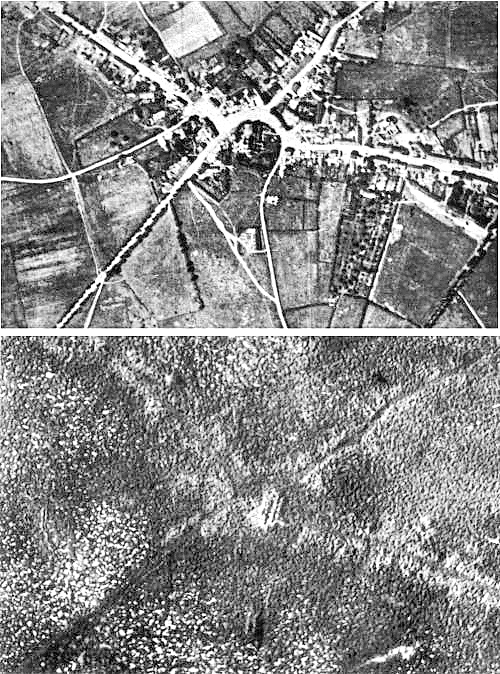
 

The actual village of Passchendaele. Top photo was taken before last week’s battle, and the bottom just after.

On October 15, German forces under Kurt Wahle came under attack near Nyangao, German East Africa, by a larger British force. Germans under region commander Paul Emil von Lettow-Vorbeck marched to support them but were caught in a pincer movement by British reinforcements. After successfully defending their positions, the Germans withdrew to Mahiwa the next day, defending those positions and counter-attacking on the 17th and 18th. Although ultimately victorious, the 1,500 Germans lost 1/3 of their force, while the British lost 2,700, over half their own force.


Elsewhere on the 15th, the US navy scored their first victory in the Atlantic when destroyer USS Cassin was torpedoed by U-61. An alert gunner’s mate, Osmond Ingram, saw the torpedo coming and warned the crew, who took evasive maneuvers and dropped depth charges. Although damaged by the torpedo, the submarine was severely damaged as well and forced to withdraw. Ingram was killed in the battle but received the Medal of Honor.

At Passchendaele, now also known as the 3rd Battle of Ypres, fighting has paused as both sides assess further winter operations.

<– Part 168 – October 7, 1917  | Part 169 – October 14, 1917 |  Part 170 – October 21, 1917 –>

Map showing flooding near Passchendaele, during the 3rd Battle of Ypres

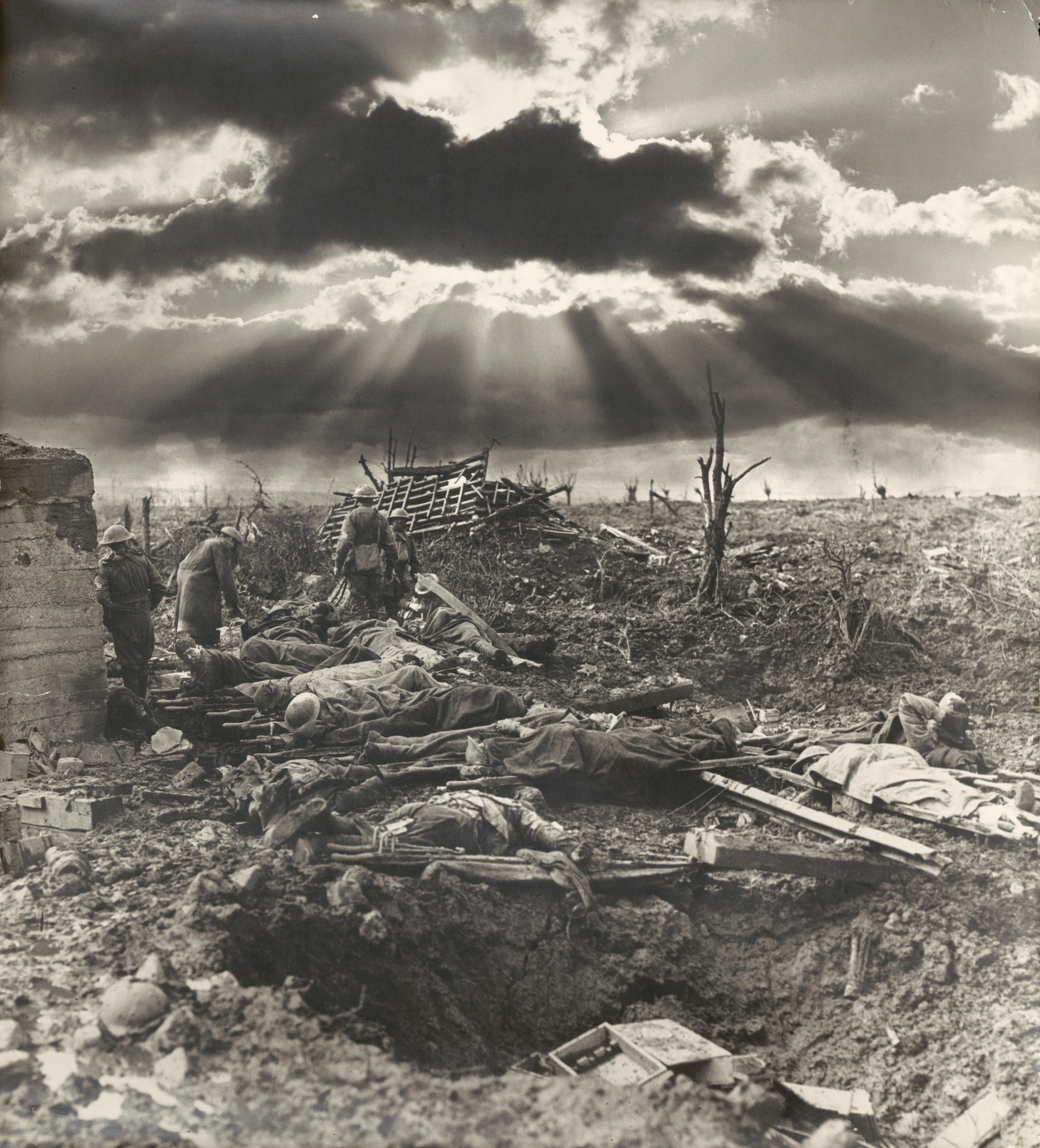
Photo showing the battlefield the morning after the battle

Another British assault at Ypres, this time near Poelcappelle, floundered October 9, following a long stream of success. This time, bad weather and rain hampered the movement of men, artillery, and ammunition, allowing the Germans to defend in the absence of the British artillery barrages – indeed, the British were only able to drop just over half the shells they’ve used in similar battles. The British lost 10,500 troops, with German losses this month reaching 35,000 (13,000 of them missing). On October 12, at the actual village of Passchendaele, near Ypres, the Germans scored another defensive victory, 13,000 British, Australian, and New Zealand soldiers fell, with an additional 10,000 German casualties.

New Zealand artillery in action, October 12

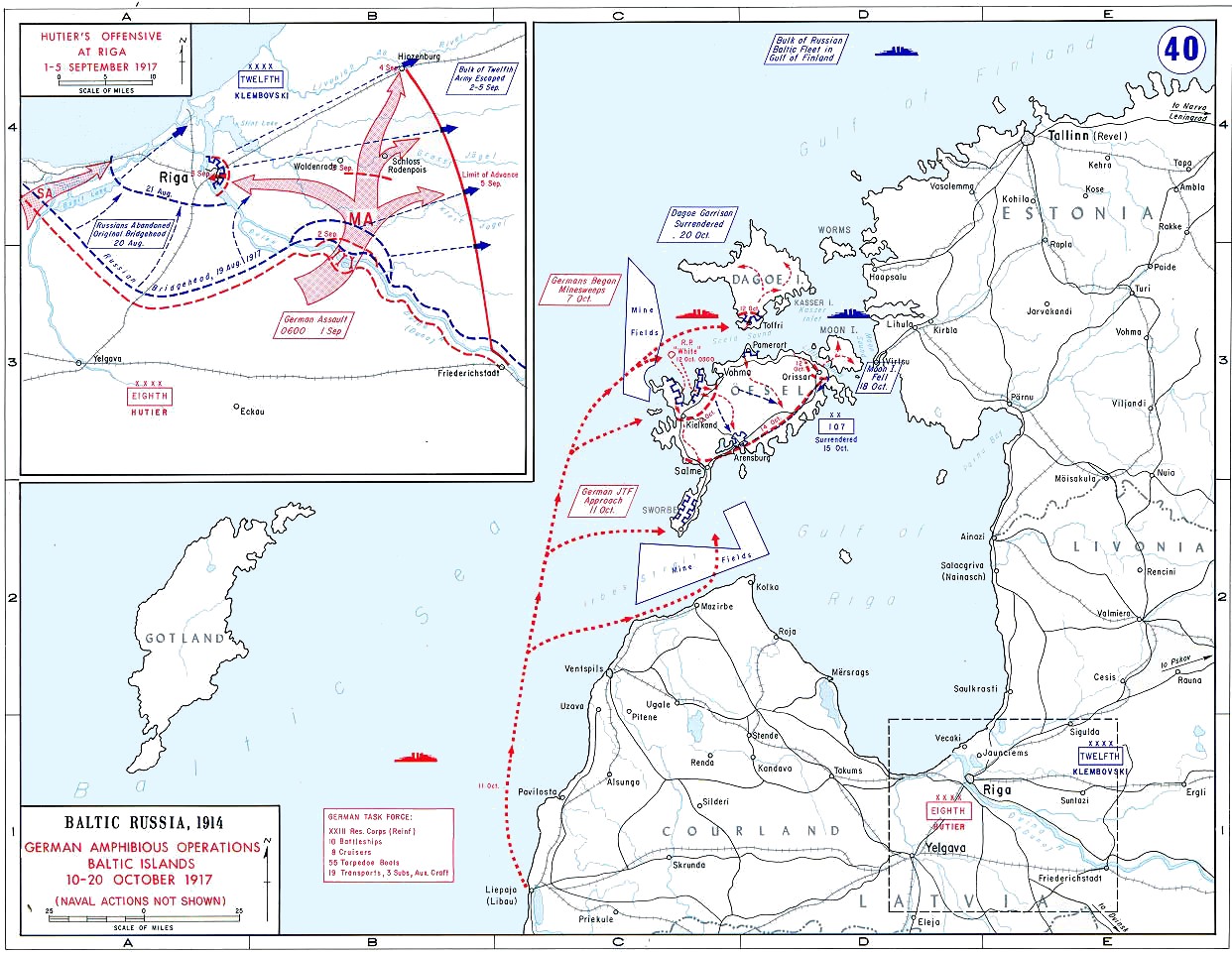
Map of Operation Albion

October 11 saw German forces in Estonia land on islands in the area, continuing their Operation Albion against Russian forces. To the south, naval forces under US command in the Mediterranean attacked the Austro-Hungarian port of Durazzo, in Albania. Following an exchange of fire, in which no American personnel were injured, the Austrian base was destroyed.


<– Part 167 – September 30, 1917  | Part 168 – October 7, 1917 |  Part 168 – October 14, 1917 –>

Battle of Broodseinde planning map

October 4 was a significant day this past week, with events on both sides of the world boding ill for Germany and the other Central Powers.

No-Man’s-Land following the battle, looking towards the German lines

First, the crew of SMS Seeadler, aboard the captured French schooner Lutece, ran aground on Easter Island as was taken into custody by Chile, thus ending the last gasp of Germany’s Pacific campaign.

Near Yypres, at the Broodseinde Ridge, the new British strategy of “bite and hold,” wherein forces take only the ground they can immediately defend against counterattack, has seen another extremely successful application, with more German territory being taken. The British suffered 20,000 casualties, to the German 35,000. Additionally, “the black day of October 4” has brought an enormous hit to German morale.


<– Part 166 – September 23, 1917  | Part 167 – September 30, 1917 |  Part 168 – October 7, 1917 –>

Fighting at the Menin Road Ridge ended September 26, following a German counterattack exhausting itself regaining some ground. The British forces lost 20,000 men to the Germans 28,000, 3000 of whom are prisoners.


British operations at Ramadi. The first advance was east-west along the river; the second battle was from the south.

Following the end of that battle, fighting flared up at nearby Polygon Wood September 26, with another successful British offensive campaign. The Allied forces lost 21,000 in the one day of fighting to the 13,500 Germans. Although the British forces have proven themselves superior in offensive operations, fresh German defenders were encountered. Both sides are scrambling to eliminate the enemy’s advantage.


From September 28-29, British forces in Mesopotamia marched on Ramadi, following a failed attack two months ago. That attack failed due to intense heat (measuring 160 degrees in sunlight, and responsible for half of British casualties), as well as an advance alongside the Euphrates river. This time, an attack from the south, with forces cutting off Ottoman paths of retreat, was successful. The British suffered 1,000 (mostly minor) casualties, to the Turks’ 3,500 (primarily prisoners).

<– Part 165 – September 16, 1917  | Part 166 – September 23, 1917 |  Part 167 – September 30, 1917 –>

Map of British objective lines

On September 20, British forces launched their third attack at Passchendaele, this time at the Menin Road Ridge in the Ypres salient (Flanders). They are using a new method called “leapfrogging,” wherein waves of infantry stop when reaching their objective, secure it, and then prepare to act as reinforcements for the next wave as it passes them. Heavy artillery was brought into the region and used to devastate German lines – many of the German defenders were so dazed from the artillery that they surrendered en masse as the British arrived. Coupled with air superiority plotting out German reinforcement point and routes, anti-air guns keeping German planes away, and the repositioning of German forces away from the area due to a mistaken belief that British offensive operations had concluded, the Allies succeeded in reaching their objectives in nearly all areas within several hours. Additionally, the leapfrog tactic of securing gains quickly has resulted in German counter-attacks failing quickly.

<– Part 164 – September 9, 1917  | Part 165 – September 16, 1917 |  Part 166 – September 23, 1917 –>

Paul Painlevé, the new French Prime Minister

The former Prime Minister Ribot

The French Prime Minister, Alexandre Ribot, resigned September 12 following a summer of failures (most notably of the Nivelle Offensive), the mutinies of vast portions of the French army, the resignation of his cabinet following the dismissal of the Interior Minister, and other seeming-failures in foreign affairs & achieving peace. He has been replaced by Paul Painlevé.

The Eleventh Isonzo also ended September 12, with both sides too exhausted to continue fighting. Although the Italians did gain some ground, the Second Army is split across the Isonzo river, which is a seriously weak point in their line. Altogether, the Italians lost 158,000 men to the Austro-Hungarians’ 115,000.

On September 13, following a lull in the British attacks, the Germans transferred 2 infantry divisions, 25 artillery brigades, and 7 air units away from Passchendaele, expected a cessation of attacks.


<– Part 163 – September 2, 1917  | Part 164 – September 9, 1917 |  Part 165 – September 16, 1917 –>

At Jugla, the Russian 12th Army has finished its retreat, with cover provided by a now heavily-depleted forces of the Latvian Rifles. Although outnumbering the Germans nearly 4:1, the Russians lost 25,000 soldiers to the Germans’ 5,000.

Sailors from the beached SMS Seeadler, the last vestiges of Germany’s Pacific Fleet, captured the French schooner Lutece. The German captain and a few forces, sailing for Fiji, have been captured, leaving these sailors alone to continue the war. The captured French ship was seen sailing towards Easter Island.

The Romanian defense at Marasesti has ended successfully, as mounting losses for the Central Powers have led the German commanders to call off the offensive. 65,000 Germans and similar numbers of Austro-Hungarians have become casualties, compared to 53,000 losses for the Russo-Romanian armies, shared relatively evenly between both nations.

The world’s socialists are holding yet another large, anti-war conference, this one in Stockholm.

<– Part 162 – August 26, 1917  | Part 163 – September 2, 1917 |  Part 164 – September 9, 1917 –>

The Germans have launched an enormous offensive at Jugla, towards Riga, beginning September 1. An enormous artillery bombardment pushed back the Russians, and the Germans quickly crossed the Daugava river. The Russians hurriedly rushed the Latvian Rifles to halt the assault, and the Latvians have held back the entire German army – together with the Germans’ planes, flamethrowers, and gas – for the last 26 hours as the Russian army retreats. The Rifles should be able to withdraw by tomorrow morning.

On the Isonzo, both the Italians and the Austrians continue to suffer heavy casualties. At Passchendale, both sides have paused to consolidate their gains and treat casualties.

<– Part 161 – August 19, 1917  | Part 162 – August 26, 1917 |  Part 163 – September 2, 1917 –>

French attack at Verdun, August 20-26 1917

The Romanian armies at Oituz and Mărășești have held their ground. The Germans and Austro-Hungarians have shifted the full offensive away from Oituz, but have had no luck breaking the Allied line.

On August 21, near Hill 70, at Lens, a Canadian offensive was interrupted by German one; armies met between objectives for hand-to-hand fighting, eventually forcing the Canadians back to their starting lines. A series of

Russian General Lavr Georgiyevich Kornilov in 1916

counter-attacks had minimal results, although several Canadian units did manage to gain ground, creating a salient in their line. The Allies suffered 10,000 casualties to the German 26,000.


The Italians continue to press their attack on the Isonzo, though the Austrians are inflicting heavy casualties on them.

At Verdun, a French offensive delayed since August 11 by poor weather was launched August 20, in the face of heavy German artillery, mustard gas, and strong defenses. By August 26, the French had gained some ground, taking 11,000 prisoners, while suffering 14,000 casualties of their own.

In Russia, an attempted coup by General Lavr Kornilov has failed. Initially ordered by the Provisional Government to bring troops to Petrograd to pacify the capital, Kornilov saw it as an opportunity to overthrow the left-wing government seen as weakening the Russian military and nation. Kornilov took advantage of “ambiguous communications” to launch his assault on both the government and the Petrograd Soviet. Only an armed resistance, led by the Bolsheviks, was successful in foiling Kornilov’s plot.

Fighting in Flanders continues, near Passchendaele, as both sides fight on the Gheluvelt Plateau.

<– Part 160 – August 12, 1917  | Part 161 – August 19, 1917 |  Part 162 – August 26, 1917 –>

At Mărășești, the Romanians have assumed full control of the joint forces with Russia and have completely halted the German-Austrian advance, while beginning their own. At nearby Oituz, the elite Romanian mountain troops, the “Vânători de munte”, arrived following a 100-mile forced march. After a 20 minute rest, they assaulted the mountain peak and broke through enemy defenses. Elsewhere, however, Romanian reinforcements failed to achieve ground against the defenders. Yet the Allies seem to be halting the Central Powers’ advance, which is losing steam.

On August 15, at Ypres, Canadian forces were sent to capture Hill 70 to draw German soldiers away from the Ypres salient. Attacking at 4:25 A.M., they reached their second line of goals within two hours and began defensive preparations. German counter-attacks were repelled later that morning. Since then, the past few days have seen attacks and counterattacks, with neither side gaining much ground, despite German use of Yellow Cross mustard gas. Both sides have halted the past day, no doubt revising their plans.

At Langemarck, near Ypres, the Allies have launched a large offensive August 16 to drive German forces back and keep the pressure on them at all sectors. The new Allied plans call for sophisticated artillery calculations, allowing infantry to advance much closer to the barrage, be shielded by smoke screens when halting, and to form flanking units when adjacent units are slowed by defenders. The British have made some advance, although the German Fourth Army halted any significant gains. FIghting seems to have ended two days later.