<– Part 159 – August 5, 1917  | Part 160 – August 12, 1917 |  Part 161 – August 19, 1917 –>

Following the Romanian victory at Maresti, the German and Austro-Hungarian forces have launched a counter-offensive August 6 towards Mărășești. So far, the Romanian and Russian defenders have held their line, forcing the Germans to turn their offensive slightly north-western, while suffering moderate casualties.
Two days later, the Central Powers launched another offensive just to the north, near Oituz. Here too the Romanian defenders have held the line, although a series of breakthroughs and counterattacks from both sides of the fighting have caused the defense to be much more lively.

The fighting at Rumbo, German East Africa has ended August 10 with a British-Portuguese victory. The Allies suffered nearly 400 casualties, while the Germans had 1,500 killed and 600 captured.
<– Part 158 – July 29, 1917  | Part 159 – August 5, 1917 |  Part 160 – August 12, 1917 –>

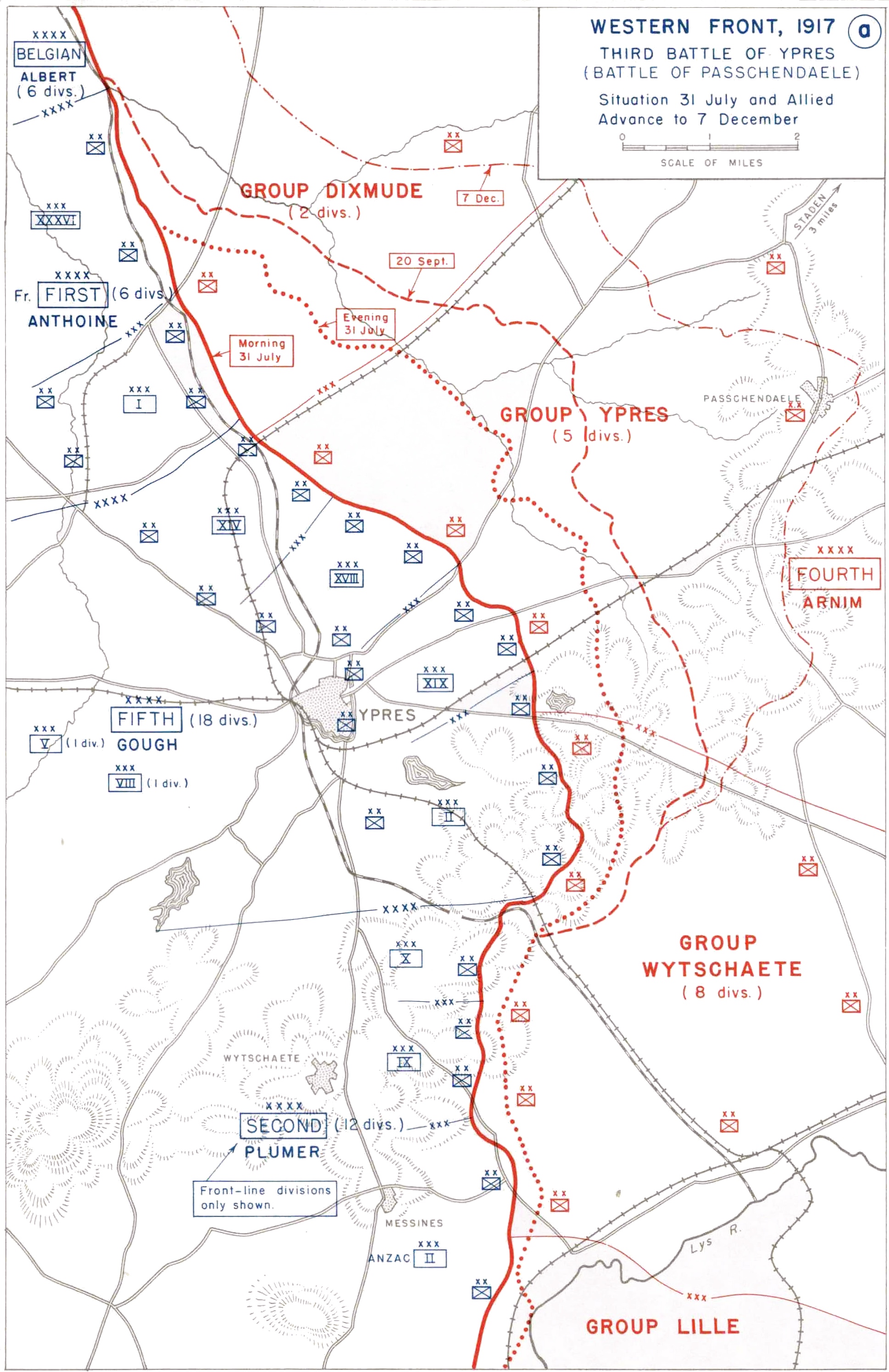
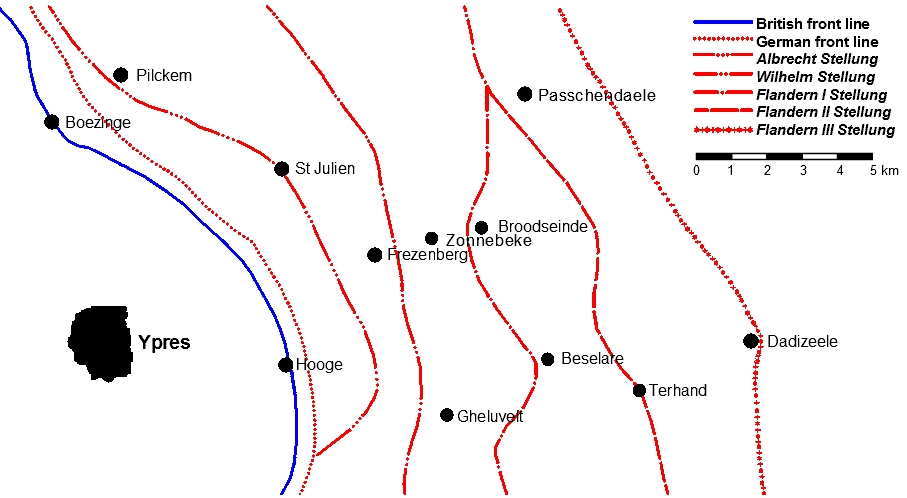
Lines at Ypres

German defensive lines

The Allies launched a major offensive at Passchendaele at 3:50am on July 31, the third major battle near Ypres. An artillery barrage began the fighting, with infantry advancing closely behind the advancing bombardment. The Second Army front lines advanced approximately 600 years along a front of 2,500, less than hoped for due to seasonal rains and German counterattacks. The Allied  Fifth Army, however,advanced nearly 3,500 yards in the center of the front and achieved its objectives. French forces also achieved their goals, although intense rains are still slowing the advance. Altogether, 13 Allied divisions lost 33,000 men, while the defending 7 German divisions lost 30,000, with an additional 5,500 taken prisoner. British General Haig has praised the low number of casualties and the success of a 3,000 yard advance. German counterattacks have been halted, but British forces in the center are exposed to heavy enfilading fire.

Details of German lines


On August 1, the Romanian forces at Marasti achieved a large victory the largest offensive advance of the war.

On August 2, a combined British-Portuguese force of 6,000 defeated German defenders at Rumbo, in German East Africa.

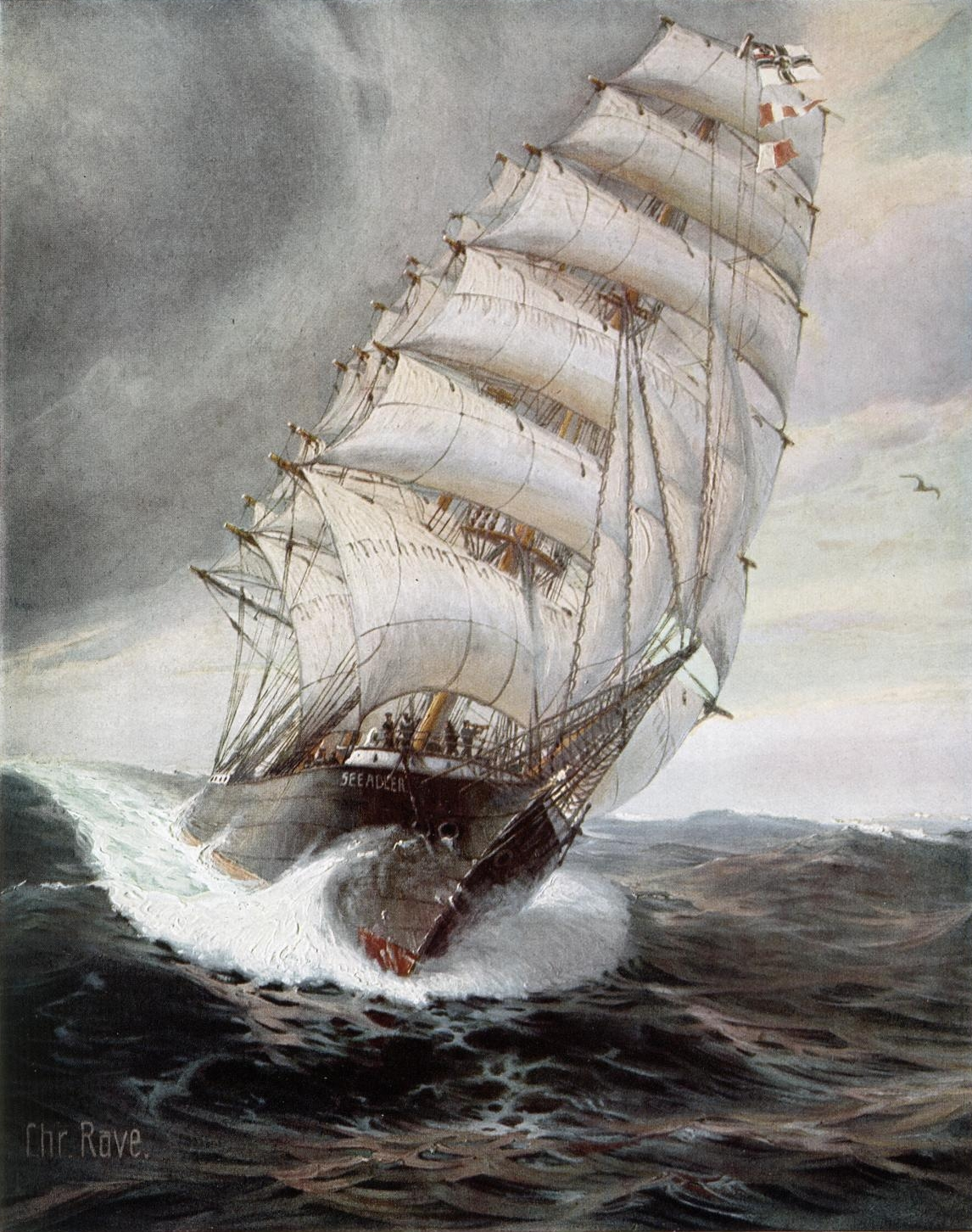
The German warship SMS Seeadler, a merchant raider, has wrecked in French Polynesia. Her captain and 5 crewman have sailed for Fiji, while the rest of the crew has been left to scuttle the vessel.


German pillbox diagram in Flanders

SMS Seeadler

<– Part 157 – July 22, 1917  | Part 158 – July 29, 1917 |  Part 159 – August 5, 1917 –>

Romanian forces at Marasti continue their rapid advance, which is on pace to become the largest offensive rate of advance for the Allied powers in the entire war – nearly 3km per day across a 35km front.

On July 29, 3,000 German defenders at the Kiawe bridge, in German East Africa, were attacked by a 4,000-strong British force. After intense fighting, in which 122 British soldiers and 500 Germans were killed, the remaining German force surrendered, and the British have captured the bridge.

<– Part 156 – July 15, 1917  | Part 157 – July 22, 1917 |  Part 158 – July 29, 1917 –>

The Romanian Armies in Eastern Romania, with assistance from Russian Republic forces, launched their offensive against the Central Powers June 22 towards Mărăști. The German and Austro-Hungarian forces, although outnumbered nearly 2:1, expect to easily repel the assaults before launching their own counter-attacks. However, expert artillery fire coordinated with infantry attacks has broken the German defenses along a nearly 30km front and the Romanian infantry is advancing quickly.

To the north, the Russian forces in the failed Kerensky Offensive are in full retreat, having withdrawn nearly 240km. The German advances in their wake seems limited only by an inability to hold occupied territory.

In Petrograd, Bolshevik forces assisting in unrest against the Provisional Government have been crushed; Lenin has fled to Finland while Trotsky has been arrested. However, Bolshevik membership has swelled nearly ten-fold in the last few months, so their power remains substantial.


<– Part 155 – July 8, 1917  | Part 156 – July 15, 1917 |  Part 157 – July 22, 1917 –>

Pershing and staff visiting Lafayette’s tomb

U.S. General Pershing has revised his number up of requested troops to nearly 3 million, in anticipation of greater involvement in the war. During a visit to the tomb of the Marquis de Lafayette, famous French advisor and supporter of General George Washington during the American Revolution, Pershing saluted the grave while his aide, Colonel Charles E. Stanton, was heard to say, “Lafayette, we are here.


<– Part 154 – July 1, 1917  | Part 155 – July 8, 1917 |  Part 156 – July 15, 1917 –>

US General Pershing formally requested an army of 1 million soldiers earlier this week in preparation for his maneuvers in Europe.

On July 6, 5,000 Arab rebels led by T.E. Lawrence captured Aquaba, defeating its garrison of 350, with an additional 450 Ottoman infantry. Two Arabs were killed, while half the Ottoman force was killed before the rest surrendered soon after British warships arrived off the coast and began shelling the defenses. T.E. Lawrence was almost killed when he shot his own camel in the head and fell off it.

Kerensky’s offensive continues with some Russian success against the Austro-Hungarian armies. Across Europe, the British war planners have postponed the amphibious landing in Belgium due to the plans being leaked and a German spoiling attack disrupting their lines.

<– Part 153 – June 24, 1917  | Part 154 – July 1, 1917 |  Part 155 – July 8, 1917 –>


“Blessed are the Peacemakers” – protest published in newspapers July 1 against the US Espionage Act

Austro-Hungarian shock troops assault the peak of Mount Ortigara June 25, taking it from the Italians and ending the fighting there. 23,000 Italians fell, to Austria’s 9,000.

The following day, the first U.S. troops landed in France. The men, approximately 14,000, are members of the 1st Division. The war for the Allies improved again June 30, with Greece officially entering the war on the side of the Allies, following last week’s replacement of the Germanophile Constantine I with his son Alexander as king.

In Russia, new minister Alexander Kerensky, head of the Provisional Government, ordered an offensive in Galicia, despite calls for peace, couple with power having officially been taken from officers and given to “soldiers committees.” Following heavy artillery bombardment, 4 armies (three Russian, and one Romanian) attacked the three armies of the Central Powers. While German forces are holding, 5,500 Austrian troops at Zborov have been pushed back by 3,500 members of the Czechoslovak Legions. The Czechs suffered 1,000 casualties, while the Austrians lost 3,500, primarily captured.

In the United States, protests against the newly passed Espionage Act are increasing, with many seeing it as an attack on the First Amendment.

In Romania, nearly 2 million men in 9 armies, with enormous field supplies and artillery, have been massed. A large offensive seems imminent.

<– Part 152 – June 17, 1917  | Part 153 – June 24, 1917 |  Part 154 – July 1, 1917 –>

Alexander Kerensky

German forces in Belgium captured a British patrol June 19, who revealed plans for an amphibious landing behind German lines. Although a surprise landing by Allied forces across the channel would perhaps be successful if a surprise, now that the attempt is expected, the Germans are sure to be ready.

On June 21, more turmoil arose in Russia as Georgy Lvov was replaced by Alexander Kerensky as head of the Provisional Government.

<– Part 151 – June 10, 1917  | Part 152 – June 17, 1917 |  Part 153 – June 24, 1917 –>

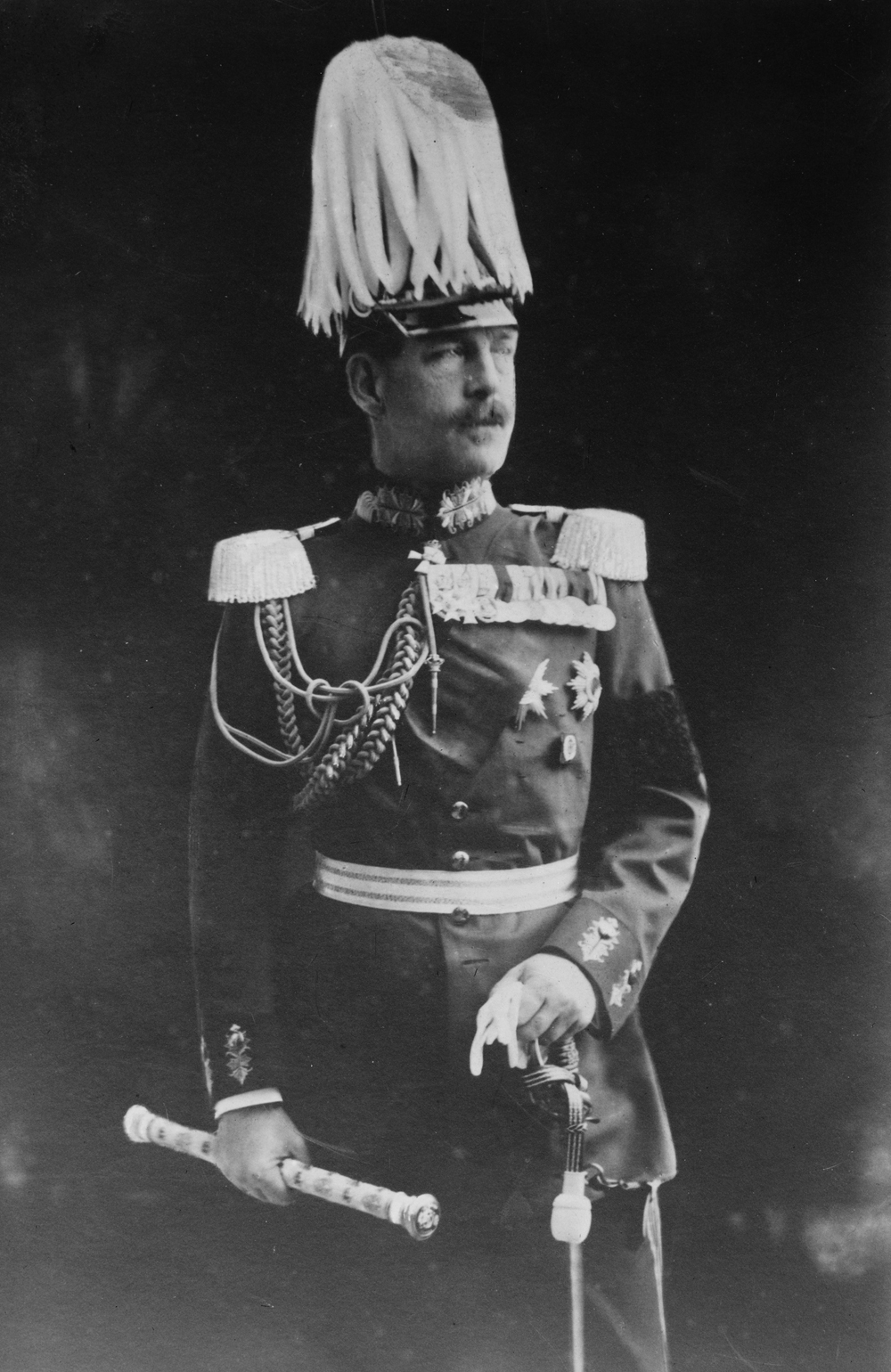
King Constantine I of Greece in a German Field Marshall uniform in 1913, an honor bestowed on him by German Emperor Wilhelm II

King Constantine I of Greece abdicated June 12 under Allied pressure, as he was suspected of being overly-friendly towards the German Empire. His eldest son likewise was bypassed (he is a veteran of the German Army), leaving Alexander to ascend to the throne.

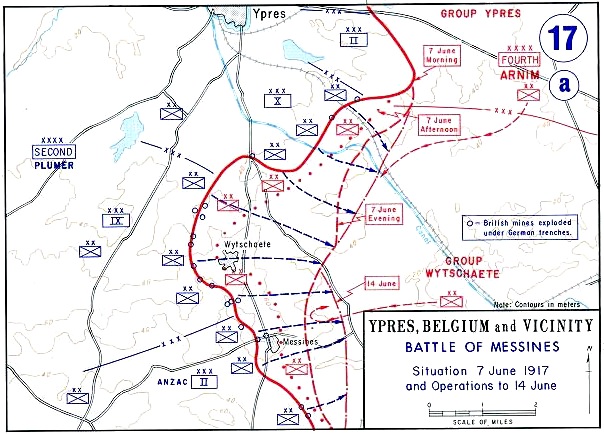
At Messines, the British Army’s advances were secured June 14, with no other fighting expected. Each side lost 25,000 soldiers, although nearly half the German losses are missing or captured.

Under pressure from conscientious objectors and other pacifists, the United States passed the Espionage Act on June 15, which makes it illegal to interfere with military operations or to discourage anyone from enlisting in the army.

<– Part 150 – June 3, 1917  | Part 151 – June 10, 1917 |  Part 152 – June 17, 1917 –>

The Battle of Messines

The British assault at Messines, an attempt to crush a large German salient, began the morning of June 4 with 19 large mines detonated beneath the ridge, killing 10,000 German soldiers, and the sound reportedly heard in London and Dublin. Weeks of miners laying miles of tunnels beneath the site have paid off, as the nearly 10-mile front has begun its assault. British planes buzzed the German defenses, masking the sound of tanks moving into position, as the Allies have followed-up on the mine detonation with a rolling artillery barrage just in front of 80,000 soldiers. The Allies reached their second objectives one-half mile behind the front lines in only 35 minutes. By 8:40, the British had achieved their early objectives, and due to lower than expected casualties (estimates were 50-60%), the higher than expected number of surviving troops clustered into the same area led to a seven-hour delay. Attacks and counter-attacks continue, although the British have held their positions without serious issue.

Earlier today, the Italian Sixth Army attack Austro-Hungarian defenders on Mount Ortigara, in southern Trentino, to secure the strategic position. Although the peak was captured, Austrian counter-attacks are imminent.

At the Isonzo, fighting has ceased, with both sides suffering 225,000 casualties, of a total of 600,000 soldiers engaged.