
<– Part 104 – July 16, 1916 | Part 105 – July 23, 1916 | Part 106 – July 30, 1916 –>
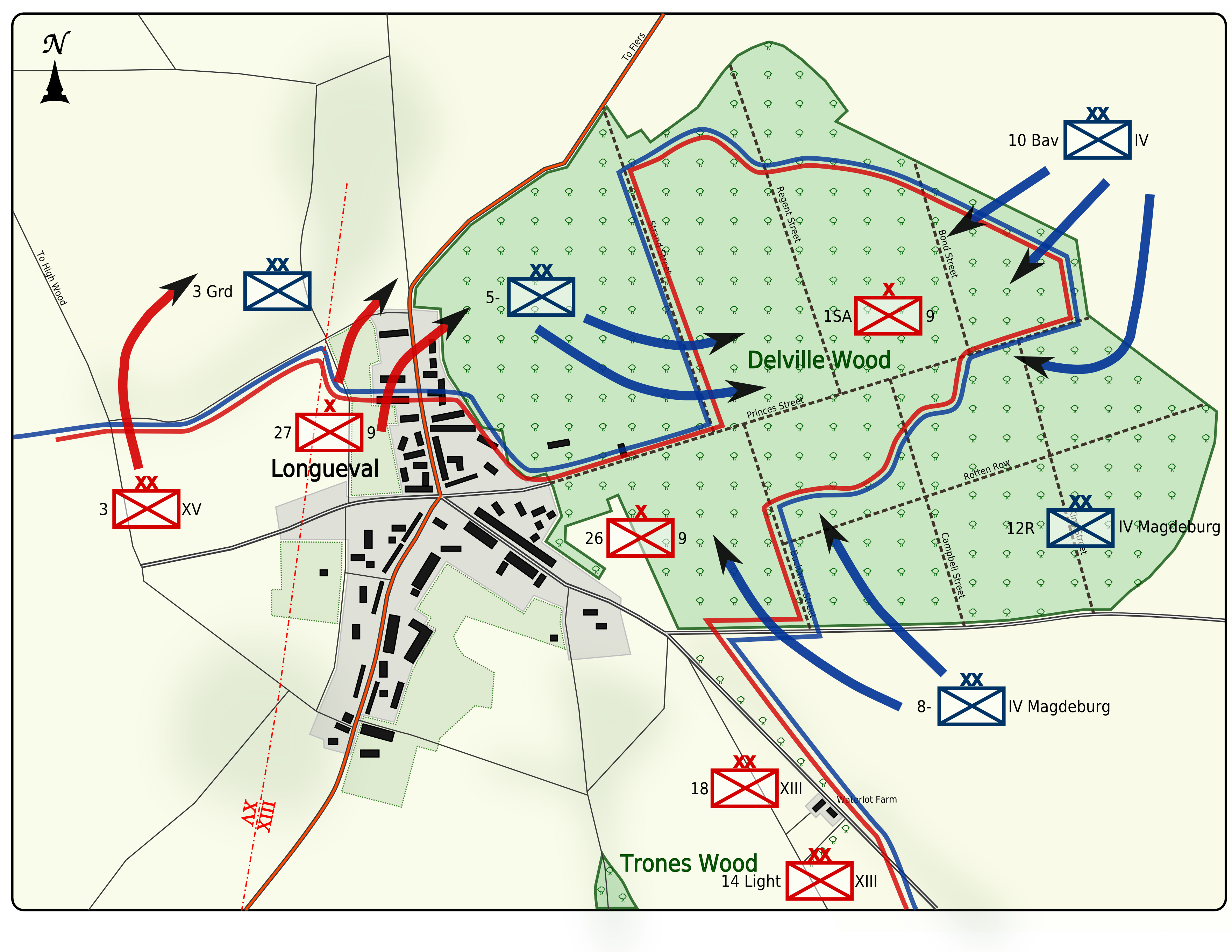
Delville Wood, 17 July 1916, showing the British salient
Fighting ended at the Bazentin Ridge July 17, with Allied units completely intermixed in the woods, as fighting at the Sommes continues. In one instance, a British pilot spotted Germans hiding to ambush British cavalry, so he opened fire on them and flew low overhead both to distract them and to alert the cavalry, sketched a layout of their positions, and then dropped it to the cavalry below. With fighting ended overall, the British are skirmishing to straighten their lines around the wooded salient, while the Germans attempt to cut it off.

Fromelles Ridge
A British distracting attack was launched at Fromelles on July 19-20, also at the Sommes offensive, but it was unprepared, undertrained, unsupported, unmotivated, and exhausted, and was launched in broad daylight against entrenched men while overlooked by hostile artillery on ridges surrounding it – and outnumbered 3:1. As expected, the 10,000 British lost 7,100 men, while the 30,000 Germans lost only 1,800. A defending German commander called the attack “operationally and tactically senseless,” and captured Australian troops showed no desire to fight at all, as well as a severe lack of understanding of how trench warfare is carried out.

Captured German bunker “Gibraltar”, with a sandbag team moving into position
Following the failure, 12 British divisions launched an attack July 23 at
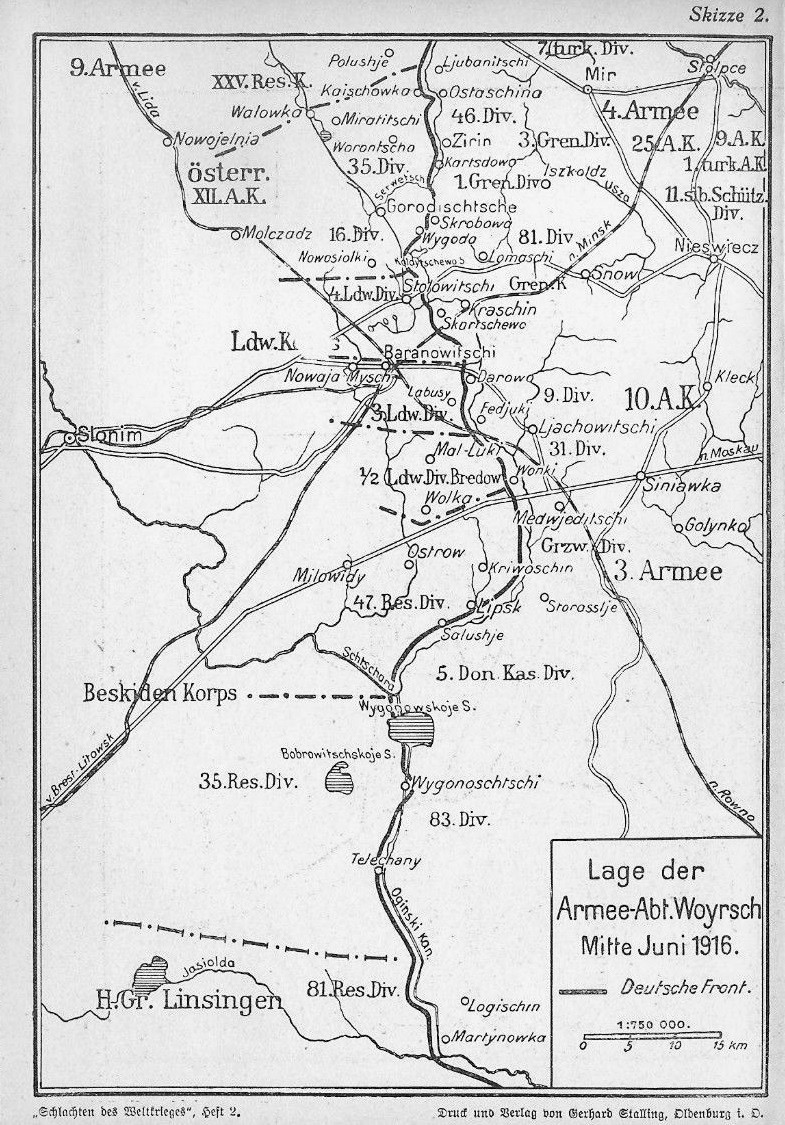
Site of fighting between the Russians & Germans
Pozieres, taking several trenches during the day, and repelling 3 German counterattacks thanks to well-placed artillery and “rolling attacks,” wherein the advancing infantry divisions are right behind the artillery detonations. However, due to the well-planned artillery, it has been difficult for the attackers to determine where trench lines are, due to the severe cratering of the landscape. However, Australian units did succeed in taking a German bunker nicknamed “Gibraltar,” on the flank of the fighting.
Finally, also on the Western front, at Verdun, both sides seem to be catching their breath. To the East, a Russian assault at Baranovichi has devolved into a back & forth with well-entrenched and fortified German defenders, as 410,000 Russians vs 70,000 Germans have been unable to breach the German lines. 80,000 Russians have fallen, with 13,000 German casualties – this despite the Russians having a 6:1 advantage in men, guns, and equipment.
Pingback: Dispatches from the Front – July 16, 1916 – The 4G Blog
Pingback: Dispatches from the Front – July 30, 1916 – The 4G Blog