<– Part 89 – April 2, 1916  | Part 90 – April 9, 1916 |  Part 91 – April 16, 1916 –>

On April 4, rumors began of planning by American military attaches in Europe to mobilize US shipping to bring an American army to Europe, should the necessity arise.

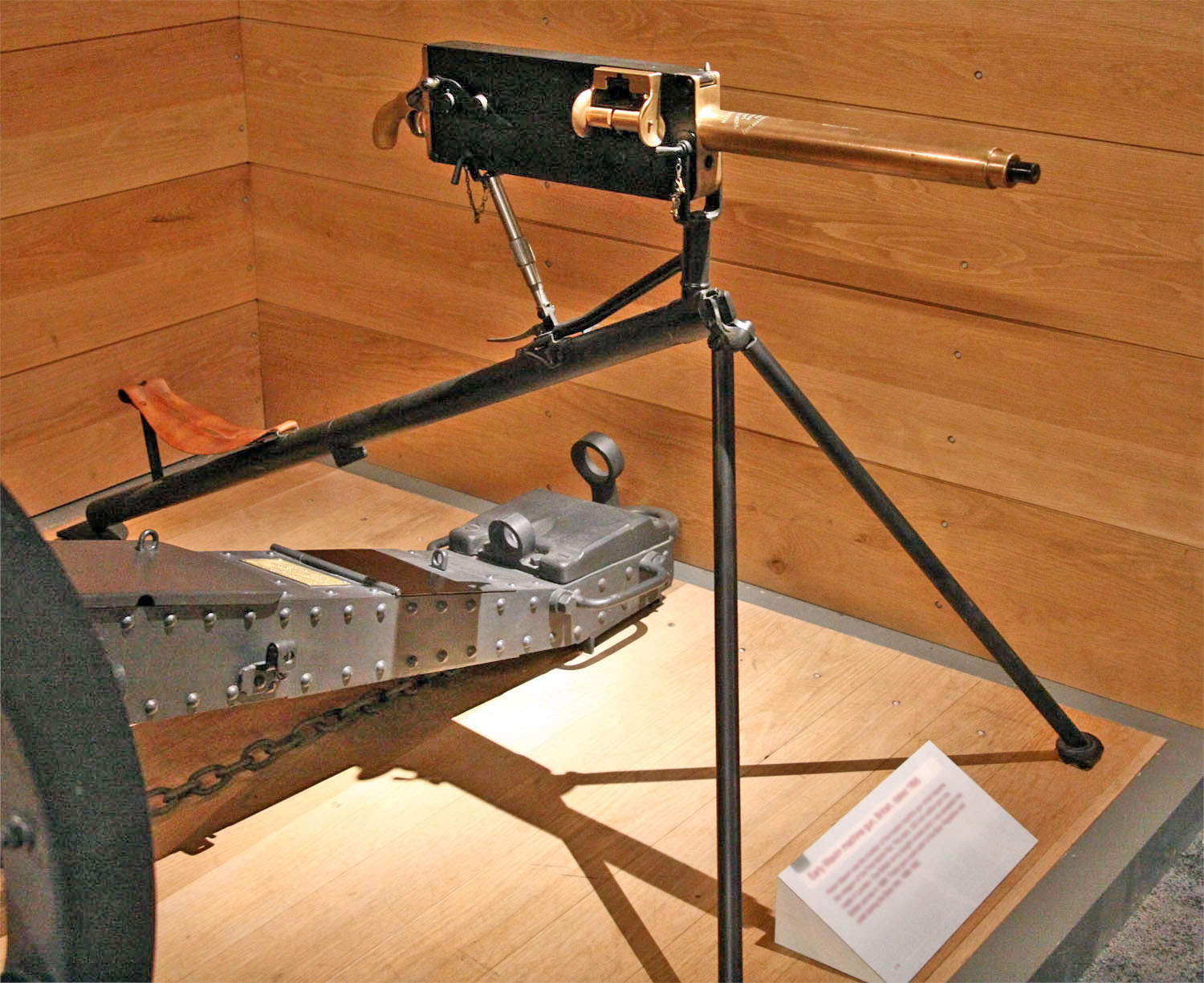
“Whatever happens we have got / the Maxim gun, and they have not.” – Hilaire Belloc

On the Western front, fighting at Verdun continues, although the Germans have only reached their first day’s objectives after nearly a month of fighting. French reinforcements are arriving, while the German reinforcements have been spent with little gain. Unless the German offensive on the Eastern bank is successful, the offensive seems doomed to an expensive failure.

In the Sudan, the Anglo-Egyptian Expedition has captured Abiad and left a garrison in place. Entrenched resistance by the Fur people has been brushed aside with artillery and Maxim machine guns. The Fur have some rifles, but many are armed with spears and chainmail armor.

<– Part 88 – March 26, 1916  | Part 89 – April 2, 1916 |  Part 90 – April 9, 1916 –>

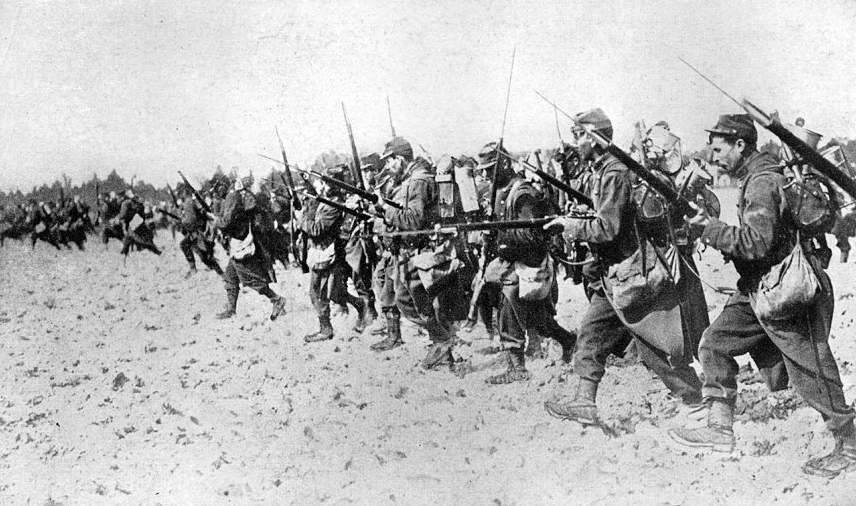
French infantry charging with fixed bayonets

The Russian offensive at Lake Naroch ended March 30 with no gains. The long bombardment was ineffective; the 10km penetration of the front caused minimal damage to German defenses, and the 5:1 numerical superiority (375,000 Russians to 82,000 Germans) was wasted in human wave attacks. Russian morale is crushed, and the French (hoping the offensive would relieve pressure on the Western front) is similarly weakened. The Russians lost approximately 100,000 men, to the Germans’ 30,000.

<– Part 87 – March 19, 1916  | Part 88 – March 26, 1916 |  Part 89 – April 2, 1916 –>

The Anglo-Egyptian Darfur expedition brushed aside Fur army forces on March 22 and has taken Jebel el Hella, opening the way for further advance against the Fur.

Just south-west of Ireland, the British Q-ship HMS Farnborough sunk the German sub SM U-68 on the sub’s first week of the war. The successful attack is surprising, as Q-ships – heavily-armed merchant ships with hidden weaponry – are generally not as dominant in a conflict with a sub. Her ability to sink the sub is surprising, and perhaps indicative of advances in British anti-sub weaponry.

On March 24, the French passenger ship Sussex was torpedoed by the German SM UB-28. Approximately 75 of the 375 on board were killed. Several Americans were among those wounded, leading to further protests and complaints from the United States against the German Empire.

<– Part 86 – March 12, 1916  | Part 87 – March 19, 1916 |  Part 88 – March 26, 1916 –>

In an odd event earlier this week, Russian anarchist Peter Kropotkin, with several other noted anarchists, issued a manifesto proclaiming support for the Allied war effort on March 14.

“Los Generales” at Fort Bliss 18 months ago – Álvaro Obregón, Villa, and Pershing.

On March 15, in response to the incursion by Mexican revolutionary “Pancho” Villa last week, US General John J. Pershing has been ordered to pursue Villa into Mexico from his base at Fort Bliss. Pershing’s wife and his three daughters were killed in a house fire six months ago, and Villa personally sent his condolences – the two had a friendly relationship.

In Italy, the Italian offensive at Isonzo – the fifth to date – has been halted, with approximately 2,000 casualties on each side. In North Africa, the Senussi have been scattered into the desert.

On March 16, after refusing to adhere to treaty stipulations, and having begun recently to mobilize his army and proclaim support for the Ottoman war cause, the Sultan of Darfur finds himself at war with a joint Anglo-Egyptian force advancing on Um Shanga.

In the German East Africa colony, on March 18, the retreating German forces from Latema Nek, some 2,000 strong, were surrounded at Kahe (south of Mount Kilimanjaro) by 500 British and South African troops. 700 Germans were killed and a further 200 captured, to the loss of 21 Allied soldiers. The remaining German forces have retreated into the colony.

U-6 on a pre-war postcard

Renaudin’s sister ship Bisson

The Russians have launched an offensive at Lake Naroch, at the request of the French, in an attempt to relieve pressure on the Western front. 375,000 Russians are attacking 82,000 Germans in strong defensive positions. After an extended 2-day artillery bombardment, the advancing Russians are encountering stiff German resistance, as their bombardment apparently has had limited effect due to poor aerial reconnaissance of German lines.

The Austro-Hungarian sub SM U-6 sunk the French destroyer Renaudin at Durazzo.


<– Part 85 – March 5, 1916  | Part 86 – March 12, 1916 |  Part 87 – March 19, 1916 –>

Yet another attempt to relieve the besieged British troops at Kut failed March 9 at Dujaila. A night attack by 18,500 British troops floundered as the multiple columns lost contact with one another. After stumbling across the Ottoman front lines early, the forces were ordered to wait 3 hours until the designated time for the surprise attack, allowing the 500 Turkish defenders to be reinforced by an additional 8,000. After some fighting, the British troops were driven back, losing 4,000 men to the Ottoman 1,300.

Battle of Latema Nek

Battle of Latema Nek

On March 9 the German Empire declared war on Portugal after the Portuguese conceded to British demands to confiscate German ships in port at Lisbon. In North America, “Pancho” Villa, the Mexican revolutionary, crossed the border of the United States and launched a raid on Columbus, New Mexico.

In Italy, the Italian army has launched another offensive at the Isonzo, the fifth to date. Approximately 250,000 Italian soldiers are assaulting the 100,000 Austro-Hungarian defenders.

A two-day battle waged in East Africa March 11-12, as the British forces pursued the Germans fleeing from Salaita. The German forces took up positions on two hills connected by “the Latema Nek,” a narrow ridge. Three assaults were launched by the British the morning, afternoon, and evening of the 11th, the last of which captured the hills. A British retreat was ordered in the hours before dawn the 12th, during which the British commander discovered his forces upon the hills and the Germans retreating.

In Persia, the Russian army has made futher advances against the Ottoman defenders.

<– Part 84 – February 27, 1916  | Part 85 – March 5, 1916 |  Part 86 – March 12, 1916 –>

The German colony of Kamerun formally issued its surrender to the Allied forces February 28. Two days later, on March 1, Germany announced the resumption of unrestricted submarine warfare.

Russian advance in Armenia. Bitlis and Mush are in the center.

In Turkey, the city of Bitlis was again the site of an offensive by the Russian Caucasus Army, with her neighboring city of Mush. After fierce hand-to-hand fighting in the falling snow, a Russian corps of Armenian troops took the city during the early morning hours of March 4. The Turks have retreated, but are expected to launch a fierce opposition, as the Russian advance into Turkey is now unhindered otherwise.

In Western Europe, the German offensive at Verdun has ground to a halt as casualties rapidly increase with troop exhaustion. A snowstorm February 29 has allowed the French to bring up nearly 100,000 reinforcements, including artillery. This artillery has opened fire on the Germans, who are unable to return fire due to their own artillery having been left behind in the rapid advance, and now unable to get to the front due to mud and mechanical malfunctions caused by weather.

In North Africa, the British troops are on the march again for the Senussi.


<– Part 83 – February 20, 1916  | Part 84 – February 27, 1916 |  Part 85 – March 5, 1916 –>

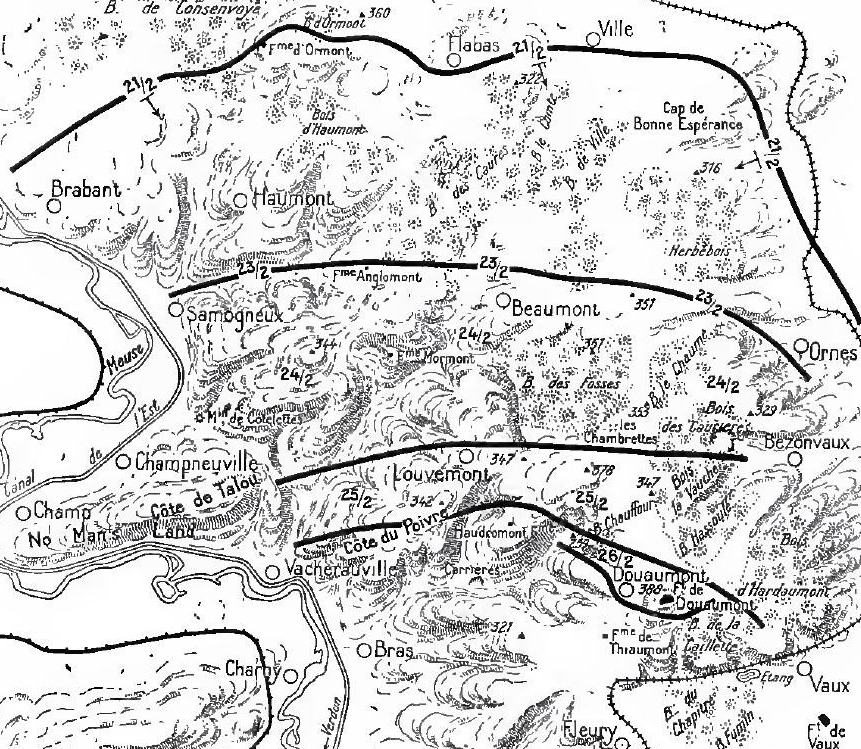
Lines of the German advance at Verdun. The dates are indicated on the lines. Douaumont is in the lower right, and Verdun is not visible off the bottom of the map. (Click to enlarge).

After a ten hour artillery bombardment, in which one million shells were fired, a massive German offensive was launched February 21 towards the city of Verdun. Having been delayed 8 days by winter weather, the German troops, expecting to easily brush aside French opposition, instead found that that time had been put to use establishing strong and multi-layered defensive lines. Nonetheless, the Germans charged forward with troops armed with “flamethrowers”, devices that shoot liquid flame, followed immediately by “storm troopers” armed with rifles and hand grenades. Despite the stronger than expected lines, a complete penetration of French lines was successful for over 3 miles, with minimal casualties. After brushing aside counterattacks and continuing their own assault for several days, the Germans captured the severely-undermanned Douaumont fortress, the first on their way to capturing the city of Verdun. Finally, after nearly a week of advance, the German assault seems to have run out of steam, and no progress has been made today in the face of a thaw turning the ground to a swamp, exhausted soldiers, and French reinforcements.

Douaumont fortress before the battle.

In North Africa, the British army finally caught the Senussi at Agagia on February 27. The attack began at 9:30, and after their trenches were captured, the Senussi began evacuating mid-afternoon. A cavalry contingent sent to cut off their retreat was successful, and after advancing on the rearguard firing from horseback, the British cavalry charged the final 50 yards with drawn sabers, upon which the Senussi broke. All told, though nearly equivalent in manpower forces (1,500 Senussi to 1,400 British) the Senussi suffered 500 losses, to the British 275 (mainly wounded).

In Persia, several towns fell to the Russian advance on February 26. There are rumors that the highest levels of the United States military have begun examining plans in case of a “complete rupture” with Germany. In the Balkans, Serbian troops await evacuation on Allied transports.

Serbian soldiers on the beaches of Corfu.

<– Part 82 – February 13, 1916  | Part 83 – February 20, 1916 |  Part 84 – February 27, 1916 –>

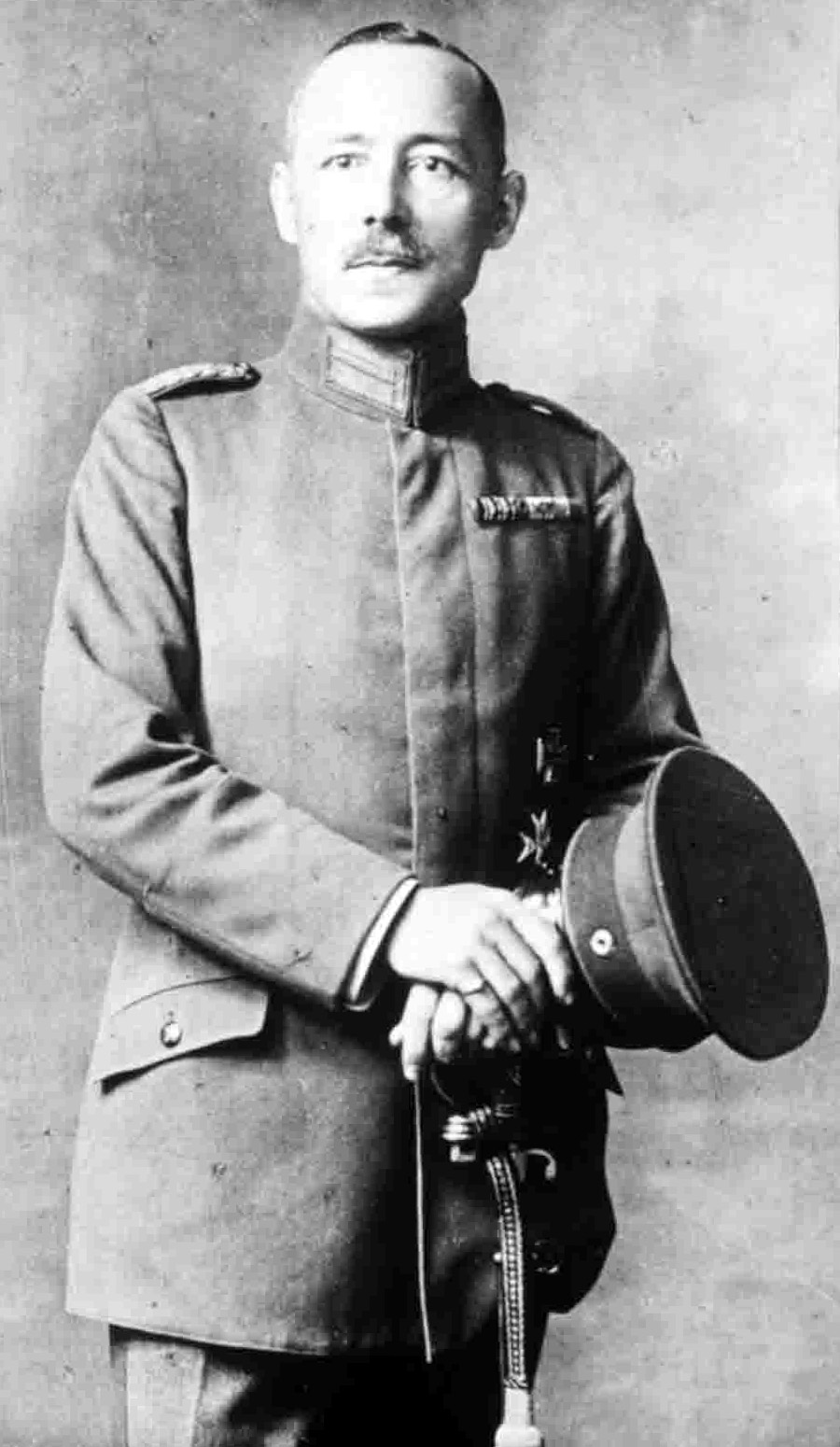
Ernst von Raben, commander of the defense at Mora.

The Erzurum campaign came to an end February 16 as the Cossack vanguard of the Russian Caucasus Army entered the city of Erzurum. The second-most heavily fortified city in the Ottoman empire (second only to the capital Constantinople[1]), Erzurum was surrounded by two rings of fortresses. With the Russians advancing over “impassible” ridges, and the Ottoman defenders too spread to support each other, the forts were abandoned February 15, and the entire city soon after. Although aware of Turkish movements due to aerial reconnaissance, the Russian forces failed to follow up on their victory. Altogether, the Russian troops lost 9,000 of their 325,000 troops, while the Ottoman Third Army lost 10,000 of their 134,000, with an additional 5,000 taken prisoner. Many of the casualties were to frostbite and other winter-related hardships.

The German Kamerun colony has finally fallen. Although the majority of the territory was de facto surrendered to the Allied forces with the evacuation of all German forces, the mountain of Mora, under siege since the beginning of the war 17 months ago has finally fallen with 155 of the 204 original defenders. The German commander, Ernst von Raben, secured the transportation of his askaris (African colonial troops) to their homelands, with £2,000 given to him to pay the troops. The German soldiers are being delivered to England for imprisonment. With this, the German Kamerun colonies has been jointly-occupied by the British and French.


[1] OOC: Istanbul did not come into vogue as the proper name of the city until the 1920’s, and was still referred to as Constantinople by English-speakers beyond that time.

<– Part 81 – February 6, 1916  | Part 82 – February 13, 1916 |  Part 83 – February 20, 1916 –>

Spicer-Simson aboard the Belgian boat Netta.

Action escalated in German East Africa this past week, as the warship Hedwig sailed from her port on Lake Tanganyika February 8 in search of the missing Kingani, presumed sunk but actually captured by the British. Spotting the Mimi and Fifi, the three ships began a circling dance on the lake as each attempted to bring her bow artillery piece to bear upon her enemy. After a half hour of maneuvering (including Fifi’s recoil stopping her in the water and spending 20 minutes clearing a jam), Fifi scored a hit on the Hedwig with her next to last shell. This shell entered the engine room of Hedwig, killed half a dozen sailors, and destroyed her boiler. After placing charges and abandoning the ship, Hedwig was sunk. The British captured 20 sailors and Hedwig’s naval ensign – the first one of the way. The following day, the German ship Götzen sailed the coastline searching for Hedwig. The British did not engage, as the commander, Geoffrey Spicer-Simson, did not feel any of his ships were adequate for such an engagement.

A land engagement February 12 in the same colony at Salaita Hill brought about a British defeat, as inadequate intelligence led to an engagement with an enemy nearly six times the size reported. Additionally, artillery fire was directed upon the German secondary line of trenches rather than the front line, allowing the Germans time to prepare for the assault. Finally, a German flanking attack drove the British back. An interesting story developed, as this battle included British, African, white South African, and Indian troops. The South African troops, after speaking disparagingly of the Indians, fled in the face of a German counter-attack while the Indians stood firm. The Indians returned one of the machine guns abandoned by the South Africans to them with the following note: “With the compilments of the 130th Baluchis. May we request that you no longer refer to our people as ‘coolies'”

The seaplane carrier HMS Ben-me-Chree

The British conscription law has gone into effect February 10. In North Africa, seaplanes from the carrier HMS Ben-my-Chree (Manx for “Woman of my heart”) have spotted the Senussi force at Agagia.


<– Part 80 – January 30, 1916  | Part 81 – February 6, 1916 |  Part 82 – February 13, 1916 –>

In the United States, neutral though definitely pro-Allied leaning, President Woodrow Wilson delivered the last of his speeches on “Preparedness” in St. Louis on February 3.

The the fighting for Erzerum tipping towards the Russian Caucasus Army more and more every day, a combined naval & land operation was launched February 5 for the northern Turkish city of Trebizond, on the Black Sea. Perhaps this operation will be better-fated than last year’s Gallipoli Offensive.