<– Part 59 – September 5, 1915  | Part 60 – September 12, 1915 |  Part 61 – September 19, 1915 –>

<– Part 59 – September 5, 1915  | Part 60 – September 12, 1915 |  Part 61 – September 19, 1915 –>The last week has been relatively quiet, especially on the western front. The Russian retreat continues, with some fighting near Sventiany. In Gallipoli, the Entente hope for victory is fading, especially as clamor back home grows. Otherwise, the horrors of war continue – disease, starvation, civilian suffering.

<– Part 58 – August 29, 1915  | Part 59 – September 5, 1915 |  Part 60 – September 12, 1915 –>

August 31 saw the Russians forced out of Poland and German forces drawing their wildly-successful offensive to a close. With the Russian

Tsar Nicholas II of the Russian Empire in a naval officer’s uniform. From Wikipedia.

armies still withdrawing, Tsar Nicholas II has removed the general in charge and assumed full and personal control of the Russian armies.

The new month opened with Germany announcing that they will no longer wage unrestricted warfare with their submarines on merchant ships, ending the policy they began this past February. Undoubtedly, the notes from the American government factored into their decision.

Gallipoli continues to be an embarrassment for the Allies as the HMS E7, mentioned in the July 18 dispatch, became trapped in an anti-submarine net. She was scuttled September 4.


<– Part 57 – August 22, 1915  | Part 58 – August 29, 1915 |  Part 59 – September 5, 1915 –>

Kaiajik Dere and Hill 60. From Wikipedia.

Rumors are growing within the United States that the government there is preparing to send as many as one million soldiers overseas. Although the government has consistently denied this, the general fervor towards war in that country is growing.

At Gallipoli, the fighting over “Hill 60” has ended in another loss for the Entente British.

In Eastern Europe, the German 10th Army has attacked the retreating Russian 10th Army and has begun driving them back farther.

<– Part 56 – August 15, 1915  | Part 57 – August 22, 1915 |  Part 58 – August 29, 1915 –>

August 17 saw an attempted invasion of the Island of Palagruza in the Adriatic. An Austro-Hungarian landing force was repulsed by the Italian defenders, who were then fired upon by several Austro-Hungarian cruisers and destroyers. One Italian submarine torpedoed a cruiser.

Details of “The Baralong Incident” against U-27, on August 19, 1915.

Just south of Ireland, the SS Arabic, an English-flagged ocean liner, was sunk by a German U-Boat on August 19. Several Americans went down with it; an American response is expected.

Later that day, the HMS Baralong, frustrated at their inability to rescue SS Arabic’s crew (they picked up the distress call from 70 miles away) came across the U-boat U-27 opening fire on a freighter to scuttle it (the crew had been ordered off in lifeboats). The Baralong, flying the US flag, signaled that she would rescue the freigher’s crew. As the U-boat set a course to intercept, the two ships were blocked from each other’s view by the freighter. Baralong replaced her flag with the Union Jack, opened her gun ports, and opened fire on the U-boat as it appeared, with 34 shells fired at 600 yards sufficient to destroy the U-boat. Fearing the German crew would attempt to reach the freighter and scuttle her, the captain of the Baralong ordered the Royal Marines onboard to shoot the Germans in the water as they swam to the freighter. The legality of this incident remains to be seen. Although no mention has been made in the British press, Americans who had been aboard the freighter have given interviews to media, and German sentiment is opposed to the Baralong’s action of shooting sailors loose in the water.

A Turkish commander at Scimitar Hill, Mustafa Kemal.

The Entente forces have had another disappointing week at Gallipoli, with the actions at Sari Bair and Chunuk Bair both having ended with Ottoman victory.  Another attack was launched at Scimitar Hill yesterday, August 21, together with an attack on Hill 60. Some gains have been made at ANZAC cove and Cape Helles, but not to the degree the Allies wished.


<– Part 55 – August 8, 1915  | Part 56 – August 15, 1915 |  Part 57 – August 22, 1915 –>

A Map of the Gallipolli peninsula, with Allied gains in brown, and an inset showing its location in the Dardanelles and Sea of Marmara. From http://www.travellinkturkey.com/.

Fighting continues across the Gallipoli peninsula, as the Allied forces continue their attempts to break out of their initial beachheads. While the Australian forces reached Lone Pine on August 10, the fighting at the Krithia Vineyard and Suvla Ba resulted in Ottoman victories on August 13 and August 15, respectively. The Entente will to fight is waning, and unless they succeed in greater breakthroughs, the desire to force the peninsula will undoubtedly wane as well.

<– Part 54 – August 1, 1915  | Part 55 – August 8, 1915 |  Part 56 – August 15, 1915 –>

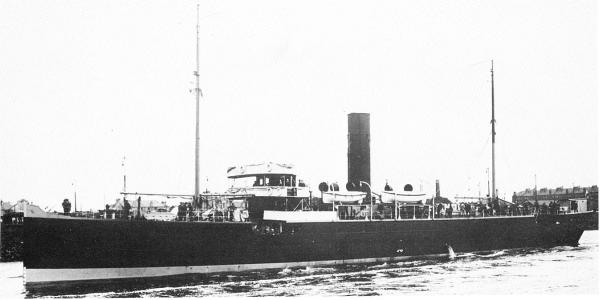
The Pass of Balmaha, an American merchant vessel, before her capture by the Germans.

An odd bit of news arrived earlier this week. The US ship Pass of Balmaha was reported missing two weeks ago on a cargo trip to England. It would appear that she was boarded by British marines and redirected to a British base for inspection. This included being forced to fly the British flag, which her crew objected to, since that would mark her a hostile vessel. The SMS U-36, a German sub, intercepted her, and the American captain hid the British marines in the hold and raised the Stars and Stripes. The German captain was suspicious, and on boarding her the American crew, resentful of the British meddling, revealed the British marines to the Germans. The Germans in turn redirected her to Germany, though her crew was taken to a neutral country and released. However, the Pass of Balmaha is now the SMS Seeadler, a German commerce raider.

In Italy, the now-called Second Battle of the Isonzo has ended on August 3, since both sides seem to have completely run out of ammunition for all weapons, both handheld and mounted. Although the Italians did not reach all of their goals, they did succeed in taking some ground and are therefore calling it a victory. Nearly 100,000 men are casualties of this latest fight.

August 5 saw German troops capture Warsaw. The Russian Army continues its great retreat.

August 6 saw an enormous series of attacks launched on the Gallipoli peninsula by the British forces at “Lone Pine” in ANZAC Cove (named for a solitary pine tree standing on a ridge at the beginning of the battle), Krithia Vineyard, Suvla Bay, and Sari Bair, with more launched the following day at the “Nek”, an easily-defended mountain pass, and Chunuk Bair. While the Australians have succeeded in reaching and holding objectives at Lone Pine, the remaining battles, though ongoing, seem to be failures due to miscommunication, too much dependence on victories by neighboring units (whose victory depends on their neighbors, leading to an impossible situation), poor planning, and atrocious military tactics (attacking uphill with enemy artillery on either side and insufficient support from one’s own artillery). In fact, one artillery barrage ended seven minutes early, leading to the British troops advancing to a dug-in, alerted, and fortified enemy position for several minutes.

August 8 saw the HMS E11, a famed British sub, sink an Austro-Hungarian warship in the Dardanelles. However, unless the tide turns at Gallipoli, it would appear the British Empire will be defeated in this area. It would appear modern warfare cannot tolerate massive naval landings, which the British have learned against the Germans.

<– Part 53 – July 25, 1915  | Part 54 – August 1, 1915 |  Part 55 – August 8, 1915 –>

On July 26, the Turks achieved their second victory at Manzikert in 850 years with a victory over the heavily outnumbered Russians. The following day, the Russian army launched a counter-attack at Kara Killisse, where the scored a victory on July 31. Otherwise, the Russian forces are in retreat across the sector. Meanwhile, in northern Italy, the second stage of fighting at the Isonzo continues.

The Mariotte, shortly before her last voyage.

July 26 saw another humiliation for the Entente, with the French submarine Mariotte becoming entangled in wires at a minefield inthe Dardanelles, stuck on the surface, and forced to be scuttled. Fortunately for the Entente, though, her captain was able to destroy sensitive documents after the Turkish guns firing on the stricken sub ceased fire when she signaled her surrender.

Across war-stricken Europe, nations are reacting to the United States’ note of last week, declaring that any sinking of an American ship would be regarded as ‘deliberately unfriendly.’ This action is clearly in response to last month’s sinking of the RMS Lusitania. Whether Germany (the clear target of the note) bears heed remains to be seen, although the United States certainly seems to be on the path towards war.

<– Part 52 – July 18, 1915  | Part 53 – July 25, 1915 |  Part 54 – August 1, 1915 –>

The Italian offensive at Isonzo continues, and earlier today the Italians reached an objective in the capture of the Cappuccio Wood.  To the north, German planes of the Fokker model have begun causing difficulties for the Entente, as they are armed with a heavy machine gun and are easily defeating the lightly-armed Allied models. Allied troops on the ground are similarly terrified of them.

HMS E14, the famed British sub under Lieutenant Commander Boyle, is reported to have begun a third tour of the straits of Marmara, having evaded an anti-submarine net that was recently installed there.

On July 21, US president Woodrow Wilson sent notes to the Secretaries of War and Navy with orders to begin preparing a defense plan.


The British Army began avenging her humilation at Lahij with a victory against a small Ottoman contingent. Although not numerically devastating, the disproportionate losses and prisoners on the Ottoman side have breathed a renewed spirit into the British troops in South Arabia.

HMS Tamarisk, another Q-ship. When near the German sub, the Q-ship will reveal her weapons, raise the British war flag, and open fire.

Losses for the Central Powers continued on July 24, when the SMS U-36, while in the process of boarding a Danish liner, was caught unawares by the British Q-ship Prince Charles and destroyed. Q-ships are a relatively recent development by the British, and are standard ships converted into warships but retaining their previous appearance. This seems to have been the first successful Q-ship destruction of a German sub.

In the Adriatic, the Germans have launched the “Pola Flotilla”, an attempt to sink Allied shipping in the Mediterranean.

<– Part 51 – July 11, 1915  | Part 52 – July 18, 1915 |  Part 53 – July 25, 1915 –>

British troops saw a painful (though ultimately minor defeat at Gallipoli on July 12 near Helles. Minor skirmishing continues in the area.

HMS E7, a British sub

On July 17, the British submarine E7 damaged a railroad from the Dardanelles, causing damage to trains and forcing a delay in supplies reaching the Turkish troops.


The Regia Marina had both a victory and a defeat on July 18, as the Austro-Hungarian

SM U-4, an Austro-Hungarian sub

submarine U-4 sunk the cruiser Giusepe Garibaldi, though only 53 off the 573 crewman were lost. However, the Italians shelled several of Austria-Hungary’s naval stations that same day.

Finally, the Italians have launched a second offensive at the Isonzo earlier today; there are reports of severe hand-to-hand fighting following heavy artillery barrages. The Italians outnumber Austrians nearly 4:1, with even more Italian reinforcements approaching.

<– Part 50 – July 4, 1915  | Part 51 – July 11, 1915 |  Part 52 – July 18, 1915 –>

July 5 saw both a British victory and a British defeat. In Gallipoli, the attack at Gully Ravine has achieved its (modest results) and advanced the Entente troops up the peninsula slightly. But in South Arabia, under attack by a superior Ottoman force, with reinforcements delayed by sand and weather, and with the heavily-outnumbered troops exhausted by heat and fighting and the sight of allied Arabs fleeing, the British were forced to withdraw. Although strategically it is not so much a problem, the fall in prestige is insulting.

Two days later, with Austrian reinforcements arriving, the Italian attacks at Isonzo were called off, with only minimal gains across the front, at the lost of nearly 25,000 men on both sides.

On July 9, following their loss at Batavi on the 1st, the German forces in South-West Afrika surrended to the South African forces under Louis Botha. Another German colony has surrendered.

Believing Turkish forces in the area to be minimal, the Russian army launched an attack near Manzikert on July 10, but were surprised to find themselves outnumbered nearly 3:1.

Finally, after many long months of fighting since last October, siege warfare, naval skirmishes, ships transported over land, and more, the German cruiser Königsberg has finally been destroyed in the Rufiji Delta.

Damage to the cruiser.