<– Part 39 – April 18, 1915  | Part 40 – April 25, 1915 |  Part 41 – May 2, 1915 –>

April 19, the Ottoman Empire surrounded the Armenian city of Vans, and a siege has been ongoing for the last week. The Ottomans appear to be systematically targeting the Armenian population for destruction or deportation, and it would appear the the residents of Van have taken up arms to resist. Their defense seems justified – yesterday, on the 24th, hundreds of Armenian intellectuals were arrested, many of them killed, all seemingly tied to an official Ottoman document issues that same day calling for the arrest of any Armenian deemed mischievous, vast searches of all towns, and other actions as deemed necessary.

On April 22, the German Empire launched a massive battle Gravenstafel, near the strategic city of Ypres, which has already seen much warfare

Area north of Ypres, Western Belgium, showing the area of the opening salvos of the Second Battle of Ypres. Note St. Julien in center, and Gravenstafel center-right.

last autumn. It is also reported that the Germans released several hundred tons of poisonous chlorine gas, causing thousands of deaths and a large gap to open in the front lines. The Germans seem to have been wary of advancing, and Canadian troops were able to secure the area. If this report of poison gas is true, it would be a violation of the Hague Conventions of 1899 and 1907. Two days later, on the 25th, the Canadian reserves at St. Julien found themselves on the front lines as thick yellow clouds of chlorine gas floated in. Fortunately for them, word had spread that by urinating into handkerchiefs and putting them over one’s mouth, painful death by the gas could be avoided. Fighting across this sector is ongoing.

Gallipoli Peninsula (with yellow coloring around it in Dardanelles waters), Turkey, indicating strategic value (together with Bosphorus strait colored red).

The following day, on the other side of Europe, masses of troops and ships were gathered in the Aegean sea by the Entente and her allies. Earlier today, 25 April 1915, Entente troops began a naval landing on the Gallipoli Peninsula, and have secured several beacheads at “Anzac Cove” and Cape Helles. The Anzacs – “Australian and New Zealand Army Corps” – are holding and awaiting reinforcements.

Finally, there are rumors that representatives of the Triple Entente (Britain, France, and Russia) have met with representatives of the Kingdom of Italy to discuss gains made for Italy and other nations at the expense of Austria, should the war be one. This cannot be confirmed, however.
<– Part 37 – April 11, 1915  | Part 38 – April 18, 1915 |  Part 39 – April 25, 1915 –>

Mesopotamian campaign

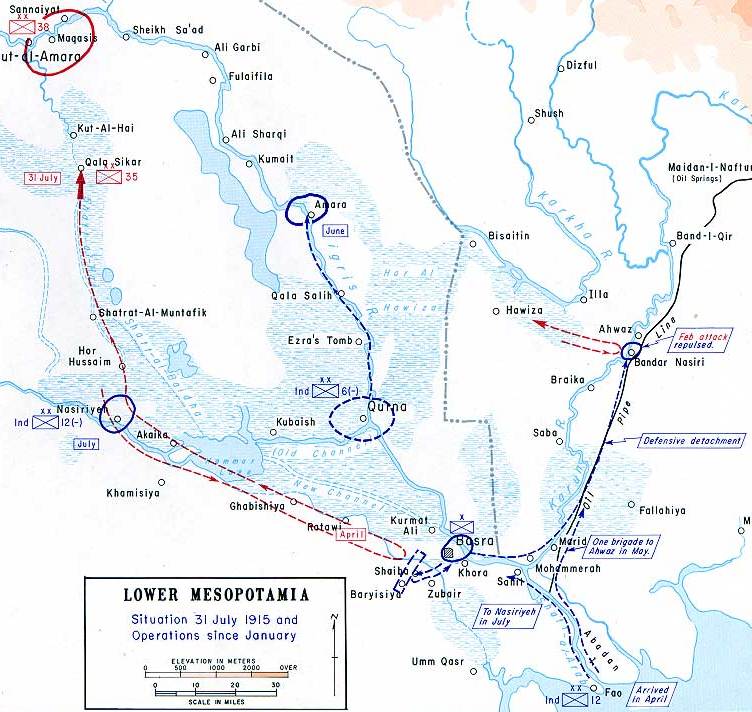
The British defenders of Shaiba, protecting the way to recently-captured Basra, 6,000 strong, came under assault by an Ottoman force three times their number April 12, although only 4,000 of the 18,000 Turks are regulars. A 5am bombardment, with Ottoman probing of British barbed wire that night, failed to dislodge the British forces. The following day, alternating thrusts and counter-thrusts were unsuccessful for either side until a British attack late in the day completely routed the 14,000 Arab irregulars, who refused to participate in the battle further. Finally, April 14, the British left their positions in search of the withdrawing Ottomans and fought them most of the day. The Turks held their line until early evening when a British bayonet charged forced the Turks to retreat. The Ottomans suffered 2,500 casualties to the British 1,500.

What I Learned Today

WordPress tells me this is the 17th post I’ve written. That’s not true at all. I know it’s not true. This is the 31st post I’ve written. But the missing 14 or are gone forever. Why? Because in my own hubris and impatience, I deleted them forever, accidentally, at 2am this morning.

Lesson 1: NEVER AUTOREMOVE/UNINSTALL/PURGE A PROGRAM WITHOUT UNDERSTANDING WHAT IT WILL TAKE WITH IT

Using Amazon Linux, I installed the (then) current versions of apache, mysql, php, etc. That’s fine. They’ve worked great. But a program I wanted to play with required PHP 5.4+, while I was stuck on 5.3. So I uninstalled PHP, but then needed to update apache, mysql, etc. – so I just uninstalled them all, purged everything, and installed newer versions.

I purged everything.

I purged everything.

I purged everything.

I purged the mysql database.

All of my posts are WERE stored in that database. All of the data from my project management software were stored in that database. All of the user login data from my site were stored in that database.

Lesson 2: NEVER DO SOMETHING REALLY LATE AT NIGHT

When I told my wife I’d done this, the first thing out of her mouth: “Did you do this really late last night?” Yes. Yes I did. Just like she’s been reminding me not to do since she was my girlfriend. I know better. It happens A LOT (though never this critically – see lesson 3…). I know by know that when I wake up at 6am with 4 hours sleep, work a full day, grab supper and run out to a function until 10pm, get home at 11 then work for 2 more hours until I’m passing out – that is not the time to do what I did.

Lesson 3: FREQUENT BACKUPS

The only reason this is post 17 and not post 1 is I do have a backup from the end of February.

This is what I’m kicking myself the most over – because the very last thing I put into the mysql database (I’m not kidding) is a reminder to myself to set up a regular backup system.

The irony of this is agonizing.

What I Lost

2 months of blog posts – my World War I series 100 years later in Real Time (each Saturday, releasing a mock news article about what happened 100 ago to date). 2 months of project management work items/tasks/bug tracking/etc.  Other things I don’t know yet.

APPLICATION

1. Regular backups. Since I write bi-weekly, I’ll just do it after each article.

2. Don’t do anything after 11pm that can’t be CTRL-Z’ed.

3. Understand what the command I’m about to do does.

4. Get away from my computer right now before I break it physically.

<– Part 36 – April 4, 1915  | Part 37 – April 11, 1915 |  Part 38 – April 18, 1915 –>

The French army launched attacks April 5 at Woevre in an attempt to eliminate a German salient formed at the end of the Battle of Flirey last October. So far, they have had no success. In the Middle East, German Colonel Kress von Kressenstein placed a mine in the Sinai canal, but it was disabled by a British patrol.

<– Part 35 – March 28, 1915  | Part 36 – April 4, 1915 |  Part 37 – April 11, 1915 –>

Remarkably, very little happened in the war this past week, outside of murmurs within the United States of war.

<– Part 34 – March 21, 1915  | Part 35 – March 28, 1915 |  Part 36 – April 4, 1915 –>

Leon Chester Thrasher, who lent his name posthumously to the “Thrasher Incident.”

The Austro-Hungarian garrison at Przemysl surrendered March 22, bringing the 133-day siege to an end. All relief and escape efforts had failed, and Russian artillery and infantry assaults had begun taking the outer defenses. The surrender of 117,000 soldiers, including 9 generals, 93 senior staff, and 2,500 other officers, combined with over 100,000 DEAD, is a crushing blow to the Austro-Hungarian efforts. The Russians, by comparison, lost 115,000, mostly in the first few days of the siege.

SM U-28

In the French-Zaian war, a French offensive earlier this month faced stiff opposition, but inflicted serious losses on the tribesman, losing only 1 killed and 8 wounded.

The British steamship RMS Falaba was torpedoed by German sub SM U-28 March 28, killing 104, including American Leon Chester Thrasher. Due to British orders to all vessels to attack any German vessels on sight, or lacking weapons, to attempt to ram, the German navy issued orders last month declaring all British waters a warzone. Intense pressure in the United States, following the death of an American, has been tempered with a detailed report showing the Falaba, rather than unloading passengers as warned (and given time to) by the Germans, instead radioed its position to nearby British warships. Then, when torpedoed, 13 tons of illegal high explosives – contraband for a passenger ship – detonated in the ship’s hold. US pressure to enter the war has waned.

<– Part 33 – March 14, 1915  | Part 34 – March 21, 1915 |  Part 35 – March 28, 1915 –>

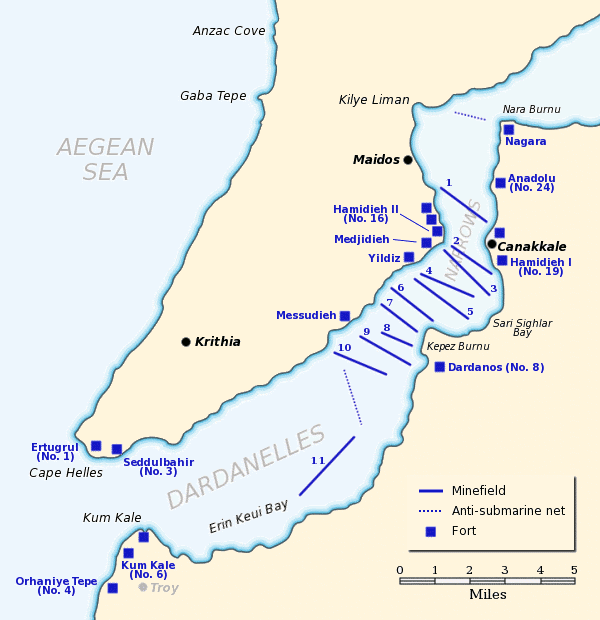
The British Admiralty gave permission to the navy in the Dardanelles to launch a total assault and bombardment of the Ottoman guns. The operation was launched March 18, and met severe setbacks. Failure to properly reconnoiter existing mines lead to severe damage from mines, as well as better-than-expected accuracy from the Ottoman guns. Nearly half the navy was damaged, with three battleships sunk and 3 more seriously damaged, and 700 casualties. The Ottomans suffered only 118 casualties, and dozens of layers of mines are still in place. Further naval attacks have been called off.

French counterattacks at Champagne were called off March 17, ending fighting in the sector. 94,000 French casualties, and 46,000 German, have led to further stalemate.

<– Part 32 – March 7, 1915  | Part 33 – March 14, 1915 |  Part 34 – March 21, 1915 –>


Defenses at the Dardanelles

The Ottoman gendarmerie completed their withdrawal to Qotur March 10, as the Russian advance under Nazarbekov continues in Persia.


In Europe, at Neuve Chapelle, a British assault was launched the same day, having been meticulously planned with aerial reconnaissance, from which maps were created and distributed. Although achieving early successes, poor weather, disrupted communications, and misaligned attacks (one flank attacked a German trench untouched by the initial artillery barrage) caused the offensive to grind to a halt, despite strong efforts by Indian troops, many of whom captured the strongest point of the German line, which included fresh troops, and also had not seen artillery fire. 7,000 British and 4,200 Indian casualties compare to 10,000 German. The battle has been a tactical victory for the British.


On March 13, the British cruiser HMS Amethyst lead a force of six minesweepers into the Dardanelles, but was forced by after taking heavy fire, along with 4 of the minesweepers.


<– Part 31 – February 28, 1915  | Part 32 – March 7, 1915 |  Part 33 – March 14, 1915 –>

British battleships continued their bombardment of Ottoman defenses in the Dardanelles March 1, this time directed at the middle line; however, British minesweepers were unable to clear mines from the strait. An attack by Royal Marines March 4 was repelled, with 23 Marines killed.

A fresh Russian corps has launched an attack on Bitlis, in eastern Asia Minor, as the Russians attempt to take the city once again. In Persia, Nazarbekov’s offensive has forced the gendarmerie of Van province to withdraw from Dilman March 7 towards Qotur.

In Champagne, the stalemate continues at counter-attacks by each side fail to gain any land.

<– Part 30 – February 21, 1915  | Part 31 – February 28, 1915 |  Part 32 – March 7, 1915 –>

Dague’s sister ship Bouclier

Fighting has officially ended for the second time at the Masurian Lakes February 22 with a solid German victory. Despite being outnumbered over 2:1, the Germans lost just 16,000 men, compared to the Russian 200,000 – nearly 90% of their army.

British marines damaged forts 3 and 6 on this map

The French destroyer Dague hit a mine February 24, sinking with the loss of 38 of her 80 crew. The following day, British naval forces attempted a second forcing of the Dardanelles strait. The Ottomans evacuated the outer forts, allowing the British Royal Marines to raid and set demolition charges on several forts.

On the Western Front, counter-attacks at Champagne fail to achieve any significant goals.